

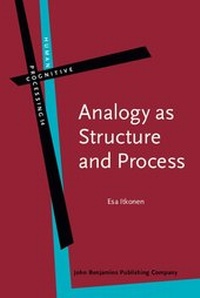
Analogy as Structure and Process
Approaches in linguistics, cognitive psychology and philosophy of science
1st Edition
Published on 8. December 2005
XIV, 249 pages
978-90-272-9401-2 (ISBN)
Description

The concept of analogy is of central concern to modern cognitive scientists, whereas it has been largely neglected in linguistics in the past four decades. The goal of this thought-provoking book is (1) to introduce a cognitively and linguistically viable notion of analogy; and (2) to re-establish and build on traditional linguistic analogy-based research.
As a starting point, a general definition of analogy is offered that makes the distinction between analogy-as-structure and analogy-as-process.
Chapter 2 deals with analogy as used in traditional linguistics. It demonstrates how phonology, morphology, syntax, semantics, and diachronic linguistics make use of analogy and discusses linguistic domains in which analogy does or did not work. The appendix gives a description of a computer program, which performs such instances of analogy-based syntactic analysis as have long been claimed impossible.
Chapter 3 supports the ultimate (non-modular) 'unity of the mind' and discusses the existence of pervasive analogies between language and such cognitive domains as vision, music, and logic.
The final chapter presents evidence for the view that the cosmology of every culture is based on analogy.
At a more abstract level, the role of analogy in scientific change is scrutinized, resulting in a meta-analogy between myth and science.
As a starting point, a general definition of analogy is offered that makes the distinction between analogy-as-structure and analogy-as-process.
Chapter 2 deals with analogy as used in traditional linguistics. It demonstrates how phonology, morphology, syntax, semantics, and diachronic linguistics make use of analogy and discusses linguistic domains in which analogy does or did not work. The appendix gives a description of a computer program, which performs such instances of analogy-based syntactic analysis as have long been claimed impossible.
Chapter 3 supports the ultimate (non-modular) 'unity of the mind' and discusses the existence of pervasive analogies between language and such cognitive domains as vision, music, and logic.
The final chapter presents evidence for the view that the cosmology of every culture is based on analogy.
At a more abstract level, the role of analogy in scientific change is scrutinized, resulting in a meta-analogy between myth and science.
More details
Other editions
Additional editions
Esa Itkonen
Analogy as Structure and Process
Approaches in linguistics, cognitive psychology and philosophy of science
Book
12/2005
John Benjamins Publishing Co
€116.60
Shipment within 10-15 days
Person
Content
- Analogy as Structure and Process
- Editorial page
- Title page
- LCC data
- dedication page
- Table of contents
- Preface
- Introduction
- 1. The concept of analogy
- 1.1 Analogy = Structural ~ functional similarity
- 1.2 Analogy as a context-dependent phenomenon
- 1.3 A taxonomy of the relations between two analogous systems
- 1.4 Analogy as generalization
- 1.5 Analogy vis-à-vis the various types of inference: Inductive, deductive, and abductive
- 1.6 Analogy and metaphor
- analogy and blend
- 1.7 Analogy and psychological reality
- 1.8 Analogical behavior: From mechanical to creative
- 1.9 Analogical ambiguity
- 1.10 The limits of analogy
- 2. Analogy inside linguistics
- 2.1 General remarks
- 2.2 Objections against the concept of analogy
- 2.3 Phonology
- 2.4 Morphology
- 2.5 Syntax
- 2.6 Semantics
- 2.7 Diachronic linguistics
- 2.8 The analogy between oral languages and sign languages
- 2.9 Conclusion
- 3. Analogy and/or overlap between language and other cognitive domains
- 3.1 General remarks
- 3.2 Iconicity revisited
- 3.3 Language and vision
- 3.4 Language and music
- 3.5 Language and logic
- 3.6 Conclusion
- 4. Analogy (mainly) outside linguistics
- 4.1 General remarks
- 4.2 Analogy in mythology/cosmology
- 4.3 Analogy in scientific (including philosophical) discovery
- 5. Concluding remarks
- Appendix
- 1. The program
- 2. Explaining the program
- 3. Summing-up
- Notes
- Chapter 1
- Chapter 2
- Chapter 3
- Chapter 4
- Appendix
- References
- Name index
- Subject index
- The series Human Cognitive Processing
