

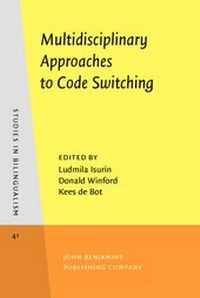
Multidisciplinary Approaches to Code Switching
1st Edition
Published on 10. July 2009
XVIII, 364 pages
978-90-272-8928-5 (ISBN)
Description

The volume presents a selection of contributions by leading scholars in the field of code-switching. In the past the phenomenon of code-switching was studied within different subfields of linguistics and they all took their own perspectives on code-switching without taking into account findings from other subdisciplines. This book raises a question of a much broader multidisciplinary approach to studying the phenomenon of code-switching; calls for integration of disciplines; and illustrates how frameworks from one subfield can be applied to models in another. The volume includes survey chapters, empirical studies, contributions that use empirical data to test new hypotheses about code-switching, or suggest new approaches and models for the study of code-switching, and chapters that discuss principles and constraints of code-switching, and code-switching vs. transfer. The book is easily accessible to anyone who is interested in the phenomenon of code-switching in bilinguals.
More details
Other editions
Additional editions

Ludmila Isurin | Donald Winford | Kees de Bot
Multidisciplinary Approaches to Code Switching
Book
07/2009
John Benjamins Publishing Co
€100.70
Shipment within 10-15 days
Persons
Content
- Multidisciplinary Approaches to Code Switching
- Editorial page
- Title page
- LCC data
- Table of contents
- Acknowledgements
- Introduction
- Psycholinguistic studies
- 1. Empirical approaches to the study of code-switching in sentential contexts
- Introduction
- Code-switching involving unambiguous words
- Code-switching for ambiguous words
- Conclusions and future directions
- References
- 2. Language selection and performance optimisation in multilinguals
- Language selection and performance optimisation in multilinguals
- Language switch costs and optimisation
- Relative proficiency and optimisation
- Optimisation in context
- Future explorations
- References
- 3. The neurocognition of switching between languages.
- Introduction
- Basic principles and applications of ERPs in language research
- Review of ERP studies of language switching
- Language switching with single stimuli: Behavioral evidence
- Language switching with single stimuli: Review of ERP evidence
- Switching words embedded in context: Review of ERP evidence
- Brain regions involved in language switching: Neuroimaging evidence
- ERP studies on language switching: Concluding remarks
- ERP studies on language switching: future studies
- References
- 4. Sources of triggering in code switching
- Introduction
- CS as a critical state
- Code switching as state phase transition
- Triggering in the individual's language system
- Co-activation of elements at different levels
- The word level
- The lexical concept level
- The syntactic procedures level
- The discourse and gesture level
- The syllable and articulatory level
- Production and perception
- States of activation
- Concluding remarks
- Acknowledgement
- References
- 5. Triggered code switching. Evidence from Dutch - English and Russian - English bilinguals
- Introduction
- Triggered code switching at the lexical level
- Dutch - English data from New Zealand
- Materials
- Method
- Results
- Dutch - English data from Australia
- Materials
- Method
- Results
- Russian - English data from the United States
- Materials
- Method
- Results
- Cognates
- Form and meaning overlap
- Morphological masking
- Triggering between speakers
- Repetitive discourse elements
- General discussion
- Acknowledgements
- References
- 6. Two speakers, one dialogue. An interactive alignment perspective on code-switching in bilingual speakers
- Introduction
- A mechanistic psychology of dialogue
- The interactive alignment model of dialogue
- Toward an interactive alignment model of code-switching in bilinguals
- Situation model
- Semantic level
- Syntactic level
- Lexical level
- Phonological level
- Phonetic level
- A cognitive account of language interaction in bilinguals
- An interactive alignment model of code-switching and bilingual processing
- Studying interactive alignment in code-switching: Methodological aspects
- Studying the equivalence constraint with the confederate-scripting technique
- Experiment 1: Code-switching in monologue
- Experiment 2: Code-switching in dialogue
- Experiments 1 and 2 compared
- The confederate-scripting technique as a useful technique for the study of code-switching
- Conclusion
- References
- 7. Language interaction as a window into bilingual cognitive architecture
- Introduction
- Switching and transfer
- Constraints on language interaction that operate on the syntactic level
- Constraints on language interaction that operate on the semantic level
- Constraints on language interaction that operate on the level of lexical category
- Constraints on language interaction that operate on the concreteness level
- Role of language environment and language experience
- Implications for models of bilingual language processing
- Conclusions
- References
- Sociolinguistic and linguistic studies
- 8. Trying to hit a moving target. On the sociophonetics of code-switching
- Introduction
- Psycholinguistic studies
- Sociophonetic studies
- The present study
- Guiding questions
- Methodology
- Results
- Discussion
- The sociophonetics of code-switching
- Conclusion
- References
- 9. Which language?. Participation potentials across lexical categories in codeswitching
- Introduction
- Asymmetry as a principle in all bilingual data
- Uniform structure as a principle
- A language production model
- The conceptual level
- Selecting the matrix language
- The mental lexicon
- The formulator
- The surface level
- The MLF and 4-M models
- The MLF model
- The 4-M model
- Content morphemes and early system morphemes
- Late system morphemes
- Implications of outsiders in CS
- Predicting morpheme distribution in CS
- Prepositions
- Prepositions as content morphemes.
- EL islands and prepositions
- Prepositions as early system morphemes
- EL prepositions as bridge system morphemes
- Prepositions as outsider system morphemes
- EL prepositions in CS: A summary
- Morphemes between clauses
- Subordinating adverbs as content morphemes
- Coordinating conjunctions as content morphemes
- Constraints on EL subordinators and coordinators
- Complementizers as bridge system morphemes
- Comp elements as late outsider system morphemes
- Summary of the distribution of EL elements between clauses
- Composite CS: No outsider late system morphemes
- Examples of composite CS
- Quichua-Spanish composite CS
- Conclusion
- References
- 10. Adjectives and word order. A focus on italian-german codeswitching
- Introduction
- Adjectives in codeswitching
- Theoretical framework
- The grammatical theory
- The codeswitching theory
- The ban on word-internal codeswitching
- Adjectives in Italian and German
- Study design and findings
- The survey
- The naturalistic data
- Analysis
- Relevance to psycholinguistic research
- The bilingual lexicon
- Child language acquisition
- Natural language processing and speech processing
- Bilingual language disorders
- Conclusions
- References
- 11. On the unity of contact phenomena and their underlying mechanisms. The case of borrowing
- Introduction
- A framework for contact-induced change
- Connections between bilingual language mixture and mixed languages
- Code switching, mixed languages, and recipient language (RL) agentivity
- Classic code switching and intertwined languages
- "Island" insertion
- Language dominance and code-switching
- Linguistic approaches to insertional code-switching.
- Relexification and language production
- Insertion of EL islands
- Mixed phrasal constituents
- Conclusion
- References
- 12. Codeswitching as one piece of the puzzle of language change. The case of Turkish yapmak
- Introduction
- The complementarity of psycholinguistic and sociolinguistic approaches in the study of language change
- Sociolinguistic corpus studies
- Change: Synchrony and diachrony
- Innovation and propagation
- Causes of change
- Attractiveness, and the role of Contact Linguistics
- Case study: yapmak
- Data
- Characterizing the changes
- Case study 1: Dutch infinitives + yapmak
- Innovation and propagation
- Case study 2: Education terms
- Case study 3: replacement of et- by yap-
- One schema or many?
- References
- 13 . Transfer and code-switching. Separate territories but common concerns on the border
- Introduction
- Contrasts in data sets
- Positive transfer
- User and interlocutor characteristics
- Constraints: Definitions and predictions
- Conclusion
- Acknowledgement
- References
- Author index
- Index of terms
- The series Studies in Bilingualism (SiBil)
