


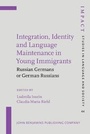
Integration, Identity and Language Maintenance in Young Immigrants
Russian Germans or German Russians
1st Edition
Published on 12. April 2017
293 pages
978-90-272-6596-8 (ISBN)
Description

The volume presents a selection of contributions related to integration, adaptation, language attitudes and language change among young Russian-speaking immigrants in Germany. At the turn of the century, Germany, which defined itself as a mono-ethnic and mono-racial society, has become a country integrating various immigrant groups. Among those, there are three different types of Russian immigrants: Russian Germans, Russian Jews and ethnic Russians, all three often perceived as "e;Russians"e; by the host country. The three groups have the same linguistic background, but a different ethnicity, known as "e;nationality"e;, a separate entry in Russian official documents. This defined the immigration paths and the subsequent integration into German society, where each group strives to position itself in relation to two other groups in the same migrant space. The book discusses the complexities of belonging and (self-/other) assignment to groups as well as the attitude to language maintenance among young Russian-speaking immigrants.
More details
Other editions
Additional editions
Ludmila Isurin | Claudia Maria Riehl
Integration, Identity and Language Maintenance in Young Immigrants
Russian Germans or German Russians
Book
04/2017
John Benjamins Publishing Co
€123.30
Shipment within 10-15 days
Content
- Intro
- Integration, Identity and Language Maintenance in Young Immigrants
- Editorial page
- Title page
- LCC data
- Table of contents
- Acknowledgements
- 1. Russian-Germans: Historical background, language varieties, and language use
- 1. Historical background
- 1.1 First settlements and origins
- 1.2 Development in the 20th century
- 1.3 Development after the perestroika
- 2. Some characteristics of Russian German varieties
- 2.1 Russian German dialects and koines
- 2.2 Transfer from the contact varieties
- 3. Language competence, use and transmission
- 3.1 General background of the study
- 3.2 Self-assessment: Language competence
- 3.3 Language use across generations
- 3.4 Language transmission
- 3.5 Consequences: Language use in the migration context
- 4. Russian Germans and their identity
- 4.1 Identity and mother tongue
- 4.2 Language and group identity
- 5. Discussion
- References
- 2. Ethnic German and Jewish immigrants from post-Soviet countries in Germany
- 1. The immigration of ethnic Germans and Jews from the (former) Soviet Union: History and context
- 2. Identity formation
- 3. Integration prospects
- 3.1 Economic integration
- 3.2 Social integration
- 4. Discussion
- References
- 3. Generation 1.5 of Russian-speaking immigrants in Israel and in Germany
- 1. Juxtaposing the Israeli and German contexts of reception
- 2. The 1.5 immigrant generation: Some generic features
- 3. Mobility tracks of young Russian Israelis
- 4. Cultural consumption and language preferences of the 1.5ers
- 5. Extant German research on the Russian Jewish 1.5ers
- 5.1 Educational challenges faced by immigrant youth
- 5.2 Social mobility of Jewish 1.5ers in Germany
- 6. Initial insights from the German pilot study
- 6.1 Schooling as a venue of social mobility
- 6.2 In search of ethnic and cultural identity
- 6.3 Social networks
- 6.4 Attitudes towards native Germans and Aussiedler
- 7. Conclusion
- References
- 4. When networks tell just half the story: Social networks, language and social identity
- 1. Conceptual framework
- 2. Methodology
- 2.1 Research tools and procedures
- 2.2 Participants
- 3. Results
- 3.1 Social networks within the communities
- 3.2 Reported in-network language use and language-related discourse
- 4. Discussion
- References
- 5. From Russian motherland to German fatherland: Young Russian immigrants in Germany
- 1. Conceptual background
- 2. Present study
- 2.1 Methodology
- 2.2 Results
- 3. Discussion
- References
- 6. Young Russian-German adults 20 years after their repatriation to Germany
- 1. Research background
- 1.1 Bilingualism and multilingualism in children and their educational contexts
- 1.2 Russian as heritage language
- 1.3 Social integration
- 2. Methodology
- 2.1 Research questions and framework
- 2.2 Participants
- 2.3 Data collection and analysis
- 3. Language competencies assessed on the basis of the anniversary interviews
- 3.1 German proficiency - general characteristics and self-evaluations
- 3.2 Russian proficiency - linguistic analysis and self-evaluations
- 4. German society and Russian-Germans
- 5. Places and processes of integration
- 5.1 Family as a place of early integration
- 5.2 School as integration medium
- 5.3 Vocational education as a process of integration
- 5.4 Interactional discrimination as an integration problem
- 5.5 Family, friends and life partners as the personal context of integration
- 6. Discussion and concluding remarks
- References
- 7. Language attitudes and linguistic skills in young heritage speakers of Russian in Germany
- 1. Method
- 1.1 Participants
- 1.2 Materials and procedure
- 2. Language attitudes
- 2.1 The affective component of language attitudes
- 2.2 The cognitive component of language attitudes
- 2.3 The behavioral component of language attitudes
- 3. Language skills
- 3.1 Methods for measuring Russian language skills
- 3.2 Self-assessments of linguistic skills
- 3.3 Story-telling of a picture book
- 3.4 Grammaticality Judgments
- 3.5 Correlations between the types of linguistic data
- 4. Relationships between attitudes and linguistic skills in Russian
- 5. Discussion
- References
- 8. Lost in transmission? Family language input and its role for the development of Russian
- 1. Family language policy and heritage language development
- 2. Impact of parental input in heritage language development: Evidence from previous studies
- 3. Research questions of the present study
- 4. Participants and methods of data collection
- 5. Voice Onset Time in Russian and German
- 6. Results
- 6.1 Fortis stops
- 6.2 Lenis stops
- 7. Discussion
- 8. Conclusions and outlook
- Acknowledgments
- References
- Conclusion: Integration, identity, and language maintenance in young immigrants
- 1. Integration, language maintenance and identity: Conclusions from this volume
- Integration
- Language maintenance
- Identity
- 2. Cross-cultural comparison in the study of immigration
- 3. Methodological approaches and their applicability for future studies on young immigrants
- 4. Implications
- References
- Index
