

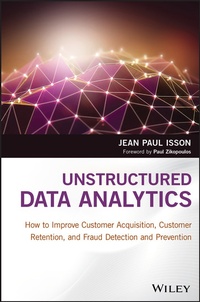
Unstructured Data Analytics
Description

Unstructured Data Analytics provides an accessible, non-technical introduction to the analysis of unstructured data. Written by global experts in the analytics space, this book presents unstructured data analysis (UDA) concepts in a practical way, highlighting the broad scope of applications across industries, companies, and business functions. The discussion covers key aspects of UDA implementation, beginning with an explanation of the data and the information it provides, then moving into a holistic framework for implementation. Case studies show how real-world companies are leveraging UDA in security and customer management, and provide clear examples of both traditional business applications and newer, more innovative practices.
Roughly 80 percent of today's data is unstructured in the form of emails, chats, social media, audio, and video. These data assets contain a wealth of valuable information that can be used to great advantage, but accessing that data in a meaningful way remains a challenge for many companies. This book provides the baseline knowledge and the practical understanding companies need to put this data to work.
Supported by research with several industry leaders and packed with frontline stories from leading organizations such as Google, Amazon, Spotify, LinkedIn, Pfizer Manulife, AXA, Monster Worldwide, Under Armour, the Houston Rockets, DELL, IBM, and SAS Institute, this book provide a framework for building and implementing a successful UDA center of excellence.
You will learn:
* How to increase Customer Acquisition and Customer Retention with UDA
* The Power of UDA for Fraud Detection and Prevention
* The Power of UDA in Human Capital Management & Human Resource
* The Power of UDA in Health Care and Medical Research
* The Power of UDA in National Security
* The Power of UDA in Legal Services
* The Power of UDA for product development
* The Power of UDA in Sports
* The future of UDA
From small businesses to large multinational organizations, unstructured data provides the opportunity to gain consumer information straight from the source. Data is only as valuable as it is useful, and a robust, effective UDA strategy is the first step toward gaining the full advantage. Unstructured Data Analytics lays this space open for examination, and provides a solid framework for beginning meaningful analysis.
More details
Other editions
Additional editions
Content
CHAPTER 1
The Age of Advanced Business Analytics
In God we trust; all others must bring data.
-Attributed to W. Edwards Deming
INTRODUCTION
If you believe that the data analytics revolution has already happened, think again. After the steam engine, mass production, and Internet technology, the Internet of Things and artificial intelligence make up the fourth industrial revolution. However, the motor of this fourth revolution is analytics. The impact of analytics in our societies, our communities, and the business world has just begun. In fact, knowledge gained from analytics in the recent years has already reshaped the marketplace, changing the way we shop, buy, think, vote, hire, play, choose, date, and live. With more than 20 billion connected devices by 20201 and more than 5 billion people with IP addresses sharing information and intelligence by 2025, the pace of upcoming changes resulting from analytics is mind boggling. The Internet of Things was the genesis of the Analytics of Things and Analytics of Apps. In the Analytics of Things era, new knowledge, resulting from artificial intelligence, like machine learning, deep learning and cognitive analytics, and blockchain, will be gathered from complex information networks flowing from billions of connected devices and from humans interfacing with their intelligent devices such as machines, apps, and wearables of all kinds.
Today, companies are under extreme pressure to dig deeper into and connect all information and pieces of data at their disposal to find new differentiators from their competition. They need to better understand their market, customers, competitors, and talent pool. They also need to think laterally and look for creative ideas and innovations in other fields. Think of all the new information layers that are at their disposal to help them achieve this goal. Exhibit 1.01 showcases the five layers of new information that are being generated and helping organizations to create business value.
Exhibit 1.01 The Exponential Growth of New Information: The Five Layers
Exhibit 1.02 showcases the exponential growth of digital information. According to International Data Corporation (IDC) estimates, by 2020, data production will balloon to 44 times what it was in 2009.
Exhibit 1.02 Data Production Evolution
Source: CSC IDC Estimate
Customers and users have become more technology-savvy and are expecting more from their service providers or product manufacturers. They are very fickle and can switch to the competition with a single click. They have options and a lot of choices. They expect their service provider to know their habits, wants, and needs and even to anticipate their next move or transaction. Therefore, for any leading organizations poised to play in this digitized data economy where consumers and users are empowered, selective, and highly informed, analytics is key.
Analytics enables organizations of all sizes to meet and exceed customers' expectations by becoming data-driven to play in the new digital economy, where customers and market deep knowledge are front and center. However, to harness and create actionable insights from the complex user- and machine-generated data, organizations need to apply science to that data. Yes, science. In data science, specialists play with unorganized or "messy" data2 to distill the intelligence differentiator.
Data Scientist: The Sexiest Job of the Twenty-First Century
You probably came across this concept if you read Harvard Business Review in October 2012. In their article,3 Thomas H. Davenport and D. J. Patil provided a comprehensive overview of the prominent job occupation for Big Data tamers. They underscored the sudden rise of data science in the business scene.
For those of us with a math and computer science background, being labeled as sexy was a shock. When I was a graduate in mathematics and statistics, most of my class was made up of men. We were referred to as "those guys" or "those geeks," and we were mostly left alone by others. Our program was perceived as difficult to understand or too theoretical. This made our field of study very hermetic and unappealing to many. At that time, none of us could see a real-life application resulting from linear algebra. How did all the theorems and concepts we were learning apply to the business world? Our ideal career pathways in those days were math teacher or researcher, not data scientist. The term was not sexy at that time.
Studying the theory of vector space along with the concept of singular value decomposition (SVD) in algebra, we manually decomposed a matrix into a product of three matrices. We understood SVD was useful in dimension reduction: It helped to transform any matrix with a universe of n vectors into a smaller number of vectors that contained all the information of the original complex matrix. For high-dimension matrices, the process was manually tedious, starting with finding eigenvalues and then building eigenvectors. While we became adept in SVD, we had no clue as to where this skill-set could be applied in real life. At that time, we didn't know that SVD would be used to analyze text. We didn't know that counting terms weights and using SVD dimension reduction would provide clean separation of customer opinion or text categorization and sentiment analysis. Now computers are proficient in running complex computations like SVD (see Chapter 3). It was when I entered the workforce that I finally came across the first application of SVD, embedded in a software program designed for text analytics. There it was, hidden in the technical section of the software: The theory of vectors space reduction power of SVD was leveraged. The text content was placed into a matrix, and a quantitative representation of the content matrix was then created. Eigenvalues and -vectors were found to reduce the content into a smaller number of vectors while retaining the essence of the original content. It turns out that the vectors space reduction and SVD I had learned in algebra were the foundations of most text analysis.
It is uncertain whether our professors had envisioned the real-life applications for the math theories they were teaching then. Only visionaries could have foreseen such an explosion of applications in our lives, today and in the future, given the new information layers I mentioned. Such foresight would have changed the evolution of the data science for sure. However, it is the explosion of technologies, the new information layers, and the empowerment of the consumers and users that have shed light on analytics and propelled it into a new science.
WHY THE ANALYTICS HYPE TODAY?
Analytics is now part of the bottom line of leading organizations and industries of all sizes and types. Some companies have used analytics to power growth and to move into new sectors. In today's global competitive landscape, where data never stops flowing and challenges and opportunities keep changing, a lot of hype surrounds advanced business analytics. Your company is probably constantly exhorted to build and implement strategies to collect, process, manage, and analyze data (big and small) and to create business value from it. And you are warned about the potential risk of falling behind your competition by not doing so.
The data scientist job title has been around for a few years; it was coined in 2008 by D.J. Patil and Jeff Hammebacher, data analytics leaders at (respectively) LinkedIn and Facebook. In fact, a lot of data scientists were working in leading companies long before the recent traction around data science. The rapid appearance of data analytics in the business arena came from Silicon Valley's online giant companies, such as Google, eBay, LinkedIn, Amazon, Facebook, and Yahoo!, all of which surged to prominence during the Y2K dot.com boom. These online firms started to amass and analyze the gigantic volume of data generated by the clickstreams generated through user searches. They pioneered the data economy by building data products, and Big Data invaded the business world. A new data economy was created; companies were inundated with information flowing from different sources, in varieties, volumes, velocity, and veracity that they wanted to harness to create actionable business value. The emergence of Big Data has triggered the overall traction around advanced business analytics, which was propelled by the consortium of the following pillars:
- Costs to store and process information have reduced
- Interactive devices and censors have increased
- Data analytics infrastructures and software have increased
- User-friendly and invisible data analytics tools have emerged
- Data analytics have become mainstream, and it means a lot to our economy and world
- Major leading tech companies have pioneered the data economy
- Big Data analytics has become a big market opportunity
- The number of data science university programs and MOOCs has intensified
1. Costs to Store and Process Information Have Reduced
The cost of storing information has significantly dropped: $600 will buy a disk drive that can store the entire world's music.4 In 1990, it cost $11,000 to buy 1 GB of disk space; today, 1 GB disk space costs less than 1 cent.5 Data storage and data processing have grown tremendously. The...
