

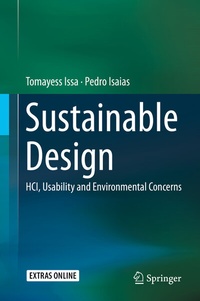
Sustainable Design
Description

This book is concerned with the importance of Human Computer Interaction (HCI), Usability, user participants, and Sustainability in the Information Communication Technology (ICT) industry throughout the world. ICT has become a crucial instrument for communication, entertainment, commerce and research and this increased usage is presenting new environmental and sustainability issues as we try and meet the ever growing needs of both businesses and individuals.
Sustainability must become central to the design of new technologies to make a concerted effort to tackle the environmental concerns we face now and for the future. Development frameworks, tools and models are used and explored and the New Participative Methodology for Sustainable Design (NPMSD) is introduced as a way of identifying key factors needed in developing more sustainable systems including new smart technology and portable devices. It is hoped additional research will be carried out in the future to assess these sustainable design steps using larger, more diverse countries with developed and developing economies to further refine such methods.
Sustainable Design will be an invaluable resource for students and researchers, designers and business managers who are interested in the human-centred, environmental concerns of sustainable technologies
More details
Other editions
New editions
Additional editions
Persons
Tomayess Issa is a senior lecturer at the School of Information Systems at Curtin University, Australia. Tomayess completed her doctoral research in Web development and Human Factors. As an academic, she is also interested in establishing teaching methods and styles to enhance the students' learning experiences and resolve problems that students face. Tomayess conducts research locally and globally in information systems, Human-Computer Interaction, Usability, Sustainability, Green IT, Cloud Computing, Social Networking, Teaching and Learning, Tomayess participated in a couple of conferences and published her work in several peer-reviewed journals, books, book chapters, papers and reports.
Tomayess is a Conference and Program Co-Chair of the IADIS International Conference on Internet Technologies and Society and IADIS International Conference on International Higher Education. Furthermore, she initiates the IADIS conference for Sustainability, Green IT and Education and is a Project leader in the International research network (IRNet-EU) to study and develop new tools and methods for advanced pedagogical science in the field of ICT instruments, e-learning and intercultural competences and is a senior research member of ISRLAb from International Association for Development of the Information Society.
Pedro Isaias is the coordinator of ISRLAb (Information Society Research Lab) from International Association for Development of the Information Society and is a Professor at the Universidade Aberta (Portuguese Open University) in Lisbon, Portugal, responsible for several courses and is the Director of the Master's program in ElectronicCommerce and Internet since its start in 2003. He holds a PhD in Information Management (in the specialty of information and decision systems) from the New University of Lisbon. Author of several books, book chapters, papers and research reports, all in the information systems area, he has headed several conferences and workshops within the mentioned area. He has also been responsible for the scientific coordination of several EU funded research projects and has participated in various research projects. He is also a member of the editorial board of several journals and program committee member of several conferences and workshops. At the moment, he is conducting research activity related to Information Systems in general, E-Learning, E-Commerce and WWW-related areas.
Content
Preface.- Introduction.- Usability & Human Computer Interaction (HCI).- User Participation in System Development Process.- Physical, Cognitive and Affective Engineering.- Color, Prototyping and Navigation, Principles and Guidelines Design, Evaluation and Testing; Task Analysis.- Models and Methodologies.- New Participative Methodology for Sustainable Design (NPMSD).- Future ICTs: Present Trends for Future Developments.
