

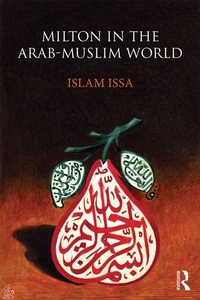
Milton in the Arab-Muslim World
Published on 14. October 2016
284 pages
978-1-317-09592-7 (ISBN)
Description

The first full-length study of the reception of John Milton's (1608-74) writings in the Arab-Muslim world, this book examines the responses of Arab-Muslim readers to Milton's works, and in particular, to his epic poem: Paradise Lost. It contributes to knowledge of the history, development, and ways in which early modern writings are read and understood by Muslims. By mapping the literary and more broadly cultural consequences of the censure, translation and abridgement of Milton's works in the Arab-Muslim world, this book analyses the diverse ways in which Arab-Muslims read and understand a range of literary and religious aspects of Milton's writing in light of cultural, theological, socio-political, linguistic and translational issues. After providing an overview of the presence of Milton and his works in the Arab world, each chapter sheds light on how cultural and translational issues shape the ways in which Arab-Muslim readers perceive and understand the characters and motifs of Paradise Lost. Chapters outline the ways in which the figures are currently understood in Milton scholarship, before exploring how they fit into the narrative drama and theology of the poem, and their position in Islamic creed and Arab-Muslim culture. Concurrently, each chapter examines the poem's subject matter in detail, placing particular emphasis on matters of linguistic, theological and cultural translation and accommodation. Chapter conclusions not only summarise the patterns and potentialities of reception, but point towards the practical functions of Arab-Muslim responses to Milton's writing and their contribution to the formation of social ideas.
Reviews / Votes
"Islam Issa is a rising star amongst scholars of the cultural interaction between the West and the Islamic world. This elegantly written book graciously eclipses previous studies of the topic. The subject is complex and in some respects volatile, but Issa grasps the tiller with a steady hand: his methodology is exemplary, and the inferences drawn from the data are characterised by common sense and intellectual honesty. Writing by literary specialists on such topics all too often describes imagined worlds, but Issa deals with the literary and religious cultures of a real world observed from the platform of his own experience and wide reading in both Arabic and English. The book will be essential reading for scholars and students of Milton, Early Modern literature, translation studies, cultural studies and reception studies, and for anyone curious about the cultural aspect of relations between the West and the Middle East."-- Gordon Campbell, University of Leicester, UK
"Islam Issa's study of Milton and the Arab-Muslim world revisits with much greater range and detail a subject first broached in 1987 by Eid Dahiyat, whose short monograph remains unfamiliar to most Milton scholars. In line with scholarly efforts to understand the distinctive nature of relations between the West and the Middle East, Issa's Milton in the Arab-Muslim World breaks important ground on two fronts. It is both a timely reception history and an invaluable illustration of how twenty-first-century scholars can engage with canonical authors. By focusing on global and peripheral readerships, translation theories and practices, and especially in this instance, the cross-cultural synergy that ensues when writings informed by Hebraic and Christian traditions are assessed by a culture that seems in many ways opposed to them, Issa has produced a book that will become a must-read for years to come."
-- Edward Jones, Editor, Milton Quarterly
"This is genuinely important work, which makes a truly original contribution to knowledge. Most of it, indeed, is completely new. Islam Issa demonstrates how, in certain instances, Milton's meaning and poetic affect is actually thickened and intensified by his Muslim reception. At these points in its argument, the book makes good on its engagingly provocative suggestion that a Qur'anic Milton might well mean more to modern Muslims than Paradise Lost does to its secularized modern Christian readership. Groundbreaking stuff."
-- Ewan Fernie, Shakespeare Institute
"In the context of current interest in Milton's global impact, Islam Issa's detailed study of his reception, appropriation and translation in the Arab-Muslim world is particularly timely and welcome."
-- Thomas N. Corns, Bangor University, UK
"Milton in the Arab-Muslim World by Islam Issa is a significant work that merits the attention of anyone interested in the larger international reception of Milton's writings ... Overall, Milton in the Arab-Muslim World is a genuinely enriching and indeed groundbreaking text, contributing tremendously to readers' understanding of Milton's reception in the Arab-Muslim culture upon which Issa focuses and setting a high standard for future studies of cross-cultural receptions of Milton's writings."
--David V. Urban, Year's Work in English Studies
More details
Language
English
Place of publication
London
United Kingdom
Publishing group
Taylor & Francis Ltd
Target group
College/higher education
Illustrations
3 Tables, black and white; 3 Line drawings, black and white; 13 Halftones, black and white; 16 Illustrations, black and white
File size
2,55 MB
ISBN-13
978-1-317-09592-7 (9781317095927)
Copyright in bibliographic data and cover images is held by Nielsen Book Services Limited or by the publishers or by their respective licensors: all rights reserved.
Schweitzer Classification
Other editions
Additional editions
Islam Issa
Milton in the Arab-Muslim World
Book
01/2019
1st Edition
Routledge
€72.70
Shipment within 15-20 days
Islam Issa
Milton in the Arab-Muslim World
Book
10/2016
1st Edition
Routledge
€232.00
Shipment within 10-20 days
Person
Islam Issa is Lecturer in English Literature at Birmingham City University, U.K.
Content
Table of Contents
List of Illustrations
Acknowledgements
Transliteration Guide
Texts and Abbreviations
Note on Translations and References
Part One
Introduction
John Milton: 'Pious Muslim' and 'Inhumane Zionist'
The Arab-Muslim World
Overcoming Periphery Neglect
Chapter 1. Milton's Presence: Texts and Translations
(1) Milton's Presence
(2) Texts and Translations
Historical Survey
Enani's Theories of Translation
Part Two
Chapter 2. Satan
(1) Satan's Dual Centrality
(2) Satan and the Fallen Angels in Books 1-2
(3) Satan's Psychology and Tactics
(4) Conclusion
Chapter 3. God the Son
(1) The Son, Jesus, and the Challenges of Reception
(2) The Subordination of the Son
(3) The Son's Missions
(4) Conclusion
Chapter 4. God the Father
(1) The Father and the Paradox of Depiction
(2) The Father and Free Will
(3) The Father and Anthropomorphism
(4) Conclusion
Chapter 5. Adam and Eve
(1) Adam, Eve, and [Im]Perfection
(2) The Relationship of Adam and Eve
(3) The Nudity and Sexuality of Adam and Eve
(4) Conclusion
Epilogue
List of Illustrations
Acknowledgements
Transliteration Guide
Texts and Abbreviations
Note on Translations and References
Part One
Introduction
John Milton: 'Pious Muslim' and 'Inhumane Zionist'
The Arab-Muslim World
Overcoming Periphery Neglect
Chapter 1. Milton's Presence: Texts and Translations
(1) Milton's Presence
(2) Texts and Translations
Historical Survey
Enani's Theories of Translation
Part Two
Chapter 2. Satan
(1) Satan's Dual Centrality
(2) Satan and the Fallen Angels in Books 1-2
(3) Satan's Psychology and Tactics
(4) Conclusion
Chapter 3. God the Son
(1) The Son, Jesus, and the Challenges of Reception
(2) The Subordination of the Son
(3) The Son's Missions
(4) Conclusion
Chapter 4. God the Father
(1) The Father and the Paradox of Depiction
(2) The Father and Free Will
(3) The Father and Anthropomorphism
(4) Conclusion
Chapter 5. Adam and Eve
(1) Adam, Eve, and [Im]Perfection
(2) The Relationship of Adam and Eve
(3) The Nudity and Sexuality of Adam and Eve
(4) Conclusion
Epilogue
