

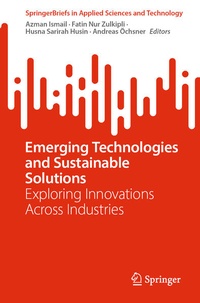
Emerging Technologies and Sustainable Solutions
Description

This book offers a comprehensive journey through fifteen chapters, each illuminating a distinct aspect of technological advancement and its impact on sustainability. From IoT-driven aquaponics systems to predictive maintenance models, the book traverses diverse domains such as maritime leadership, data analysis, healthcare, and environmental management. Through practical insights and theoretical frameworks, it unveils how cutting-edge technologies like blockchain, AI, and IoT are revolutionizing traditional practices, fostering sustainability, and enhancing societal well-being. By navigating through real-world applications and challenges, this book can serves as a guide for researchers, practitioners, and policymakers, showcasing the transformative potential of technology in building a more sustainable future.
More details
Other editions
Additional editions
Persons
Azman Ismail is Associate Professor at the Centre for Women Advancement and Leadership (CWAL), Universiti Kuala Lumpur Malaysian Institute of Marine Engineering Technology.
Fatin Nur Zulkipli is Researcher and academic at Universiti Teknologi MARA, Machang, Malaysia. She is working at the College of Computing, Information & Mathematics.
Husna Sarirah Husi n is Senior Lecturer at School of Computer Science, Faculty of Innovation & Technology, Taylor's University, Subang Jaya, Malaysia
Andreas Öchsner is Professor of Mechanical and Systems Engineering at Esslingen University of Applied Sciences, Germany.
Content
1 Design of an IoT -Based Aquaponics System with Monitoring Capabilities.- 2 Maritime Leadership Module Using a Ship Navigation Simulator.- 3 Assessing the Efficiency of Cargo Distribution using Road Freight through Data Envelopment Analysis.- 4 Factors that Influence the Sustainability of Insurance Companies in Malaysia in Facing the Issue of Phase Liberalization.- 5 The Use of Multiple Linear Regression to Predict Inter-Industry Knowledge Sharing: The Effect of Port Workers' Non-Technological Determinants.- 6 Blockchain Technologies in Cyber Physical Systems.- 7 Practiced-Based Research in New Media Design and Technology: Issues and Challenges in Designing Creative Outcome to Facilitate Learning.- 8 Design and Development of Android-Based Gesture Recognition System for Deaf-Mute Individuals.- 9 Geometrical Parameters Optimization of a Square Micro Coil using a Two Level Factorial Technique.- 10 Impact of Covid-19 on Software Development Life Cycle.- 11 Generative Adversarial Network Driver View Image Synthesis for Autonomous Vehicle Training.- 12 Predictive Maintenance Using a Long Short-Term Memory Model for Industrial Applications.- 13 A Rule-Based Approach: Health Tracker for Inflammatory Bowel Disease Patients.- 14 Brain Tumor Classification using Depthwise Separable Convolution.- 15 Lesson Learned from the Mox Plant Case on Precautionary Measures for Sustainable Marine Environment Management.
