

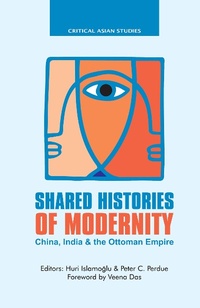
Shared Histories of Modernity
China, India and the Ottoman Empire
1st Edition
Published on 29. November 2020
348 pages
978-1-000-08392-7 (ISBN)
Description

While pre-modernity is often considered to be the 'time' of non-European regions and modernity is seen as belonging to the West, this book seeks to transcend the temporal bifurcation of that world history into 'pre-modern' and 'modern', as well as question its geographical split into two irreconcilable trajectories: the European and the non-European. The book examines shared experiences of modern transformation or modernity in three regions -- China, India and the Ottoman Empire -- which conventional historiography identifies as non-European, and therefore, by implication, outside of modernity or only tangentially linked to it as its victim. In other words, this work looks at modernity without reference to any 'idealised' criteria of what qualifies as 'modern' or not, studying the negotiation and legacies of the early modern period for the modern nation state. It focuses on the experience of modernity of non-European regions for they play a crucial role in the new phase of transformational patterns may have deeper roots than are generally assumed.
Rejecting European characterisations of 'eastern' states as Oriental despotisms, the volume conceives of the early modern state as a negotiated enterprise, one that questions the assumption that state centralisation must be a key metric of success in modernisation. Among other topics, the book highlights: state formations in the three empires; legislation pertaining to taxation, property, police reform, the autonomy of legal sphere, the interaction of different types of law, law's role in governance, administrative practice, negotiated settlements and courts as sites of negotiation, the blurred boundaries between formal law and informal mediation; the ability of 18th century Qing and Ottoman imperial governments to accommodate diverse local particularities within an overreaching structure; and the pattern of regional development pointing to the accommodative institutional capacity of the Mughal empire.<
Rejecting European characterisations of 'eastern' states as Oriental despotisms, the volume conceives of the early modern state as a negotiated enterprise, one that questions the assumption that state centralisation must be a key metric of success in modernisation. Among other topics, the book highlights: state formations in the three empires; legislation pertaining to taxation, property, police reform, the autonomy of legal sphere, the interaction of different types of law, law's role in governance, administrative practice, negotiated settlements and courts as sites of negotiation, the blurred boundaries between formal law and informal mediation; the ability of 18th century Qing and Ottoman imperial governments to accommodate diverse local particularities within an overreaching structure; and the pattern of regional development pointing to the accommodative institutional capacity of the Mughal empire.<
More details
Series
Edition
1. Auflage
Language
English
Place of publication
London
United Kingdom
Publishing group
Taylor & Francis Ltd
Target group
College/higher education
Product notice
Reflowable
ISBN-13
978-1-000-08392-7 (9781000083927)
Copyright in bibliographic data and cover images is held by Nielsen Book Services Limited or by the publishers or by their respective licensors: all rights reserved.
Schweitzer Classification
Other editions
Additional editions
Book
06/2019
1st Edition
Routledge India
€65.50
Shipment within 15-20 days
Book
03/2009
1st Edition
Routledge India
€206.70
Shipment within 15-20 days
Persons
Huricihan Islamoglu is Professor of Economic History and Political Economy, Bogazici University, Istanbul, Turkey, and Central European University, Budapest, Hungary. Her research interests are economic history, economic theory as well as international relations and European studies. She is the author of Constituting Modernity: Private Property in the East and West (2004); State and Peasant in the Ottoman Empire (1994); and Ottoman Empire and the World Economy (1987).
Peter C. Perdue is Professor of History, Yale University. He was Professor of History, MIT from 1982 to 2008. His doctoral research at the Havard University was in History and East Asian Languages. He co-edited the recent volume: Imperial Formations (2007). Some of his monographs include: China Marches West: The Qing Conquest of Central Eurasia (2005); and Exhausting the Earth: State and Peasant in Hunan, 1500-1850 A.D. (1987).
Peter C. Perdue is Professor of History, Yale University. He was Professor of History, MIT from 1982 to 2008. His doctoral research at the Havard University was in History and East Asian Languages. He co-edited the recent volume: Imperial Formations (2007). Some of his monographs include: China Marches West: The Qing Conquest of Central Eurasia (2005); and Exhausting the Earth: State and Peasant in Hunan, 1500-1850 A.D. (1987).
Content
1. Introduction by Huri Islamoglu and Peter C. Perdue 2. Empire and Nation in Comparitive Perspective: Frontier Administration in Eighteenth-Century China by Peter C. Perdue 3. Administrative Practice between Religious Law (Shari'a) and State Law (Kanun) on the Eastern Frontiers of the Ottoman Empire by Dina Rizk Khoury 4. Administering the City, Policing Commerce by Peter Carroll 5. Heaven and the Administration of Things: Some Remarks on Law in the Tanzimat Era by Serif Mardin 6. A World Made Simple: Law and Property in the Ottoman and Qing Empires by Melissa Macauley 7. Modernities Compared: State Transformations and Constitutions of Property in the Qing and Ottoman Empires by Huri Islamoglu 8. A History of Cast in South India: From Pre-colonial Polity to Bio-political State by Ananya Vajpeyi 9. Formal and Informal Mechanisms of Rule and Economic Development: The Qing Empire in Comparitive Perspective by R. Bin Wong 10. When Strong Men Meet: Recruited Punjabis and Constrained Colonialism by Rajit Mazumdar 11. The Fate of Empires: REthinking Mughals, Ottomans and Habsburgs by Sanjay Subrahmanyam
