

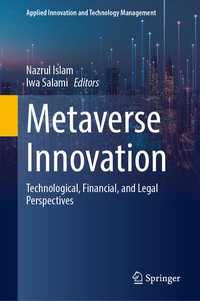
Metaverse Innovation
Description

The Metaverse can be defined as an immersive 3-D simulated digital environment that deploys technologies like augmented reality, virtual reality, blockchain, and artificial intelligence to imitate the real world and allow people to conduct daily activities through digital versions of themselves (avatars). The opportunities brought by the metaverse for the economy and the society are wide in scope from business models to equitable education possibilities. This prompts regulators and policymakers around the world to assess the crucial legal and regulatory issues that arise in the process of metaverse development. This book offers a comprehensive understanding of metaverse innovation from technological, financial, and legal perspectives. It offers the basics of the metaverse, such as its enabling technologies, main characteristics and the global trends that shape its development. It also reviews the positive and negative impact of the metaverse on different sectors of the economy as well as the implications for policy and law.
More details
Other editions
Additional editions
Persons
Nazrul Islam is Chair Professor of Business and Director of Research Degrees (PhD/MPhil) at the Royal Docks School of Business and Law, University of East London (UEL), UK. He also serves as Associate Director of the Centre of FinTech. Holding a PhD in Innovation Management, his research spans technology management, digital transformation, disruptive innovation, and SME sustainability. His work has been widely published and recognized internationally, including the Brad Hosler Award for Outstanding Paper (USA) and the Pratt & Whitney Canada Best Paper Award. Most notably, his pioneering work on innovation and artificial intelligence was cited by The White House and featured in the 2024 Economic Report of the President of the United States. He serves on the Board of Directors of the Business and Applied Sciences Academy of North America (BAASANA) and holds editorship with Technological Forecasting and Social Change, IEEE Transactions on Engineering Management, and the International Journal of Technology Intelligence and Planning.
Iwa Salami is Professor in Financial Law and Regulation and Director for the Centre of FinTech at the Royal Docks School of Business and Law, University of East London, UK. Dr. Salami has published extensively in the field of financial regulation in emerging economies and financial technology (FinTech) regulation. Her publications include numerous articles in internationally refereed journals and two books.
Content
Chapter1: How will metaverse technologies impact the global economy and society.- Chapter2: Navigating the Digital Frontier Exploring the Characteristics and Core Functionalities of the Metaverse.- Chapter3: Leveraging the Metaverse for Technological Advancements in Construction Industry.- Chapter4: Digital Identity Avatars, Land, and Ownership in the Metaverse.- Chapter5: Virtual Immersion and Global Learning: The Future of Education through the Metaverse.- Chapter6: Application of Artificial Intelligence as A Metaverse Technology Tool in Finance.- Chapter7: FinTech and the Metaverse Financial Inclusion through GenAI, Blockchain, and Digital Banking.- Chapter8: National Strategies and Practices for the Metaverse Development The Case of Finland.- Chapter9: Convergence of Metaverse, AI, Blockchain, Web3 and CBDCs.- Chapter10: Intellectual Property and NFT Use in the Metaverse A Global Approach to Regulation.- Chapter11: Financial Services in the Metaverse Legal and Regulatory Considerations.- Chapter12: Law enforcement and policing against crime, misconduct, discrimination, harassment, and fraud in the metaverse.- Chapter13: Virtual Property Rights in the Metaverse.
