

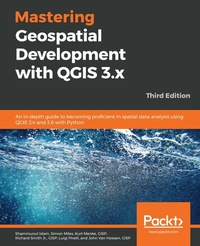
Mastering Geospatial Development with QGIS 3.x
An in-depth guide to becoming proficient in spatial data analysis using QGIS 3.4 and 3.6 with Python
3rd Edition
Published on 23. September 2024
466 pages
978-1-78899-487-3 (ISBN)
Description

No detailed description available for "Mastering Geospatial Development with QGIS 3.x".
More details
Edition
3rd Revised edition
Language
English
Place of publication
Birmingham
United Kingdom
Target group
Professional and scholarly
US School Grade: College Graduate Student
Edition type
Revised edition
File size
34,38 MB
ISBN-13
978-1-78899-487-3 (9781788994873)
Copyright in bibliographic data and cover images is held by Nielsen Book Services Limited or by the publishers or by their respective licensors: all rights reserved.
Schweitzer Classification
Other editions
Additional editions
Shammunul Islam | Simon Miles | Kurt Menke, GISP
Mastering Geospatial Development with QGIS 3.x
An in-depth guide to becoming proficient in spatial data analysis using QGIS 3.4 and 3.6 with Python
Book
03/2019
3rd Edition
Packt Publishing
€52.30
Shipment within 3-4 weeks
Persons
Islam Shammunul :
Shammunul Islam is a consulting spatial data scientist at the Institute of Remote Sensing, Jahangirnagar University, and a senior consultant at ERI, Bangladesh. He develops applications for automating geospatial and statistical analysis in different domains such as in the fields of the environment, climate, and socio-economy. He also consults as a survey statistician and provides corporate training on data science to businesses. He holds an MA in Climate and Society from Columbia University, an MA in development studies, and a BSc in statistics.Miles Simon :
Simon Miles is a GIS developer working for the Royal Borough of Windsor and Maidenhead, and has been working in the GIS industry since 2003. He always works using open source technologies. His main kit includes QGIS, PostGIS, Python, GDAL, Leaflet, JavaScript, and PHP. His main focus is on digital delivery/transformation, chiefly through the consolidation of data, applications, and legacy systems, and replacing these with APIs and web applications. In 2013, He helped to establish the UK QGIS user group, which holds regional meetings two or three times a year.Menke, GISP Kurt :
Kurt Menke, a certified GIS Professional (GISP), has been working in the GIS field since 1997. Prior to this, he worked as a professional archaeologist for 10 years in the American Southwest. He earned a master's degree (MA) in Geography from the University of New Mexico in 2000. That same year, he founded Bird's Eye View (www.BirdsEyeViewGIS.com) to apply his expertise with the GIS technology to the World's mounting ecological and social problems. Towards this end, Mr. Menke's work focuses largely on wildlife conservation and public health. His specialties are spatial analysis, modeling, and cartography. He is a longtime advocate of FOSS4G. He began writing MapServer applications in 2001 and has been using QGIS since 2007. He is one of the coauthors of the curriculum at the FOSS4G AcademySmith Jr., GISP Richard :
Richard Smith Jr., GISP, is an asst. professor of geographic information science in the School of Engineering and Computing Sciences at Texas A&M University, Corpus Christi. He has a Ph.D. in geography from the University of Georgia, MSc in computer science, and BSc in geographic information science from Texas A&M University, Corpus Christi. He researches in cartography, systems integration, and the use of geospatial technology for disaster response. He is an advocate for FOSS4G and building a FOSS4G curriculum. He is a co-author of the FOSS4G Academy.Pirelli Luigi :
Luigi Pirelli is a QGIS developer and software analyst with a degree in computer science from Bari University. He has worked in the Satellite Ground Segment and Direct Ingestion for the European Space Agency. He is involved in GFOSS world, contributing in QGIS, GRASS, & MapServer core, and developing QGIS plugins. Luigi is the founder of the OSGEO Italian local GFOSS chapter. He has taught PyQGIS, delivered training from basic to advanced levels, and supported companies to develop their own QGIS plugins. He founded a local hackerspace group-Bricolabs.cc. He likes training groups on conflict resolution. He contributed to the Lonely Planet guide Cycling Italy.Van Hoesen, GISP John :
John Van Hoesen, GISP, is an associate professor of geology and environmental studies at Green Mountain College in rural west-central Vermont, USA. He has an MS and a Ph.D. in geology from the University of Nevada, Las Vegas. He is a certified GISP with a broad background in the geosciences and has used some flavor of GIS to evaluate and explore geological processes and environmental issues. John has taught graduate, undergraduate, and continuing education courses using some variants of FOSS GIS since 2003.
Shammunul Islam is a consulting spatial data scientist at the Institute of Remote Sensing, Jahangirnagar University, and a senior consultant at ERI, Bangladesh. He develops applications for automating geospatial and statistical analysis in different domains such as in the fields of the environment, climate, and socio-economy. He also consults as a survey statistician and provides corporate training on data science to businesses. He holds an MA in Climate and Society from Columbia University, an MA in development studies, and a BSc in statistics.Miles Simon :
Simon Miles is a GIS developer working for the Royal Borough of Windsor and Maidenhead, and has been working in the GIS industry since 2003. He always works using open source technologies. His main kit includes QGIS, PostGIS, Python, GDAL, Leaflet, JavaScript, and PHP. His main focus is on digital delivery/transformation, chiefly through the consolidation of data, applications, and legacy systems, and replacing these with APIs and web applications. In 2013, He helped to establish the UK QGIS user group, which holds regional meetings two or three times a year.Menke, GISP Kurt :
Kurt Menke, a certified GIS Professional (GISP), has been working in the GIS field since 1997. Prior to this, he worked as a professional archaeologist for 10 years in the American Southwest. He earned a master's degree (MA) in Geography from the University of New Mexico in 2000. That same year, he founded Bird's Eye View (www.BirdsEyeViewGIS.com) to apply his expertise with the GIS technology to the World's mounting ecological and social problems. Towards this end, Mr. Menke's work focuses largely on wildlife conservation and public health. His specialties are spatial analysis, modeling, and cartography. He is a longtime advocate of FOSS4G. He began writing MapServer applications in 2001 and has been using QGIS since 2007. He is one of the coauthors of the curriculum at the FOSS4G AcademySmith Jr., GISP Richard :
Richard Smith Jr., GISP, is an asst. professor of geographic information science in the School of Engineering and Computing Sciences at Texas A&M University, Corpus Christi. He has a Ph.D. in geography from the University of Georgia, MSc in computer science, and BSc in geographic information science from Texas A&M University, Corpus Christi. He researches in cartography, systems integration, and the use of geospatial technology for disaster response. He is an advocate for FOSS4G and building a FOSS4G curriculum. He is a co-author of the FOSS4G Academy.Pirelli Luigi :
Luigi Pirelli is a QGIS developer and software analyst with a degree in computer science from Bari University. He has worked in the Satellite Ground Segment and Direct Ingestion for the European Space Agency. He is involved in GFOSS world, contributing in QGIS, GRASS, & MapServer core, and developing QGIS plugins. Luigi is the founder of the OSGEO Italian local GFOSS chapter. He has taught PyQGIS, delivered training from basic to advanced levels, and supported companies to develop their own QGIS plugins. He founded a local hackerspace group-Bricolabs.cc. He likes training groups on conflict resolution. He contributed to the Lonely Planet guide Cycling Italy.Van Hoesen, GISP John :
John Van Hoesen, GISP, is an associate professor of geology and environmental studies at Green Mountain College in rural west-central Vermont, USA. He has an MS and a Ph.D. in geology from the University of Nevada, Las Vegas. He is a certified GISP with a broad background in the geosciences and has used some flavor of GIS to evaluate and explore geological processes and environmental issues. John has taught graduate, undergraduate, and continuing education courses using some variants of FOSS GIS since 2003.
Content
Table of Contents
What
Styling Raster and Vector Data
Creating Spatial Databases and Working with GeoPackages
Preparing Vector Data for Processing
Preparing Raster Data for Processing
Advanced Data Creation and Editing
Advanced Data Visualization
The Processing Toolbox
Automating Workflows with the Graphical Modeler
Creating QGIS Plugins with PyQGIS and Problem Solving
PyQGIS Scripting
What
Styling Raster and Vector Data
Creating Spatial Databases and Working with GeoPackages
Preparing Vector Data for Processing
Preparing Raster Data for Processing
Advanced Data Creation and Editing
Advanced Data Visualization
The Processing Toolbox
Automating Workflows with the Graphical Modeler
Creating QGIS Plugins with PyQGIS and Problem Solving
PyQGIS Scripting
