

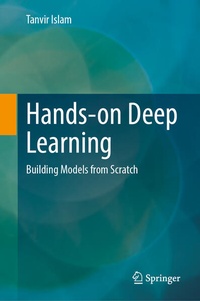
Hands-on Deep Learning
Description

This book is designed for data scientists and machine learning engineers who are keen to dive deep into the complexities of deep learning. The book is particularly useful for professionals in industries where machine learning is applied. It serves as a comprehensive guide for those eager to explore and expand their knowledge in this domain. The book caters to aspirational practitioners, those who are enthusiastic about the field of deep learning in general, being also suitable for engineers and data scientists who are preparing for machine learning interviews. Furthermore, undergraduate and graduate students who possess a basic understanding of machine learning will find this book to be a valuable resource.
Learning to create deep learning algorithms from scratch provides a deeper understanding of the underlying principles and mechanics, which can be beneficial in customizing and optimizing models for specific tasks. As such, this book will allow the readers to innovate, creating new architectures or techniques beyond what existing libraries offer. Moreover, it fosters a problem-solving mindset, as the learner navigates through the challenges of implementing complex algorithms. This knowledge will help readers and learners to debug and improve models using pre-built libraries.
The author goes beyond just explaining the theory of deep learning, connecting theoretical ideas to their real-world implementations, and dives into how the theoretical aspects of deep learning can be applied in real-world scenarios. Through hands-on examples and case studies, the author demonstrates the application of deep learning principles in solving problems across diverse domains like computer vision, natural language processing, and business analytics.
More details
Other editions
Additional editions
Person
Dr. Tanvir Islam is presently a staff data scientist at Okta, specialized in machine learning, algorithms, optimization, statistics, and big data technologies. Previously, he held research scientist positions at NASA JPL, Caltech, and NOAA. He holds a PhD in Engineering (Machine Learning and Sensing) from the University of Bristol. He has numerous publications and patents in machine learning, deep learning, artificial intelligence, rover autonomy, optimization techniques, and data-driven systems.
Content
"1-Introduction".- "2-Implementing the gradient descent algorithm".- "3-Training deep neural networks".- "4-Dealing with bias and variance".- "5-Leveraging advanced optimization techniques".- "6- Applying convolutional neural networks".- "7-Creating recurrent neural networks".- "8-Crafting long short-term memory networks".- "9-Using embeddings in language models".- "10-Assembling attention mechanisms and transformers".
