

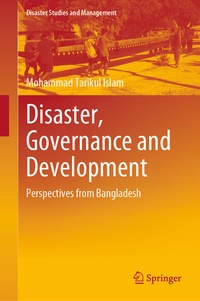
Disaster, Governance and Development
Description

This book unveils the nexus between disaster, governance and development with a particular focus on Bangladesh and examines the legislative and institutional aspects in mainstreaming disaster risk reduction into development planning. With the help of rich content analysis interpreting disaster management history of the country, it looks at the challenges associated with disaster management in the context of Bangladesh. The book highlights the most reasonable strategy on how to accelerate a paradigm shift from relief culture to DRR culture. It also assesses the viewpoint of how political economy influences governance and institutional strengthening, thus identifying obstructions and opportunities for mainstreaming disaster management into development. The book also lays emphasis on collaboration between public sector and private sector for the expansion of disaster risk reduction programme. It shows how multilevel governance works for professionalizing disaster management and throws light on policy frameworks developed. This book is a tremendous resource for scholars, practitioners and researchers of disaster management, environmental studies, development agencies, political science, public policy, development studies, governance, regional development, South Asian studies and local government, particularly those interested in disaster, governance and sustainable development.
More details
Other editions
Additional editions
Person
Dr. Mohammad Tarikul Islam is an Associate Professor of Government and Politics at the Jahangirnagar University in Bangladesh. Before joining the University in 2014, he worked with the UN Development Programme for seven years in various managerial capacities. Professor Islam acts as a Resource Person at Bangladesh Public Administration Training Centre. His edited book, "Human Security, Peace, and Development: South Asian Perspective," which was released in India, has received a great deal of scholarly acclaim. His two significant textbooks, "COVID-19 in South Asia: Its Impact on Society, Economics and Politics" (Routledge) and "Local Government in Bangladesh: Contemporary Issues and Challenges" (Routledge), are forthcoming. Dr. Islam is a regular contributor to the South Asia Blog of the London School of Economics and Political Science (LSE), Oxford Political Review and ISAS, NUS. His articles regularly appear in some of the leading English dailies of South Asiasuch as the Daily Star, the Daily Independent, the Financial Express, the Business Standard, the South Asia Monitor, and the Khabarhub (Nepal). Professor Islam has held a number of prestigious positions (Postdoctoral Fellow, Visiting Researcher, Visiting Scholar) at the University of Oxford, the University of Cambridge and the School of Oriental and African Studies (SOAS) in the past.
