

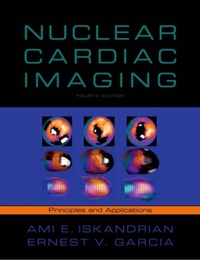
Nuclear Cardiac Imaging: Principles and Applications
Principles and Applications
1st Edition
Published on 25. September 2008
749 pages
978-0-19-971862-7 (ISBN)
Description

Nuclear cardiac imaging refers to cardiac radiological diagnostic techniques performed with the aid of radiopharmaceuticals, which are perfused into the myocardium as markers. These imaging studies provide a wide range of information about the heart, including the contractility of the heart, the amount of blood supply to the heart and whether parts of the heart muscle are alive or dead. This is essential information for cardiologists, and nuclear imaging has become an increasingly important part of the cardiologists armamentarium. Iskandrians text has become a leading book in the field and the fourth edition will continue the tradition. The text is completely updated to reflect the many advances in the field, and, as a new feature, each chapter concludes with a Q&A session on important and difficult clinical issues.
More details
Other editions
New editions
E-Book
11/2015
5th Edition
OUP eBook
€358.99
Available for download
Additional editions
Book
09/2008
4th Edition
Oxford University Press Inc
€179.51
Article exhausted; check different version
Content
- Cover
- Contents
- Preface
- Contributors
- 1. A Brief Historical Perspective on Nuclear Cardiology
- 2. Radiation Physics and Radiation Safety
- 3. Imaging Instrumentation
- 4. Kinetics of Myocardial Perfusion SPECT Imaging Radiotracers
- 5. Acquisition, Processing, and Quantification of Nuclear Cardiac Images
- 6. Quantification of SPECT Myocardial Perfusion Images
- 7. Image Artifacts
- 8. Myocardial Perfusion Single-Photon Emission Computed Tomography Attenuation Correction
- 9. Gated SPECT
- 10. Gated Blood Pool SPECT
- 11. SPECT/CT and PET/CT Hybrid Imaging and Image Fusion
- 12. Phase Analysis in Resynchronization Therapy: Old and New
- 13. Infarct Sizing
- 14. Treadmill Exercise Testing
- 15. Exercise Myocardial Perfusion Imaging
- 16. Pharmacological Stress Testing
- 17. Risk Assessment in CAD: Suspected CAD/Known Stable CAD
- 18. Risk Assessment in Acute Coronary Syndromes
- 19. Risk Assessment before Noncardiac Surgery
- 20. Use of Nuclear Techniques in the Assessment of Patients before and after Cardiac Revascularization Procedures
- 21. Accuracy of Cardiovascular Imaging for the Assessment of Cardiac Symptoms in Women
- 22. Imaging Patients with Chest Pain in the Emergency Department
- 23. Imaging Left Ventricular Remodeling
- 24. Iodinated Fatty Acid Imaging
- 25. Imaging Myocardial Innervation
- 26. First-Pass Radionuclide Angiography
- 27. Radionuclide Angiography: Equilibrium Imaging
- 28. Positron Emission Tomography
- 29. Cardiac PET Imaging without an On-Site Medical Cyclotron
- 30. Myocardial Viability/Hibernation
- 31. Cardiovascular Molecular Imaging: Current Progress and Future Prospects
- 32. Noninvasive Imaging Techniques in the Detection and Prognostication of Coronary Artery Disease
- 33. Cost-Effectiveness of Myocardial Perfusion SPECT Compared to Other Diagnostic Testing Modalities
- 34. Screening of Asymptomatic Patients
- 35. Artificial Intelligence Methods in Nuclear Cardiology
- 36. Quality Practical Nuclear Cardiology: Appropriateness, Training, Physician Certification, Laboratory Accreditation, and Reporting
- 37. Cardiac Computed Tomography for the Nuclear Cardiology Specialist
- 38. Practical Issues: Ask the Experts
- Index
- A
- B
- C
- D
- E
- F
- G
- H
- I
- J
- K
- L
- M
- N
- O
- P
- Q
- R
- S
- T
- U
- V
- W
- Y
