

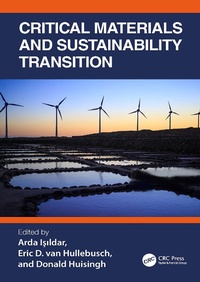
Critical Materials and Sustainability Transition
1st Edition
Published on 21. December 2023
178 pages
978-1-003-81096-4 (ISBN)
Description

Critical minerals play a vital role in the ongoing energy transition, which aims to shift global energy systems towards more sustainable and low-carbon alternatives. These minerals, also known as critical minerals, are essential components in various clean energy technologies such as wind turbines, solar panels, electric vehicles, and energy storage systems. They possess unique properties that enable efficient energy generation, storage, and transmission. For instance, neodymium, a rare earth element, is crucial for the production of high-performance magnets used in wind turbines and electric motors. Lithium, another critical mineral, is a key component in rechargeable batteries powering electric vehicles and energy storage solutions. As the demand for clean energy technologies continues to rise, securing a sustainable and reliable supply of critical minerals becomes increasingly important to support the global energy transition and reduce dependence on fossil fuels.
In this book, we investigate various aspects of critical mineral governance in the context of sustainability transition. We give perspectives around the critical metal requirements of sustainability transition in a forward-looking manner.
We discuss the answers to the following questions:
What role do the critical raw materials play in the transition to a sustainable economy and energy systems transformation?
What are the bottlenecks in achieving a sustainable critical material supply?
How do the critical minerals enable renewable energy transition and sustainable development? What is their role in the sustainability transition?
How is mineral criticality assessed? And how critical are minerals? What are some regional differences in terms of critical mineral availability, processing capacity, and the supply chain?
What strategy should be followed in deciding between primary raw materials and secondary raw materials in supplying critical raw materials for the transition to a sustainable economy?
What is the (known) critical material budget, and how does it fit with the climate pledges?
The authors of the chapters of this book take a multi-perspective approach and provide insights from industrial ecology, environmental engineering, and sustainable management of natural resources. The information provided will help readers to understand critical metal requirements of present and future key technologies and will help societies to develop and implement sustainable supply strategies.
In this book, we investigate various aspects of critical mineral governance in the context of sustainability transition. We give perspectives around the critical metal requirements of sustainability transition in a forward-looking manner.
We discuss the answers to the following questions:
What role do the critical raw materials play in the transition to a sustainable economy and energy systems transformation?
What are the bottlenecks in achieving a sustainable critical material supply?
How do the critical minerals enable renewable energy transition and sustainable development? What is their role in the sustainability transition?
How is mineral criticality assessed? And how critical are minerals? What are some regional differences in terms of critical mineral availability, processing capacity, and the supply chain?
What strategy should be followed in deciding between primary raw materials and secondary raw materials in supplying critical raw materials for the transition to a sustainable economy?
What is the (known) critical material budget, and how does it fit with the climate pledges?
The authors of the chapters of this book take a multi-perspective approach and provide insights from industrial ecology, environmental engineering, and sustainable management of natural resources. The information provided will help readers to understand critical metal requirements of present and future key technologies and will help societies to develop and implement sustainable supply strategies.
More details
Series
Edition
1. Auflage
Language
English
Place of publication
London
United Kingdom
Publishing group
Taylor & Francis Ebooks
Target group
College/higher education
Professional and scholarly
Product notice
Reflowable
Illustrations
23 Tables, color; 41 Line drawings, color; 4 Halftones, color; 45 Illustrations, color
ISBN-13
978-1-003-81096-4 (9781003810964)
Copyright in bibliographic data and cover images is held by Nielsen Book Services Limited or by the publishers or by their respective licensors: all rights reserved.
Schweitzer Classification
Other editions
Additional editions
Arda Isildar | Eric D. van Hullebusch | Donald Huisingh
Critical Materials and Sustainability Transition
Book
12/2023
1st Edition
CRC Press
€219.30
Shipment within 10-20 days
Persons
Arda Isildar is an independent author and consultant working on climate change, energy transition, and sustainable resource management. Previously, he worked on recycling of metals from wastes using innovative routes. His interest focuses on recovery of (critical) metals from wastes using novel routes and their techno-economic and sustainability assessment. Currently, he is involved in scholarly work regarding the critical mineral governance, energy transition scenarios, and climate change mitigation and adaptation. Arda advises large organizations in their net-zero strategy, critical minerals governance strategy, and climate change risk management. Arda has a PhD in environmental technology (joint degree IHE Delft/Delft University of Technology, Universite Paris-Est Marne-la-Vallee), MSc in sustainable resource management (Technische Universitaet Muenchen) and BEng in environmental engineering (Istanbul University).
Eric D. van Hullebusch is a full professor of biogeochemistry of engineered ecosystems at Universite Paris Cite and the Institut de Physique du Globe de Paris (IPGP) in France. He has published many articles on recovery of metals from secondary resources. He is currently involved in international research projects in critical minerals production as well as recovery of critical minerals from secondary sources. Additionally, he has a long track record of research on (i) metals and metalloids biogeochemistry in engineered ecosystems; (ii) wastewater treatment for pollution control and resource recovery; and (iii) the investigation of living organisms on the weathering of materials and minerals and remediation of soils contaminated by organic contaminants. Eric is a recognized expert in critical minerals governance, particularly on the processing of primary minerals as well as recovery from secondary resources.
Donald Huisingh is a retired full professor of sustainability. He was the founder of the Journal of Cleaner Production in 1992 and was editor-in-chief until 2015. He has more than 68 years of experience in teaching, researching, and publishing more than 350 articles and books about cleaner production, sustainable production and consumption, sustainable agriculture, sustainable societal development, and circular economies. He has taught in 40 countries and continues to teach online and in-person at many of those universities. His PhD from the University of Wisconsin in 1965 was in biochemistry and plant pathology. He is currently engaged in research projects in five countries on regenerative agriculture and on other climate change-related issues. He focuses on ways to make cities more livable and energy efficient via nature-based approaches that expand the "blue" and "green" dimensions of cities and surrounding regions. He is involved in integrative approaches to "circular economies." He is engaged in many universities in helping scientists, students, and policy makers to develop and implement processes to accelerate the transition to equitable, sustainable, livable, post-fossil carbon societies.
Eric D. van Hullebusch is a full professor of biogeochemistry of engineered ecosystems at Universite Paris Cite and the Institut de Physique du Globe de Paris (IPGP) in France. He has published many articles on recovery of metals from secondary resources. He is currently involved in international research projects in critical minerals production as well as recovery of critical minerals from secondary sources. Additionally, he has a long track record of research on (i) metals and metalloids biogeochemistry in engineered ecosystems; (ii) wastewater treatment for pollution control and resource recovery; and (iii) the investigation of living organisms on the weathering of materials and minerals and remediation of soils contaminated by organic contaminants. Eric is a recognized expert in critical minerals governance, particularly on the processing of primary minerals as well as recovery from secondary resources.
Donald Huisingh is a retired full professor of sustainability. He was the founder of the Journal of Cleaner Production in 1992 and was editor-in-chief until 2015. He has more than 68 years of experience in teaching, researching, and publishing more than 350 articles and books about cleaner production, sustainable production and consumption, sustainable agriculture, sustainable societal development, and circular economies. He has taught in 40 countries and continues to teach online and in-person at many of those universities. His PhD from the University of Wisconsin in 1965 was in biochemistry and plant pathology. He is currently engaged in research projects in five countries on regenerative agriculture and on other climate change-related issues. He focuses on ways to make cities more livable and energy efficient via nature-based approaches that expand the "blue" and "green" dimensions of cities and surrounding regions. He is involved in integrative approaches to "circular economies." He is engaged in many universities in helping scientists, students, and policy makers to develop and implement processes to accelerate the transition to equitable, sustainable, livable, post-fossil carbon societies.
Content
1. Futuristic perspectives for making transitions to sustainable societal governance and usage of 'Critical Minerals'
2. The Implications of Materials-Energy Nexus on Global EnergyTransition: A Forward Looking Analysis upto 2050
3. Material Needs for Electric Mobility Transitions
4. Green Aluminium: A game changer or a buzzword?
5. Platinum Group Elements: Critical Resources for Sustainable Technology
6. Environmental and Social Impacts of Recycling Critical Raw Material
7. Critical Minerals: A criticality assessment approach
8. Moving towards a circular or a spiral economy? The link between critical raw materials and sustainable transition
9. Critical minerals in the context of needed sustainability transitions
2. The Implications of Materials-Energy Nexus on Global EnergyTransition: A Forward Looking Analysis upto 2050
3. Material Needs for Electric Mobility Transitions
4. Green Aluminium: A game changer or a buzzword?
5. Platinum Group Elements: Critical Resources for Sustainable Technology
6. Environmental and Social Impacts of Recycling Critical Raw Material
7. Critical Minerals: A criticality assessment approach
8. Moving towards a circular or a spiral economy? The link between critical raw materials and sustainable transition
9. Critical minerals in the context of needed sustainability transitions
