

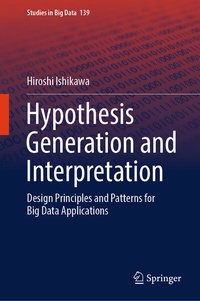
Hypothesis Generation and Interpretation
Description

The novel methods and technologies proposed in Hypothesis Generation and Interpretation are supported by the incorporation of historical perspectives on science and an emphasis on the origin and development of the ideas behind their design principles and patterns.
Academic investigators and practitioners working on the further development and application of hypothesis generation and interpretation in big data computing, with backgrounds in data science and engineering, or the study of problem solving and scientific methods or who employ those ideas in fields like machine learning will find this book of considerable interest.More details
Other editions
Additional editions
Person
He has published actively in international, refereed journals and conferences, such as ACM Transactions on Database Systems , IEEE Transactions on Knowledge and Data Engineering , The VLDB Journal , IEEE International Conference on Data Engineering, and ACM SIGSPATIAL and Management of Emergent Digital EcoSystems (MEDES). He has authored and co-authored a dozen books, including Social Big Data Mining (CRC, 2015) and Object-Oriented Database System (Springer-Verlag, 1993).
He received the Sakai Memorial Distinguished Award from the Information Processing Society of Japan (IPSJ) in 1994, Commendation by the Director General of Science and Technology Agency of Japan in 1997, Commendation for Science and Technology by the Minister of Education, Culture, Sports, Science and Technology of Japan in 2021, and Commendation from the Database Society of Japan in 2022. He was twice an invited professor at the Polytechnic School of the University of Nantes, France. He was a trustee board member of the Database Society of Japan, an editorial board member of The VLDB Journal , the chairman of the SIG on Database Systems of IPSJ, and an editor-in-chief of IPSJ Trans. on Databases . He is a co-founder of ACM MEDES conference. He is a Fellow of the IPSJ and the Institute of Electronics, Information and Communication Engineers (IEICE) and a member of both the ACM and the IEEE.