

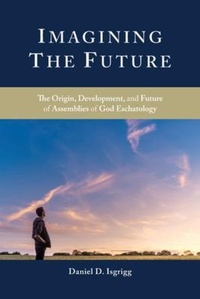
Imagining the Future
Description

Since the beginning of the Assemblies of God, the doctrine of the Second Coming of Christ
has featured prominently in their proclamation of the Pentecostal gospel. Many early believers
passionately proclaimed by the Spirit, "Jesus is coming soon!" Yet in many churches today,
teaching on the Second Coming of Christ has fallen into a period of neglect. Is the Assemblies of
God losing its faith in "the Blessed Hope?"
Imagining the Future answers this question by exploring the development of Assemblies of God
eschatological doctrines and their role as a central pillar of the fellowship's Pentecostal ethos.
Through critical historical assessment, Daniel Isgrigg sheds new light upon existing assumptions
about its dispensational orientation and the inherent incompatibility of that orientation with
Pentecostal theology. Drawing from the deep wells of the past, Isgrigg uncovers a hopeful and
Spirit-inspired eschatology that imagines the future for a new generation of Pentecostal believers.
"A thorough, comprehensive and complex analysis of the origin and development of the eschatological thinking in one of the largest and most important Pentecostal denominations in the world, Assemblies of God (AG). Isgrigg offers a fascinating, constructive proposal for a contemporary pneumatological eschatology building on the huge potential of the pneumatological imagination which leads into a consequent eschatological imagination, as the Holy Spirit is the Spirit of the 'last days' and so the eschatological end is conceived as the future work of the Spirit."
Corneliu Constantineanu, Ph.D.
Professor of Pentecostal Theology, Aurel Vlaicu University of Arad, Romania
"This books stimulates much needed thought on eschatology within the AG and Pentecostal communities and be a blessing to both. Isgrigg combines thorough historical analysis with informed and insightful theological reflection. He writes clearly and with an irenic spirit. The result is a wonderful encouragement to the AG community to engage in much needed reflection on the contours, purpose, and impact of our eschatology."
Robert P. Menzies, Ph.D.
Director, Asia Center for Pentecostal Theology
"This fine and multi-layered study of American Assemblies of God shows how it has adjusted fundamental interpretations of its eschatology in the face of a changing world. This is a vigorous and expertly documented account that deserves to be widely read, not least because the church has a pressing need to revisit its expectations of humanity's future."
William K Kay, D.D.
Emeritus Professor, Wrexham Glyndwr University
"Isgrigg's meticulously researched and engagingly written monograph on eschatology in the Assemblies of God provides not only the first comprehensive historical and theological treatment of the development of AG eschatology throughout the movement's entire history, particularly as it relates to dispensationalism, but also makes the important theological contribution of an emphasis on pneumatological imagination, calling for both a renewed focus on and hopeful expectation for the Holy Spirit's work in eschatological signs. I highly recommend this book for ministers, scholars, and all who eagerly await the Blessed Hope."
Alicia R. Jackson, Ph.D.
Assistant Professor, Vanguard University
More details
Person
Content
Preface ...................................................................................................... ix
Part One: The Origins of Assemblies of God Eschatology
Chapter 1: The Soon Coming King ........................................................ 3
Chapter 2: The Landscape of Assemblies of God Eschatology ............... 19
Chapter 3: The Statement of Fundamental Truths ................................ 41
Chapter 4: Eschatological Controversies ................................................. 69
Chapter 5: Analysis of Assemblies of God Eschatology .......................... 95
Part Two: The Development of Assemblies of God Eschatology
Chapter 6: Establishment Period (1914-1927) ...................................... 101
Chapter 7: Scholastic Period (1927-1948) ............................................. 125
Chapter 8: Institutional Period (1948-1961) ......................................... 137
Chapter 9: Evangelical Period (1961-1985) ........................................... 151
Chapter 10: Modern Period (1985-Present) ........................................... 167
Chapter 11: Toward an Assemblies of God Eschatology ......................... 177
Part Three: The Future of Assemblies of God Eschatology
Chapter 12: Imagining the Future of Assemblies of God Eschatology 197
Chapter 13: Images of Hope: Toward a Pneumatological Eschatology .. 213
Chapter 14: A Future for the Eschatological Fundamental Truths ......... 265
Chapter 15: Conclusion .......................................................................... 277
Bibliography ............................................................................................. 281
Major Name and Subject Index ............................................................... 297
