

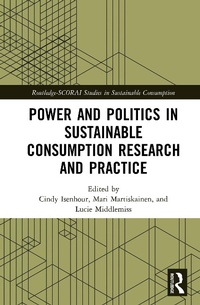
Power and Politics in Sustainable Consumption Research and Practice
1st Edition
Published on 4. March 2019
220 pages
978-1-351-67730-1 (ISBN)
Description

With growing awareness of environmental deterioration, atmospheric pollution and resource depletion, the last several decades have brought increased attention and scrutiny to global consumption levels. However, there are significant and well documented limitations associated with current efforts to encourage more sustainable consumption patterns, ranging from informational and time constraints to the highly individualizing effect of market-based participation.
This volume, featuring essays solicited from experts engaged in sustainable consumption research from around the world, presents empirical and theoretical illustrations of the various means through which politics and power influence (un)sustainable consumption practices, policies and perspectives. With chapters on compelling topics including collective action, behaviour-change and the transition movement, the authors discuss why current efforts have largely failed to meet environmental targets and explore promising directions for research, policy and practice.
Featuring contributions that will help the reader open up politics and power in ways that are accessible and productive and bridge the gaps with current approaches to sustainable consumption, this book will be of great interest to students and scholars of sustainable consumption and the politics of sustainability.
This volume, featuring essays solicited from experts engaged in sustainable consumption research from around the world, presents empirical and theoretical illustrations of the various means through which politics and power influence (un)sustainable consumption practices, policies and perspectives. With chapters on compelling topics including collective action, behaviour-change and the transition movement, the authors discuss why current efforts have largely failed to meet environmental targets and explore promising directions for research, policy and practice.
Featuring contributions that will help the reader open up politics and power in ways that are accessible and productive and bridge the gaps with current approaches to sustainable consumption, this book will be of great interest to students and scholars of sustainable consumption and the politics of sustainability.
Reviews / Votes
"This timely, accessible, and thought-provoking collection brings together leading scholars to deftly explore the systems and norms keeping us on pathways to social and ecological disintegration. It is a vital reminder that there are no easy wins when it comes to changing production and consumption patterns, with the authors facing key challenges head-on. An essential read for policy makers, change agents, business leaders, and researchers alike." -- Kersty Hobson, University of Cardiff, UK"The authors of this book do not flinch from asking the hardest questions about the causes of climate change, the defining crisis of our time. They move the discussion of consumption and sustainability forward in new and important directions and challenge a lot of the accepted wisdom. Essential reading for anyone searching for ways to promote a more sustainable kind of consumer culture." -- Richard Wilk, Distinguished Professor Emeritus at Indiana University, and Director of the Open Anthropology Institute, USA
"This is a bold and engaging book that tells it like it is: research, policy and practice in sustainable consumption have failed to take power, politics and social difference seriously. And in answer to this claim is offered a set of theoretically and empirically rich chapters by leading experts from around the world that critically interrogate a wide range of intersecting themes at multiple levels. It is exactly the kind of collection needed to shake up this emerging interdisciplinary field." -- Sherilyn MacGregor, Sustainable Consumption Institute and Politics Department, The University of Manchester, UK
"This book studies the trajectories of increasing household debt in the contexts of the USA, the UK, Germany, the Netherlands, Finland, and Norway. The author examines remedies to prevent and alleviate the over-indebtedness "epidemic," creating a conceptual framework with which to analyse the causes and consequences of debt. Hiilamo calls for and outlines social policies to tackle the current borrowing crisis that endangers and prevents the full participation in society of individuals with excessive debts."
- L. A. Reisch and F. C. Doebbe, Book Notes "Economics and Social Sciences", Journal of Consumer Policy
More details
Series
Edition
1. Auflage
Language
English
Place of publication
London
United Kingdom
Publishing group
Taylor & Francis Ltd
Target group
College/higher education
Product notice
Reflowable
Illustrations
3 Tables, black and white; 7 Line drawings, black and white; 7 Illustrations, black and white
File size
0,95 MB
ISBN-13
978-1-351-67730-1 (9781351677301)
Copyright in bibliographic data and cover images is held by Nielsen Book Services Limited or by the publishers or by their respective licensors: all rights reserved.
Schweitzer Classification
Other editions
Additional editions
Cindy Isenhour | Mari Martiskainen | Lucie Middlemiss
Power and Politics in Sustainable Consumption Research and Practice
Book
12/2020
1st Edition
Routledge
€59.51
Shipment within 15-20 days
Book
10/2019
Routledge
Unfortunately, price unknown
Available (delivery time upon request)
Cindy Isenhour | Mari Martiskainen | Lucie Middlemiss
Power and Politics in Sustainable Consumption Research and Practice
Book
03/2019
1st Edition
Routledge
€233.00
Shipment within 10-20 days
Persons
Cindy Isenhour is Associate Professor in the Department of Anthropology and in the Climate Change Institute at the University of Maine, USA.
Mari Martiskainen is a Research Fellow at Science Policy Research Unit (SPRU), University of Sussex, UK
Lucie Middlemiss is Associate Professor in Sustainability, and Co-director of the Sustainability Research Institute, in the School of Earth and Environment at the University of Leeds, UK.
Mari Martiskainen is a Research Fellow at Science Policy Research Unit (SPRU), University of Sussex, UK
Lucie Middlemiss is Associate Professor in Sustainability, and Co-director of the Sustainability Research Institute, in the School of Earth and Environment at the University of Leeds, UK.
Content
List of Figures
List of Tables
Author Biographies
Introduction
Power, Politics and Unsustainable Consumption
Lucie Middlemiss, Cindy Isenhour, Mari Martiskainen
Section I: On Political Economy and Sustainable Consumption
A Consuming Globalism: On Power and the Post-Paris Agreement Politics of Climate and Consumption
Cindy Isenhour
Practice Does Not Make Perfect: Sustainable Consumption, Practice Theory and the Question of Power
Dennis Soron
Sources of Power for Sustainable Consumption: Where to Look
Doris Fuchs, Sylvia Lorek, Antonietta Di Giulio, Rico Defila
Section II: On Governmentality and the Notion of the Subject in Sustainable Consumption
Pro-environmental Behaviour Change and Governmentality: Counter-Conduct and the Making up of Environmental Individuals
Tom Hargreaves
Freedom, Autonomy and Sustainable Behaviours: The Politics of Designing Consumer Choice
Tobias Gumbert
The 'Double Dividend' Discourse in Sustainable Consumption: A Critical Commentary
Lucie Middlemiss, David Wingate and Anna Wesselink
Section III: On the Politics of Identity and Difference in Sustainable Consumption
Housing as a Function of Consumption and Production in the United Kingdom
Mari Martiskainen
Power and Politics in the (Work-Life) Balance: A Mixed Methods Evaluation of the Risks and Rewards of Downshifting
Jacob Hammond & Emily Huddart Kennedy
Who Participates in Community-Based Sustainable Consumption Projects and Why Does It Matter? A Constructively Critical Approach
Manisha Anantharaman, Emily Huddart Kennedy, Lucie Middlemiss and Sarah Bradbury
Index
List of Tables
Author Biographies
Introduction
Power, Politics and Unsustainable Consumption
Lucie Middlemiss, Cindy Isenhour, Mari Martiskainen
Section I: On Political Economy and Sustainable Consumption
A Consuming Globalism: On Power and the Post-Paris Agreement Politics of Climate and Consumption
Cindy Isenhour
Practice Does Not Make Perfect: Sustainable Consumption, Practice Theory and the Question of Power
Dennis Soron
Sources of Power for Sustainable Consumption: Where to Look
Doris Fuchs, Sylvia Lorek, Antonietta Di Giulio, Rico Defila
Section II: On Governmentality and the Notion of the Subject in Sustainable Consumption
Pro-environmental Behaviour Change and Governmentality: Counter-Conduct and the Making up of Environmental Individuals
Tom Hargreaves
Freedom, Autonomy and Sustainable Behaviours: The Politics of Designing Consumer Choice
Tobias Gumbert
The 'Double Dividend' Discourse in Sustainable Consumption: A Critical Commentary
Lucie Middlemiss, David Wingate and Anna Wesselink
Section III: On the Politics of Identity and Difference in Sustainable Consumption
Housing as a Function of Consumption and Production in the United Kingdom
Mari Martiskainen
Power and Politics in the (Work-Life) Balance: A Mixed Methods Evaluation of the Risks and Rewards of Downshifting
Jacob Hammond & Emily Huddart Kennedy
Who Participates in Community-Based Sustainable Consumption Projects and Why Does It Matter? A Constructively Critical Approach
Manisha Anantharaman, Emily Huddart Kennedy, Lucie Middlemiss and Sarah Bradbury
Index
