

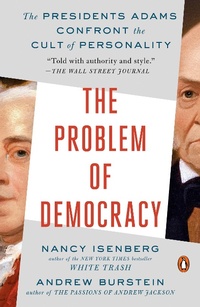
The Problem of Democracy
The Presidents Adams Confront the Cult of Personality
Published on 16. April 2019
576 pages
978-0-525-55751-7 (ISBN)
Description

"Told with authority and style. . . Crisply summarizing the Adamses' legacy, the authors stress principle over partisanship."--The Wall Street Journal
How the father and son presidents foresaw the rise of the cult of personality and fought those who sought to abuse the weaknesses inherent in our democracy, from the New York Times bestselling author of White Trash.
John and John Quincy Adams: rogue intellectuals, unsparing truth-tellers, too uncensored for their own political good. They held that political participation demanded moral courage. They did not seek popularity (it showed). They lamented the fact that hero worship in America substituted idolatry for results; and they made it clear that they were talking about Benjamin Franklin, George Washington, Thomas Jefferson, and Andrew Jackson.
When John Adams succeeded George Washington as President, his son had already followed him into public service and was stationed in Europe as a diplomat. Though they spent many years apart--and as their careers spanned Europe, Washington DC, and their family home south of Boston--they maintained a close bond through extensive letter writing, debating history, political philosophy, and partisan maneuvering.
The problem of democracy is an urgent problem; the father-and-son presidents grasped the perilous psychology of politics and forecast what future generations would have to contend with: citizens wanting heroes to worship and covetous elites more than willing to mislead. Rejection at the polls, each after one term, does not prove that the presidents Adams had erroneous ideas. Intellectually, they were what we today call "independents," reluctant to commit blindly to an organized political party. No historian has attempted to dissect their intertwined lives as Nancy Isenberg and Andrew Burstein do in these pages, and there is no better time than the present to learn from the American nation's most insightful malcontents.
How the father and son presidents foresaw the rise of the cult of personality and fought those who sought to abuse the weaknesses inherent in our democracy, from the New York Times bestselling author of White Trash.
John and John Quincy Adams: rogue intellectuals, unsparing truth-tellers, too uncensored for their own political good. They held that political participation demanded moral courage. They did not seek popularity (it showed). They lamented the fact that hero worship in America substituted idolatry for results; and they made it clear that they were talking about Benjamin Franklin, George Washington, Thomas Jefferson, and Andrew Jackson.
When John Adams succeeded George Washington as President, his son had already followed him into public service and was stationed in Europe as a diplomat. Though they spent many years apart--and as their careers spanned Europe, Washington DC, and their family home south of Boston--they maintained a close bond through extensive letter writing, debating history, political philosophy, and partisan maneuvering.
The problem of democracy is an urgent problem; the father-and-son presidents grasped the perilous psychology of politics and forecast what future generations would have to contend with: citizens wanting heroes to worship and covetous elites more than willing to mislead. Rejection at the polls, each after one term, does not prove that the presidents Adams had erroneous ideas. Intellectually, they were what we today call "independents," reluctant to commit blindly to an organized political party. No historian has attempted to dissect their intertwined lives as Nancy Isenberg and Andrew Burstein do in these pages, and there is no better time than the present to learn from the American nation's most insightful malcontents.
More details
Other editions
Additional editions
Nancy Isenberg | Andrew Burstein
The Problem of Democracy
The Presidents Adams Confront the Cult of Personality
Book
04/2020
Penguin USA
€19.00
Shipment within 10-20 days
Nancy Isenberg | Andrew Burstein
The Problem of Democracy
The Presidents Adams Confront the Cult of Personality
Book
05/2019
Thorndike Press
€53.41
Article exhausted; check different version
Nancy Isenberg | Andrew Burstein
The Problem of Democracy
The Presidents Adams Confront the Cult of Personality
Book
04/2019
Viking
€52.20
Article exhausted; check different version
Persons
Nancy Isenberg is the T. Harry Williams Professor of American History at Louisiana State University, and the author of the New York Times bestseller White Trash: The 400-Year Untold History of Class in America, and two award-winning books, Fallen Founder: The Life of Aaron Burr and Sex and Citizenship in Antebellum America. She is the coauthor, with Andrew Burstein, of Madison and Jefferson.
Andrew Burstein is the Charles P. Manship Professor of History at Louisiana State University, a noted Jefferson scholar, and the author of ten previous books on early American politics and culture. These include The Passions of Andrew Jackson, Jefferson's Secrets, and Democracy's Muse. He and Nancy Isenberg have coauthored regular pieces for national news outlets.
Andrew Burstein is the Charles P. Manship Professor of History at Louisiana State University, a noted Jefferson scholar, and the author of ten previous books on early American politics and culture. These include The Passions of Andrew Jackson, Jefferson's Secrets, and Democracy's Muse. He and Nancy Isenberg have coauthored regular pieces for national news outlets.
