

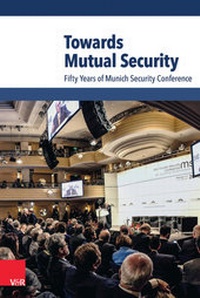
Towards Mutual Security
Fifty Years of Munich Security Conference. Hg.Stiftung Münchn.Sicherheitskonferenz/Ischinger
1st Edition
Published on 22. January 2014
477 pages
978-3-647-30054-2 (ISBN)
Description

Die 1963 als Internationale Wehrkundebegegnung gegründete Münchner Sicherheitskonferenz hat sich mittlerweile zum führenden unabhängigen Forum für Sicherheitspolitik entwickelt. Traditionell eher als eine Art transatlantisches Familientreffen begriffen, auf dem während des Kalten Krieges die NATO-Strategie diskutiert wurde, hat die Konferenz seither ihre Agenda stetig erweitert und zieht heute Teilnehmer aus aller Welt an. Im Rahmen der jährlichen Hauptkonferenz treffen sich jedes Jahr in München Dutzende Staats- und Regierungschefs, Minister und Experten aus allen Bereichen der Sicherheitspolitik für einen offenen Austausch von Ideen und Politikansätzen zu den drängendsten Problemen der internationalen Sicherheit. Zu den debattierten Themenfeldern gehören neben regionalen Konflikten, internationalen Friedensmissionen und nuklearer Abrüstung auch Fragen der Cybersicherheit oder energie- und umweltpolitische Herausforderungen.Zum Autorenkreis gehören u.a. amtierende und ehemalige Außen- und Verteidigungsminister, Staats- und Regierungschefs sowie Mitglieder des US-Kongresses und des Deutschen Bundestages.
More details
Other editions
Additional editions

Book
01/2014
1st Edition
Vandenhoeck & Ruprecht
€65.00
Shipment within 5-7 days
Persons
Editor
Wolfgang Ischinger ist seit 2008 Vorsitzender der Münchner Sicherheitskonferenz und berät die Allianz SE. Der Karrierediplomat war u.a. Leiter des Planungsstabs, Politischer Direktor und Staatssekretär im Auswärtigen Amt sowie deutscher Botschafter in den USA und im Vereinigten Königreich.
Associate editor
Content
- Cover
- Title Page
- Copyright
- Table of Contents
- Body
- Acknowledgments
- Anniversary Messages
- Angela Merkel: Message from the Federal Chancellor to Mark the Fiftieth Anniversary of the Munich Security Conference
- Joseph R. Biden: Congratulating the Munich Security Conference on Fifty Years of Contributions to Transatlantic Security
- Wolfgang Reitzle: The 50th Munich Security Conference - Security Policy in the Era of Globalization
- The Chairmen
- Wolfgang Ischinger: Towards Mutual Security: From Wehrkunde to the Munich Security Conference
- Horst Teltschik: The Munich Conference on Security Policy - Continuity and Change
- John McCain: Remembering Ewald von Kleist
- Peter C. Hughes and Theresa M. Sandwith: Ewald-Heinrich von Kleist: The Man behind Wehrkunde
- Wehrkunde and the Cold War
- Theo Sommer in Conversation with Helmut Schmidt
- Lothar Rühl: The Discussions in the Critical Period of the East-West Conflict from the Mid-Sixties to the Early Nineties
- Uwe Nerlich: Wehrkunde and the Transatlantic Nuclear Discourse
- Egon Bahr: "The Shorter the Range, the Deader the Germans"
- Karl Kaiser: NATO's Double-Track Decision, the Peace Movement, and Arms Control
- Richard Burt: Wehrkunde and the End of the Cold War
- Sam Nunn: Countering Nuclear Threats: From Cold War Wehrkunde to Today's Munich Security Conference
- New Challenges after the End of the Cold War
- Carl Bildt: Why Didn't We Stop the Bosnia War Earlier? Thoughts and Lessons
- Ulrich Weisser: From the Fall of the Berlin Wall to the Admission of New Members to NATO
- Klaus Naumann: The 1999 Munich Conference on Security Policy-Paving the Way for the Kosovo Air Campaign Operation Allied Force
- Rudolf Scharping: Key Meetings at the Margins-Kosovo and the Munich Conference
- George Robertson: The Margins at Munich: The Conference from Kosovo to Iraq
- James L. Jones: The Munich Security Conference in the Post-9/11 Era
- Kerstin Müller: The Iraq War and the Transatlantic Rift
- Javier Solana: Capacity for Adaptation: The Munich Conference and European Security
- Euro-Atlantic Security in a Globalized World
- John Kerry: Transatlantic Ties That Must Still Bind
- Guido Westerwelle: Peace and Security in Germany, Europe, and the World
- Thomas de Maizière: The Transatlantic Partnership-The Foundation of German Security Policy
- Chuck Hagel: The Munich Security Conference at Fifty: The Challenge of Change
- Anders Fogh Rasmussen: Keeping NATO Strong
- James Stavridis: NATO: Quo Vadis?
- Ruprecht Polenz: The United States, Europe, and a Pivot to Reality
- Constanze Stelzenmüller: Indispensable Partners in an Uncertain World
- Frank-Walter Steinmeier: Euro-Atlantic Security: Before and after the "Reset"
- Igor S. Ivanov: The Munich Security Conference and the Russia-NATO Relationship
- Volker Perthes: Enter the Arab People: The Munich Security Conference, the Middle East, and the Arab Revolts
- Omid Nouripour: Not the Whole Picture: The History of the Incomplete Answer to Iran's Nuclear Threat
- Kevin Rudd: Europe, the United States, and the Rise of the Asia-Pacific
- Eberhard Sandschneider: Asia's Rise and Asia's Risks
- Nikolaus von Bomhard: Climate Change and Its Impact on Security
- Friedbert Pflüger: The Shifting Geopolitics of Energy-The Green and Shale Revolution
- Jane Harman: Moving the Conversation Forward on Nuclear Disarmament
- Anne-Marie Slaughter: To Tweet or Not to Tweet? The Impact of Social Media on Global Politics
- Keith B. Alexander: The New Frontier: Cyberspace and International Security
- Toomas Hendrik Ilves: Cyberspace and International Security
- Spotlights on the Conference
- Joseph I. Lieberman: A Constant Reminder of the Transatlantic Alliance's Strategic and Moral Imperative
- Hans-Ulrich Klose: Good Arguments Are What Matters
- William S. Cohen: Little Patience for Frivolous Speeches-A Personal Remembrance of Wehrkunde and Ewald-Heinrich von Kleist
- Charles Powell: The Munich Security Conference: A British Perspective
- Jim Hoagland: The German-American Relationship Remains at the Conference's Heart
- Stefan Kornelius: Talking Points. The Conference between Genuine Debate, Catwalk, and Public Ambiguity
- Ulrich Wilhelm: From Munich to the World:Broadcasting the MSC
- Catherine McArdle Kelleher: "I Didn't Know They Were Letting Girls Go to Wehrkunde"
- Klaus Wehmeier and Thomas Paulsen: The Munich Young Leaders
- Josef Joffe: Fasching, Family Reunions, and Hard Power. The Munich Security Conference, the Alliance, and International Security-A Very Personal Remembrance
- Mutual Security in the Twenty-First Century
- Joseph S. Nye, Jr.: The Future of Power inthe Twenty-First Century
- Strobe Talbott: Atlanticism in the Era of Globalization
- François Heisbourg: The Future Isn't What It Used to Be
- Radoslaw Sikorski: Munich Security Conference 1963-2063: The European Union as a Superpower?
- Appendix
- Image Credits
- List of Abbreviations
- Back Cover
