

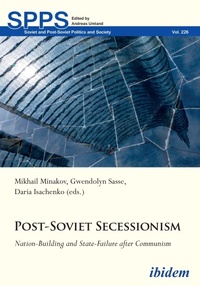
Post-Soviet Secessionism
Nation-Building and State-Failure after Communism
Published on 20. April 2021
260 pages
978-3-8382-9092-8 (ISBN)
Description

The USSR's dissolution resulted in the creation of not only fifteen recognized states but also of four non-recognized statelets: Nagorno-Karabakh, South Ossetia, Abkhazia, and Transnistria. Their polities comprise networks with state-like elements. Since the early 1990s, the four pseudo-states have been continously dependent on their sponsor countries (Russia, Armenia), and contesting the territorial integrity of their parental nation-states Azerbaijan, Georgia, and Moldova. In 2014, the outburst of Russia-backed separatism in Eastern Ukraine led to the creation of two more para-states, the Donetsk People's Republic (DNR) and the Luhansk People's Republic (LNR), whose leaders used the experience of older de facto states. In 2020, this growing network of de facto states counted an overall population of more than 4 million people.
The essays collected in this volume address such questions as: How do post-Soviet de facto states survive and continue to grow? Is there anything specific about the political ecology of Eastern Europe that provides secessionism with the possibility to launch state-making processes in spite of international sanctions and counteractions of their parental states? How do secessionist movements become embedded in wider networks of separatism in Eastern and Western Europe? What is the impact of secessionism and war on the parental states?
The contributors are Jan Claas Behrends, Petra Colmorgen, Bruno Coppieters, Nataliia Kasianenko, Alice Lackner, Mikhail Minakov, and Gwendolyn Sasse.
The essays collected in this volume address such questions as: How do post-Soviet de facto states survive and continue to grow? Is there anything specific about the political ecology of Eastern Europe that provides secessionism with the possibility to launch state-making processes in spite of international sanctions and counteractions of their parental states? How do secessionist movements become embedded in wider networks of separatism in Eastern and Western Europe? What is the impact of secessionism and war on the parental states?
The contributors are Jan Claas Behrends, Petra Colmorgen, Bruno Coppieters, Nataliia Kasianenko, Alice Lackner, Mikhail Minakov, and Gwendolyn Sasse.
More details
Series
Edition
New edition
Language
English
Place of publication
Hannover
Germany
Target group
Professional and scholarly
Edition type
New edition
Product notice
Reflowable
Illustrations
Illustrations
File size
3,44 MB
ISBN-13
978-3-8382-9092-8 (9783838290928)
Copyright in bibliographic data and cover images is held by Nielsen Book Services Limited or by the publishers or by their respective licensors: all rights reserved.
Schweitzer Classification
Other editions
Additional editions
Daria Isachenko | Mykhailo Minakov | Gwendolyn Sasse
Post-Soviet Secessionism
Nation-Building and State-Failure after Communism
Book
04/2021
ibidem
€34.90
Shipment within 10-15 days
Persons
The editors:
Dr. Daria Isachenko is Research Fellow at the Centre for Applied Turkey Studies of the German Institute for International and Security Affairs (SWP) in Berlin. She is the author of, among others, The Making of Informal States: Statebuilding in Northern Cyprus and Transdniestria (Palgrave Macmillan 2012).
Dr. Mikhail Minakov is Senior Advisor at The Kennan Institute of the Woodrow Wilson Center in Washington, DC, and editor-in-chief of the Ideology and Politics Journal. He is the author of, among others, Development and Dystopia: Studies in Post-Soviet Ukraine and Eastern Europe (ibidem-Verlag 2018).
Dr. Gwendolyn Sasse is Director of the Centre for East European and International Studies (ZOiS) in Berlin and Professor of Comparative Politics at the University of Oxford. She is the author of, among others, The Crimea Question: Identity, Transition, and Conflict (Harvard University Press 2007).
Dr. Daria Isachenko is Research Fellow at the Centre for Applied Turkey Studies of the German Institute for International and Security Affairs (SWP) in Berlin. She is the author of, among others, The Making of Informal States: Statebuilding in Northern Cyprus and Transdniestria (Palgrave Macmillan 2012).
Dr. Mikhail Minakov is Senior Advisor at The Kennan Institute of the Woodrow Wilson Center in Washington, DC, and editor-in-chief of the Ideology and Politics Journal. He is the author of, among others, Development and Dystopia: Studies in Post-Soviet Ukraine and Eastern Europe (ibidem-Verlag 2018).
Dr. Gwendolyn Sasse is Director of the Centre for East European and International Studies (ZOiS) in Berlin and Professor of Comparative Politics at the University of Oxford. She is the author of, among others, The Crimea Question: Identity, Transition, and Conflict (Harvard University Press 2007).
