

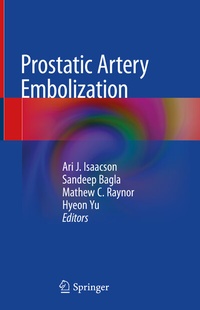
Prostatic Artery Embolization
Description

This book comprehensively covers prostatic artery embolization (PAE) in interventional radiology (IR). PAE is a recently developed procedure primarily for the treatment of benign prostatic hyperplasia (BPH). BPH is an extremely common problem, affecting the urination of about half of men over the age of 50. PAE is a minimally invasive IR procedure that improves urinary symptoms secondary to BPH and, unlike most available BPH treatments, carries very little risk of compromising sexual function. It should be noted, however, that PAE is known to be a very difficult procedure due to the variations in pelvic arterial anatomy and small diameter of the target vessels. Because of the inherent challenge, interventional radiologists need resources to learn how to perform PAE, so they can add this exciting new procedure to their practice.
This comprehensive, yet compact, text covers everything from patient evaluation, through procedure, and finally how to deal with failureor repeat procedures. Expert authors who are responsible for more than a third of PAEs performed in the United States include best practices and detailed steps for performing PAE, with potential pitfalls and related issues considered. Readers should come away from reading the text feeling confident in being able to provide PAE to their patients, whether it be for BPH, hemorrhage, or hematuria. This is an ideal guide for interventional radiologists hoping to learn or improve their skills for PAE.
More details
Other editions
Additional editions
Persons
Ari J. Isaacson, MD, Department of Radiology, University of North Carolina School of Medicine, Chapel Hill, NC, USA
Hyeon Yu, MD, Division of Vascular and Interventional Radiology, Department of Radiology, University of North Carolina School of Medicine, Chapel Hill, NC, USA
Mathew C. Raynor, MD, Department of Urology, UNC Hospitals, Chapel Hill, NC, USA
Sandeep Bagla, MD, Chair of Vascular & Interventional Radiology, Vascular Institute of Virginia, Woodbridge, Virginia, USA
Adjunct Clinical Associate Professor of Radiology
UNC Chapel Hill, NC, USA
Content
The Prostate and Benign Prostatic Hyperplasia.- Diagnosis of Benign Prostatic Hyperplasia.- Medical Management of Benign Prostatic Hyperplasia.- Indications for Surgical Management of Benign Prostatic Hyperplasia.- Imaging of the Prostate.- Pre-Clinical and Clinical Evidence for Prostatic Artery Embolization.- Arterial Anatomy for Prostatic Artery Embolization.- Patient Selection for Prostatic Artery Embolization.- Preprocedural Imaging for Prostatic Artery Embolization.- Intraprocedural Techniques for Prostatic Artery Embolization.- Post-Procedural Care and Complication Management for Prostatic Artery Embolization.- Failed and Repeat Prostatic Artery Embolization.
