

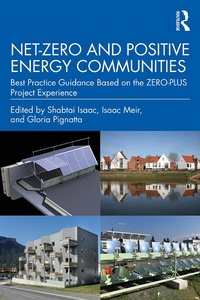
Net-Zero and Positive Energy Communities
Best Practice Guidance Based on the ZERO-PLUS Project Experience
1st Edition
Published on 12. December 2023
224 pages
978-1-003-81109-1 (ISBN)
Description

This book presents a methodology for the design, construction, monitoring, optimization, and post-occupancy evaluation of net-zero and positive-energy communities based on the experiences gained in the EU Horizon 2020 ZERO-PLUS project. It describes the steps, tools, and methods developed during the project, providing practical information for the energy and construction sector that will be of interest to students, engineers, architects, developers, and professionals working around high performance architecture and sustainable communities.
Through the ZERO-PLUS project, a consortium of 32 partners from eight countries, including academic institutions, technology providers, architects, and construction companies, designed four communities covering completely different geo-climatic regions, construction practices, and cultural backgrounds in Cyprus, Italy, France, and the UK. The communities were designed, optimized, constructed, monitored, handed over to tenants, post-occupancy evaluated, and troubleshooted through a system of continuous collaboration and data acquisition. This book presents these case studies and shows how the project targets of reducing electricity consumption below 20 kWh/m2/y, increasing electricity production from Renewable Energy Systems to over 50 kWh/m2/y, and at cheaper costs when compared to current zero-energy buildings were reached and surpassed. These cases demonstrate that a holistic and interactive approach to design and construction can bring communities a high standard of sustainability.
The key features of the book include:
Practical guidance drawn from the interdisciplinary, international, and remote cooperation between experts from academia and industry across the construction sector
A survey of the state-of-the-art on net-zero and positive-energy communities, including the experience and the lessons learned from previous projects and from the ZERO-PLUS project
Descriptions of novel emerging renewable energy technologies, integrated into real case study communities to achieve the energy generation target of the communities
A comprehensive set of approaches, tools, guidelines, best practices, challenges, and lessons learned from the five-year ZERO-PLUS project and the completion of four residential case studies to inform the reader of how to achieve affordable net-zero energy communities
Four typologies of residential communities located in different climatic conditions are presented, touching on the critical aspects of the design, construction, monitoring, and occupancy phase
A discussion of future trends for developing communities that are more liveable, accessible, and sustainable and which can comply with new energy policies in a way that is affordable for the owners and residents.
Through the ZERO-PLUS project, a consortium of 32 partners from eight countries, including academic institutions, technology providers, architects, and construction companies, designed four communities covering completely different geo-climatic regions, construction practices, and cultural backgrounds in Cyprus, Italy, France, and the UK. The communities were designed, optimized, constructed, monitored, handed over to tenants, post-occupancy evaluated, and troubleshooted through a system of continuous collaboration and data acquisition. This book presents these case studies and shows how the project targets of reducing electricity consumption below 20 kWh/m2/y, increasing electricity production from Renewable Energy Systems to over 50 kWh/m2/y, and at cheaper costs when compared to current zero-energy buildings were reached and surpassed. These cases demonstrate that a holistic and interactive approach to design and construction can bring communities a high standard of sustainability.
The key features of the book include:
Practical guidance drawn from the interdisciplinary, international, and remote cooperation between experts from academia and industry across the construction sector
A survey of the state-of-the-art on net-zero and positive-energy communities, including the experience and the lessons learned from previous projects and from the ZERO-PLUS project
Descriptions of novel emerging renewable energy technologies, integrated into real case study communities to achieve the energy generation target of the communities
A comprehensive set of approaches, tools, guidelines, best practices, challenges, and lessons learned from the five-year ZERO-PLUS project and the completion of four residential case studies to inform the reader of how to achieve affordable net-zero energy communities
Four typologies of residential communities located in different climatic conditions are presented, touching on the critical aspects of the design, construction, monitoring, and occupancy phase
A discussion of future trends for developing communities that are more liveable, accessible, and sustainable and which can comply with new energy policies in a way that is affordable for the owners and residents.
More details
Edition
1. Auflage
Language
English
Place of publication
London
United Kingdom
Publishing group
Taylor & Francis Ebooks
Target group
College/higher education
Professional and scholarly
Illustrations
58 Halftones, color; 1 Halftones, black and white; 59 Illustrations, black and white
ISBN-13
978-1-003-81109-1 (9781003811091)
Copyright in bibliographic data and cover images is held by Nielsen Book Services Limited or by the publishers or by their respective licensors: all rights reserved.
Schweitzer Classification
Other editions
Additional editions
Shabtai Isaac | Isaac Meir | Gloria Pignatta
Net-Zero and Positive Energy Communities
Best Practice Guidance Based on the ZERO-PLUS Project Experience
Book
12/2023
1st Edition
Routledge
€231.60
Shipment within 10-20 days
Shabtai Isaac | Isaac Meir | Gloria Pignatta
Net-Zero and Positive Energy Communities
Best Practice Guidance Based on the ZERO-PLUS Project Experience
Book
12/2023
1st Edition
Routledge
€79.40
Shipment within 10-20 days
Persons
Shabtai Isaac is a Senior Lecturer in Project Management at Ben Gurion University of the Negev, Israel.
Isaac Meir is Architect, Town Planner, Archaeologist, and Professor at Ben Gurion University of the Negev, Israel.
Gloria Pignatta is Scientia Lecturer and City Futures Research Centre (CFRC) Fellow (2021-2024) in the School of Built Environment (BE), Faculty of Arts, Design, and Architecture (ADA), at University of New South Wales, Australia.
Isaac Meir is Architect, Town Planner, Archaeologist, and Professor at Ben Gurion University of the Negev, Israel.
Gloria Pignatta is Scientia Lecturer and City Futures Research Centre (CFRC) Fellow (2021-2024) in the School of Built Environment (BE), Faculty of Arts, Design, and Architecture (ADA), at University of New South Wales, Australia.
Content
Foreword, 1. Introduction to net-zero and positive-energy communities, 2. Background: the current energy community implementation state in the EU, 3. Methodology: the ZERO-PLUS approach, 4. Part 1: UK case study, Part 2: Energy modeling of positive-energy dwellings, 5. Part 1: Italian case study, Part 2: Community-level strategies for microclimate mitigation and energy efficiency improvement, 6. Part 1: Cypriot case study, Part 2: Production and installation planning, 7. Part 1: French case study, Part 2: Project and design management - best practices and tools, 8. Part 1: Concentrating solar energy - the FAE system, Part 2: Bot-based building design, Part 3: Solar air-conditioning - the Freescoo system, 9. Monitoring and evaluation of the performance of positive-energy communities, 10. Post-occupancy evaluation: the missing link, Conclusions, or a more critical rethinking of the project, Index
