

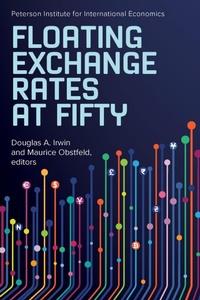
Floating Exchange Rates at Fifty
Description

Fifty years ago, in March 1973, the major industrial economies abandoned fixed exchange rates, conclusively ending the post-World War II Bretton Woods arrangements. Proponents believed their action would strengthen countries' ability to reconcile domestic macroeconomic policies with the balance of payments. But opponents feared it would initiate a new era of instability and financial shocks. Since 1973, much of the world has moved away from fixed exchange rates to a variety of regimes based on considerable exchange rate flexibility. But international trade conflicts and unstable capital flows, along with a rise in financial crises around the world, have nonetheless accompanied the global shift away from exchange rate pegs.
How has the international monetary system performed over the past half century? What have we learned from the experience of more flexible exchange rates? What has been the impact on macroeconomic and financial stability in the years since? This book derives from papers delivered at a conference that brought together leading economists and policymakers to debate and discuss these questions, as well as to assess the evolution of the international monetary system, the dominance of the US dollar, and the role of exchange rate regimes in shaping the world economy.
More details
Other editions
Additional editions
Persons
Maurice Obstfeld is Class of 1958 Professor of Economics at University of California, Berkeley and Chief Economist at the International Monetary Fund. His work has appeared in International Economic Journal, Journal of International Money and Finance, and elsewhere.
Douglas A. Irwin (Edited by)
Douglas A. Irwin, nonresident senior fellow at the Peterson Institute for International Economics, is the John French Professor of Economics at Dartmouth College.
Content
Preface
Acknowledgments
Introduction, by Douglas A. Irwin and Maurice Obstfeld
1 From the Postwar World Economy to the Modern World Economy, 1973-2023, by Maurice Obstfeld
Part I Historical Perspective on 1973 and Its Legacy
2 From There to Here: 1973 Expectations and 2023 Reality, by Edwin M. Truman
3 The Greatest of All International Monetary Reforms, by C. Fred Bergsten
4 The Source of Monetary Instability, 1980-2020, by Robert Z. Aliber
5 Reflections on Flexible Exchange Rates after 50 years, by Anne O. Krueger
6 International Finance in 1973 and 2023: What Changed in Half a Century?, by Richard Portes
Part II Politics, Institutions, and Ideas in International Monetary Evolution
7 The Political Economy of International Monetary Arrangements, by Jeffry Frieden
8 The Euro: A Phoenix Rising from the Ashes of the Dollar?, by Harold James
9 Has Japan Conquered the Fear of Freedom? Reflections on Exchange Rate Systems and Monetary Policy, by Masazumi Wakatabe
10 The Trade-Finance Disconnect: Geopolitical Repricing and Its Consequences, by Yanliang Miao and Zhou Fan
11 Evolving Views on Exchange Rates and Currency Unions, by Linda Tesar
Part III International Prices, International Adjustment, and Trade
12 The Floating Dollar and the Geography of US Manufacturing, by Katheryn Russ
13 Will Persistent Trade Imbalances Become a Problem?, by Joseph E. Gagnon
14 Floating Exchange Rates and Trade Policy, by Douglas A. Irwin
15 Fifty Years of Exchange Rate Pass-Through from a Central Banker's Perspective, by Catherine L. Mann
16 Replacing the Golden Anchor for Price Stability, by Kristin Forbes
Part IV Floating Exchange Rates and Emerging Markets
17 How Much Insulation Do Flexible Exchange Rates Provide for Emerging Markets?, by Andrés Velasco
18 Emerging Markets and the Transition to Stability: Role of Flexible Exchange Rates, by José De Gregorio
19 Why Do Oil Producers in the Middle East and North Africa Still Fix Their Currencies?, by Adnan Mazarei
20 Role of Flexible Exchange Rates in Three Financial Shocks in Indonesia, by Muhamad Chatib Basri
Part V The Dollar and International Financial Markets
21 The Fed's International Dollar Liquidity Facilities and the COVID-19 Period, by Linda S. Goldberg
22 The Dollar-Based Financial System through the Window of the Foreign Exchange Swap Market, by Hyun Song Shin
23 Dollar Dominance in Global Finance and Exchange Rate Policies, by Sebnem Kalemli-Özcan
24 Strengths and Flaws of the Dollar-Based System, by Hélène Rey
Part VI The Futures of the Dollar, the Euro, and the Renminbi
25 "Dollar Rivals": Can the Dollar-Based System Be Improved or Replaced?, by Jeffrey A. Frankel
26 The Dollar Might Slip but Will Still Rule, by Eswar Prasad
27 US and Dollar Dominance in the International Monetary System: Weakening but Not Disappearing, by Philippe Martin
28 50 Years since the End of Bretton Woods, 25 Years since the Launch of the Euro, by Philip R. Lane
29 The Renminbi in the Post-Bretton Woods Era, by Shang-Jin Wei
Index
