

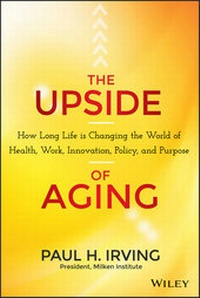
The Upside of Aging
Description

More details
Other editions
Additional editions
Person
Content
Foreword
The economic benefits far outweigh the challenges that come with an aging society. The extension of life, and the extension of healthy life, are positive developments to be celebrated, not feared. Their impact will be an economic boon, not a drag.
What does it mean to be old? We each have our own definition, but we probably agree that the chronological ages that used to define “elderly” are increasingly irrelevant. I’ve had many friends and colleagues who did their most important work in their eighties and nineties. Unfortunately, I’ve also lost far too many family members and dear friends to disease before they had a chance to experience full lives.
When my father was diagnosed and treated for melanoma in the mid-1970s, the doctors thought they had caught the cancer before it spread. A few years later, however, the disease recurred, and by the time it was discovered, the prognosis was terminal. I took Dad to cancer centers around the country and consulted with leading physicians and researchers before it became frustratingly clear that medical science didn’t have a solution. So I moved my family from the East Coast back to California to give my kids and their grandfather a chance to know each other. Dad passed away 10 months later.
In 1993, I was diagnosed with advanced prostate cancer and given 12 to 18 months to live. It was devastating to think that the family continuity I sought after my father’s diagnosis now seemed impossible. There probably would be no chance to see my kids get married and start families of their own.
But the science had improved by then, and I drew upon the network of cancer researchers the Milken Family Foundation had assembled throughout the 1980s. In addition to standard therapies, I consulted nutritionists, eliminated meat from my diet, consulted Eastern medicine, and practiced yoga. There were a lot more tools to draw upon than when my father was diagnosed.
If my father’s cancer had occurred in 1993, he may have survived. Had I received my diagnosis in 1974, I may not have. The great news for my generation is that medical science advanced remarkably in the interim, and it’s moving faster today than ever.
We’re transforming what it means to be “old,” in terms not only of how we perceive aging, but also how we experience it. The personal and social benefits of living longer are priceless, and the economic benefits far outweigh the challenges that come with an aging society. The extension of life, and the extension of healthy life, are positive developments to be celebrated, not feared, and their impact will be an economic boon, not a drag.
The Greatest Achievement in Human History
Over the past two centuries—by far the most prosperous 200 years in human history—at least half of all economic growth can be attributed to advances in public health and medicine that led to longer, healthier lives. To understand just how much life improved in the twentieth century alone, consider the life of Jiroemon Kimura, whose name you may recognize from news stories.
Born in a western Japanese fishing village in 1897, Mr. Kimura is among a very small group of people who lived through the entire twentieth century. He witnessed some of the greatest advances and most transformational inventions in human history: horseless carriages, Marconi’s radio blast across the Atlantic, the Wright brothers’ first flights, the theory of relativity, Fleming’s discovery of penicillin, the exploration of DNA, Salk’s vaccine, Sputnik, heart transplants, man’s first steps on the moon, personal computers, MRIs, cell phones, the Internet, and . . . the list could go on for pages.
Kimura himself accomplished something remarkable: He was recognized by Guinness World Records as the oldest man in recorded history and was the oldest living person on the planet until he passed away at age 116. He attributed his longevity to good nutrition—light and healthy meals—and he stayed active long after his 1962 retirement from the post office, working on his son’s farm.
But of all the advances during his life, Kimura participated in what is perhaps the greatest achievement in the history of civilization: the doubling, in less than one century, of average life spans around the globe.
When Kimura was born, worldwide life expectancy at birth was 31 years. It’s now 70. The United States went from 47 to 79 years. When people pine for the “good old days,” they take for granted just how much things have improved—most notably that we live longer, healthier, and more productive lives.
“What a Drag Thrill It Is Getting Old”
A few years ago, on a sunny Los Angeles morning, I drove up the winding, tree-shaded driveway of my longtime friend Kirk Kerkorian. We were scheduled to play doubles tennis, but I was running late. By the time I arrived, he had found a replacement player to fill my spot. It was a remarkable scene: four players on the court with a combined age of 358 years! Kirk looked young, especially for a 90-year-old. Over lunch, we talked about how playing in their eighties and nineties was different from playing when they were younger. “The guys we play against are thinner these days,” one of them told me, and the others agreed—most of their heavier friends had died years ago. I also noticed that all four men had full, thick heads of hair, but I choose to believe that’s unrelated to their longevity.
Kirk and his friends are an anomaly for that generation. But they represent the promise of what many in my generation will realize—a vibrant, active, and productive life well into their ninth and tenth decades. The late Robert Fogel, a Nobel laureate at the University of Chicago, told me a few years ago that average life span in the developed world will easily exceed 100 within the current century. In fact, it’s probable that the first person who will live to be 150 has already been born. There’s always seemed to be a natural limit to human life, but with advances in genomics, immunology, stem cells, and organ “printing” and transplants, that limit may be much higher than previously thought.
At a recent Milken Institute Global Conference, Dr. Robert Butler of the Alliance for Health and the Future, pointed out that in terms of health, a 60-year-old woman is equivalent to a 40-year-old in 1960. Today’s 80-year-old American man is similar to a 60-year-old as recently as 1975.
To see those numbers come to life, look no further than the Rolling Stones, who recently celebrated their fiftieth anniversary. If you’re able to see them in concert, pay attention to the front rows, with attendees in their sixties and seventies dancing like crazed teenagers. This sight is as inspirational for those of us over 60 as it is unsettling for our grandkids.
Advertisers and the media have taken note and updated how they portray older people. (As well they should: By 2017, nearly half the U.S. population will be over 50 and will control 70 percent of disposable income. This is a population that doesn’t want to be called “old.”) In the late 1980s, LifeCall’s commercials featured a capsized woman, next to her walker, moaning: “I’ve fallen and I can’t get up!” Today, Cialis asks the male segment of her age cohort: “When the moment is right, will you be ready?”
Ron Howard’s 1985 film Cocoon featured Wilford Brimley as the lead actor and part of a group of retirement home residents who were visited by aliens. Brimley was 51 when the movie was released. Imagine a reprisal of that role today by Tom Cruise, Jim Carrey, Steve Carell, or Matthew Broderick—all of whom turned 51 in 2013.
At a conference a few years ago, I estimated the median attendee age was about 35. As a speaker, whatever concern I had about the age gap was allayed when I saw the entertainment: Bob Dylan; Rod Stewart; and Crosby, Stills and Nash. I was the youngest person onstage that night.
The Long View: Never Underestimate Human Ingenuity
The Milken Institute has focused on aging for the past several years. One of my favorite panels remains the 2009 discussion called “Life After 80: Always Looking Forward,” featuring five prominent octogenarians. All the panelists were still active in business and philanthropy. Jim Pattison, chairman of the Jim Pattison Group, who was 80 at the time, said, “Retirement is not in the cards.” (True to his word, he remains chairman of his company as I write this.) For most of the panelists, social interaction was important, too—they echoed the finding that people with more friends live longer. Diet and exercise were also common themes.
While the benefits of extended life spans are undeniable, developed nations also need to make economic adjustments. When America’s Social Security system was introduced in 1935, life expectancy was 61.7 years. It made sense for people to start collecting pension checks as early as age 62. As the program was expanding in the early 1950s, there were 17 workers supporting every beneficiary. By 2012, there were fewer than three workers, and that ratio is expected to drop closer to 2:1 by 2035.
The simplest solution to this challenge is to increase the age at which individuals become eligible for retirement benefits. Ideally, the retirement age...
