

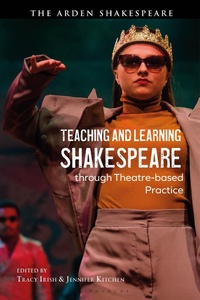
Teaching and Learning Shakespeare through Theatre-based Practice
1st Edition
Published on 28. December 2023
216 pages
978-1-350-29206-2 (ISBN)
Description

How can the study of Shakespeare contribute to equipping young people for the challenges of an uncertain future?
This book argues for the necessity of a Shakespeare education that: finds meaning in the texts through inviting in the prior knowledge, experiences and ideas of students; combines intellectual, social and emotional learning; and develops a critical perspective on what a cultural inheritance is all about. It offers a comprehensive exploration of the educational principles underpinning theatre-based practice and explains how and why this practice can open up the possibilities of Shakespeare study in the classroom. It empowers Shakespeare educators working with young people aged 5-18 to interact critically, creatively and collaboratively with Shakespeare as a living artist.
Drawing on the authors' research and experience with organizations including the Royal Shakespeare Company, Shakespeare's Globe, the Folger and Coram Shakespeare Schools Foundation, Part One consolidates recent developments in the field and engages in lively dialogue with core questions of Shakespeare's place in the classroom. Part Two curates a series of interviews with leaders and practitioners from the above and other Shakespeare institutions, exploring their core principles and practices. Part Three presents chapters from and about classroom teachers, who share their experiences of successfully embedding theatre-based approaches to Shakespeare in their own diverse contexts.
This book argues for the necessity of a Shakespeare education that: finds meaning in the texts through inviting in the prior knowledge, experiences and ideas of students; combines intellectual, social and emotional learning; and develops a critical perspective on what a cultural inheritance is all about. It offers a comprehensive exploration of the educational principles underpinning theatre-based practice and explains how and why this practice can open up the possibilities of Shakespeare study in the classroom. It empowers Shakespeare educators working with young people aged 5-18 to interact critically, creatively and collaboratively with Shakespeare as a living artist.
Drawing on the authors' research and experience with organizations including the Royal Shakespeare Company, Shakespeare's Globe, the Folger and Coram Shakespeare Schools Foundation, Part One consolidates recent developments in the field and engages in lively dialogue with core questions of Shakespeare's place in the classroom. Part Two curates a series of interviews with leaders and practitioners from the above and other Shakespeare institutions, exploring their core principles and practices. Part Three presents chapters from and about classroom teachers, who share their experiences of successfully embedding theatre-based approaches to Shakespeare in their own diverse contexts.
More details
Edition
1. Auflage
Language
English
Place of publication
London
United Kingdom
Publishing group
Bloomsbury Publishing PLC
Target group
Primary & secondary/elementary & high school
College/higher education
ISBN-13
978-1-350-29206-2 (9781350292062)
Copyright in bibliographic data and cover images is held by Nielsen Book Services Limited or by the publishers or by their respective licensors: all rights reserved.
Schweitzer Classification
Other editions
Additional editions
Tracy Irish | Jennifer Kitchen
Teaching and Learning Shakespeare through Theatre-based Practice
Book
01/2024
The Arden Shakespeare
€31.50
Available immediately
Persons
Tracy Irish is an associate learning practitioner with the RSC and a visiting lecturer at the Shakespeare Institute, University of Birmingham, UK. She is a theatre practitioner, education researcher and teacher with a specialism in Shakespeare and communication.
Jennifer Kitchen is an honorary research fellow at The University of Warwick and also teaches at The University of Glasgow, UK. She is a theatre education practitioner and researcher with a focus on Shakespeare and social justice.
Jennifer Kitchen is an honorary research fellow at The University of Warwick and also teaches at The University of Glasgow, UK. She is a theatre education practitioner and researcher with a focus on Shakespeare and social justice.
Content
Notes on Contributors
Foreword, James Stredder
Acknowledgements
Note on the Text
Introduction
Part 1: Perspectives from Multidisciplinary Research
Chapter 1: The Pedagogy Question
Chapter 2: The Cultural Capital Question
Chapter 3: The Literature Question
Chapter 4: The Language Question
Part 2: Perspectives from Organizations and Practitioners
Chapter 5: Perspectives from Organizations and Practitioners: Introduction
Chapter 6: Aims, Scope and Areas of Focus
Chapter 7: On Teaching, Schools, and Culture
Chapter 8: Why Shakespeare?
Part 3: Perspectives from the Classroom
Chapter 9: Perspectives from the Classroom: Introduction
Chapter 10: Dirty Shakespeare: Outdoor Learning with Primary Pupils, Mary Carey (Primary School Teacher, Channel Islands)
Chapter 11: How Relevant is Shakespeare in an International School Context?, Judith Berends O'Brien (Secondary School Teacher, international)
Chapter 12: Macbeth: Utilising Students' Code-Switching as a Tool for Engaging with Shakespeare at Secondary Level, Kirsty Emmerson (Secondary School Teacher, UK)
Chapter 13: Salvaging the Bard: A Success Story of Theatre-based Practice for Neurodiverse Learners, Eleni Kmeic (International Theatre & Dance Project, Greece and ICON-School for the Arts, USA)
Chapter 14: Transference and Integration: Using Shakespeare to Teach Composition, Carol Parker (Pikes Peak State College, USA)
Chapter 15: Theatre-based Pedagogy in a 'Knowledge-based' Curriculum: Perspectives from Initial Teacher Education, Karen McGivern (Teacher Educator)
Chapter 16: Much Ado about Decolonizing Shakespeare, Nobulali Dangazeli (ShakeXperience, South Africa)
Epilogue
References
Index
Foreword, James Stredder
Acknowledgements
Note on the Text
Introduction
Part 1: Perspectives from Multidisciplinary Research
Chapter 1: The Pedagogy Question
Chapter 2: The Cultural Capital Question
Chapter 3: The Literature Question
Chapter 4: The Language Question
Part 2: Perspectives from Organizations and Practitioners
Chapter 5: Perspectives from Organizations and Practitioners: Introduction
Chapter 6: Aims, Scope and Areas of Focus
Chapter 7: On Teaching, Schools, and Culture
Chapter 8: Why Shakespeare?
Part 3: Perspectives from the Classroom
Chapter 9: Perspectives from the Classroom: Introduction
Chapter 10: Dirty Shakespeare: Outdoor Learning with Primary Pupils, Mary Carey (Primary School Teacher, Channel Islands)
Chapter 11: How Relevant is Shakespeare in an International School Context?, Judith Berends O'Brien (Secondary School Teacher, international)
Chapter 12: Macbeth: Utilising Students' Code-Switching as a Tool for Engaging with Shakespeare at Secondary Level, Kirsty Emmerson (Secondary School Teacher, UK)
Chapter 13: Salvaging the Bard: A Success Story of Theatre-based Practice for Neurodiverse Learners, Eleni Kmeic (International Theatre & Dance Project, Greece and ICON-School for the Arts, USA)
Chapter 14: Transference and Integration: Using Shakespeare to Teach Composition, Carol Parker (Pikes Peak State College, USA)
Chapter 15: Theatre-based Pedagogy in a 'Knowledge-based' Curriculum: Perspectives from Initial Teacher Education, Karen McGivern (Teacher Educator)
Chapter 16: Much Ado about Decolonizing Shakespeare, Nobulali Dangazeli (ShakeXperience, South Africa)
Epilogue
References
Index
