

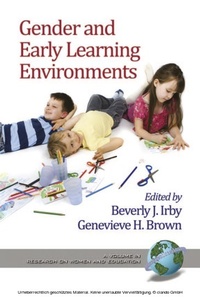
Gender and Early Learning Environments
1st Edition
Published on 1. July 2011
197 pages
978-1-61735-329-1 (ISBN)
Description

The Research on Women and Education SIG of the American Educational Research Association presents the third book in its series, Gender and Early Learning Environments. Finding after the publication of Gender and Schooling in the Early Years, the second book in the series, that there was and is a paucity of published literature on early childhood gender issues, the editors determined that one additional book on early childhood and gender issues was warranted in this series. The latest book in the series, Gender and Early Learning Environments, is encompassing of a wide range of topics addressing early childhood influences on gender and development of the whole child. For early childhood educators, this book aides in making visible and exploring the definition of what gender means in contemporary culture.
All prices
More details
Other editions
Additional editions

Beverly J. Irby | Genevieve H. Brown
Gender and Early Learning Environments
Book
05/2011
Information Age Publishing
€62.50
Article not available at the moment
Content
- Front Cover
- Gender and Early Learning Environments
- Series
- Gender and Early Learning Environments
- Copyright
- Contents
- Preface
- References
- 1: "Their Play Is Different" Power, Language, and Gender Socialization at a Waldorf Daycare
- What is Waldorf Education?
- Gender Socialization of Young Children: The Prevalence of Difference and Dominance Assumptions
- A Gap in the Research: Power, Diversity, and Resistance in Waldorf Gender Socialization
- A Non-Neutral Theoretical and Methodologica lStance: Critical Poststructuralist Feminism
- Statement of Focus
- Data Collection
- Participant Observation
- Interviews
- Documents
- Data Analysis
- Findings
- Girls Are "More Social," Boys Have "More Energy": Teachers' Dichotomous Gender Stereotypes in Theory and Practice
- The "Mother Knows Best" Approach: Connecting Adult Power and Gendered Language
- The Special Case of Joseph: Adult Responses to Problematic "Boy" Behavior
- The Construction of Heteronormativity and Privileging of Traditional Middle-Class Nuclear Families
- Children's Responses to Gender Socialization Efforts: Appropriation and Resistance
- Children's Appropriation of Adult Gender Stereotypes
- Sallie and Amber: Model "Good Girls"
- Children's Agency, Resistance, and Diversity of Gender Performance
- Conclusion
- Notes
- References
- 2: Girls and Boys, Work and Play: Gendered Meanings and Participation in Early Childhood Education
- Mastery as Submission: Becoming a Worker in School
- "I'll Be the Teacher": Girls' Playful Preparation for School Work
- Worksheets, Table Work, and the Gendering of Productivity
- Toby's View
- Good Ideas or Fair Effort? Boys and Girls in the Gifted Class
- Conclusion
- Acknowledgements
- References
- 3: Young Children's Gendered Positioning and Emotional Scenarios in Play Narratives
- Gendered Emotions
- The Study
- Setting and Participants
- Body of Data
- Targeted Children
- Playing Kitties
- Kitty Meeting
- Having Power
- Gendered Play Groups
- Playing Girlfriend
- Who Sally Loves
- Gendered Pairings within the Early Childhood Classroom
- Football Girl
- Discussion
- Implications
- References
- 4: May I Still Call You Honey-Man: One Child, Vacillating Gender, and the Experiences of Home, School, and Community
- Definitions and Statistics Related to People who are Transgender
- Are We Ready to Meet the Needs of Bryce in Our Families?
- Are We Ready to Meet the Needs of Bryce in Our Communities?
- Are We Ready to Meet the Needs of Bryce in Our Schools?
- So, May I Still Call You Honey Man?
- Author's Note
- References
- 5: On Being a Boy or a Girlin Mrs. Sanders' First Grade Classroom
- Gender Differences in Mathematics and Science
- The Classroom Context and the Participants
- The Classroom Vignettes
- Discussion
- Implications
- References
- 6: How South African Teachers Construct Gender in the Early Years of Schooling
- Theoretical Framework
- Background to the Study
- Boys will be Boys
- Children are Children: Gender Does Not Matter
- Parents are the Models
- Conclusion
- References
- 7: Race, Space, and Girls' Interactions on Urban Playgrounds
- Conceptual Framework and Prior Research
- Influence of Gender
- Influence of Race
- Interaction of Gender and Race
- Methodology
- Context
- School Sites
- Participants
- Data Collection Strategies
- Data Analysis
- Girls' Same-Race and Mixed-Race Actions and Interactions
- Girls' Peer Groups and Playground Activities
- Pattern 1: Same-race girls' groups were observed interacting more often than mixed-race girls' groups
- Pattern 2: Girls' group activities span a range of different types
- Pattern 3: Same-race girls' groups tended to prefer different activities than mixed-race girls' groups
- Girls' Conflicts
- Pattern 4: Conflict was observed and described less in same-race girls' groups than in mixed-race girls' groups
- Girls' Cooperation
- Pattern 6: Cooperation was observed more in same-race girls' groups than in mixed-race girls' groups
- Discussion
- Notes
- References
- Appendix A
- Student Survey
- Appendix B
- Participant and Thematic Codes
- Participant Codes
- Descriptive Codes
- 8: A Hallmark Moment?
- Early Socialization to Gender Roles
- Greeting Cards and the Transmission of Culture, Values, and Expectations
- Greeting Card and Gender Role Expectations Research
- Baby Congratulations
- Birthday Cards from Parents
- Birthday Cards from Grandparents
- What Girls May Learn from Birthday Cards
- What Boys May Learn from Birthday Cards
- Conclusions and Recommendations
- Examine Personal Beliefs and Myths about Gender Roles
- Avoid the Use of Stereotyping Language
- Select Gender-Responsive Reading Material
- Find the Perfect Card
- Create Alternatives to Traditional Greeting Cards
- Raise the Level of Awareness of Gender Bias
- Summary
- References
- 9: Child Abuse: Traumatic Influences and Treatment
- Prevalence of Child Abuse
- Brain Changes
- Hallmark Symptoms of Traumatization
- Memory Reenactment as Flashbacks
- Triggers
- Poor Self-Regulation
- Attachment
- Behaviors of Traumatized Infants and Toddlers
- Behaviors of Traumatized Children/Adolescents
- Attachment
- Biology
- Affect Regulation
- Dissociation
- Behavioral Regulation
- Cognition
- Self-Concept
- Treatment
- Conclusion
- References
- 10: Teacher Education Students' Perceptions of Gender Differences in Children
- Statement of the Problem
- Purpose of the Study
- Method
- Sample
- Instrumentation
- Procedure
- Results
- Responses by Percentages
- Discussion and Implications
- Conclusions
- References
- About the Contributors
- About the Editors

