

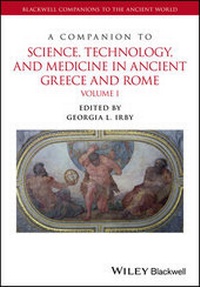
A Companion to Science, Technology, and Medicine in Ancient Greece and Rome
Description

More details
Other editions
Additional editions
Person
Content
Volume I
Contributor Biographies xi
Abbreviations xix
List of Figures and Maps xxiii
Introduction 1
Part I Physics and Cosmogony 11
1 The Creation and Destruction of the World 13 Andrew D. Gregory
2 Matter 29 Daniel W. Graham
3 Motion and Energy 43 Jean De Groot
4 Nature and the Divine 60 Svetla Slaveva-Griffin
Part II The Mathematical Sciences 77
5 Mathematics 79 Reviel Netz
6 Astronomy 96 Andrew D. Gregory
7 Astrology 114 Kocku von Stuckrad
8 Ancient Optics: Theories and Problems of Vision 130 Philip Thibodeau
9 Hydrostatics and Pneumatics in Antiquity 145 Matteo Valleriani
10 The Science of Harmonics and Music Theory in Ancient Greece 161 Sophie Gibson
Part III Earth Sciences 179
11 Hydrology: Ocean, Rivers, and Other Waterways 181 Georgia L. Irby
12 Classical Geology and the Mines of the Greeks and Romans 197 Paul T. Craddock
13 Greco-Egyptian and Byzantine Alchemy 217 Matteo Martelli
14 Meteorology 232 Liba Taub
15 Geography 247 Duane W. Roller
Part IV Life Sciences 263
16 Greek and Roman Botany 265 M. Eleanor Irwin
17 Zoology 281 Tiberiu Popa
18 "Ecology" in the ancient Mediterranean 296 Georgia L. Irby, Robin McCall, and Anita Radini
19 The Failure of Evolutionary Thinking in Antiquity 313 Devin Henry
20 Embryology 329 James Wilberding
Part V Healing and the Human Body 343
21 Anatomy and Physiology 345 Julius Rocca
22 Gynecology 360 Lauren Caldwell
23 Surgery 371 Frédéric Le Blay Translated by Todd Black
24 Physicians and "Schools" 386 Molly Jones-Lewis
25 Pharmacy 402 Molly Jones-Lewis
26 Magic, Curses, and Healing 418 Andrew D. Gregory
27 Healing Shrines 434 Georgia Petridou
28 Regimen and Athletic Training 450 Jason König
29 Epidemiology and Pathology 465 Efthymia Nikita, Anna Lagia, and Sevi Triantaphyllou
30 Psychology and Physiognomics 483 Arnaud Zucker
31 Anthropology: Knowledge of Man 500 Gordon Campbell
Volume ii
Abbreviations xi
List of Figures and Maps xv
Part VI Food Sciences 517
32 Greek and Roman Agriculture 519 Philip Thibodeau
33 Animal Husbandry 533 Kenneth F. Kitchell Jr.
34 Oil and Wine Production 550 Rafael Frankel
35 Cooking and Baking Technology 570 John Paulas
36 Food Storage Technology 587 Robert I. Curtis
37 Culinary and Medicinal Uses of Wine and Olive Oil 605 John F. Donahue
38 Nutrition 618 John F. Donahue
Part VII Technology of Human Life 633
39 Greek Public and Religious Architecture 635 John R. Senseney
40 Greek Domestic Architecture 656 Bradley A. Ault
41 Greek Interior Decoration: Materials and Technology in the Art of Cosmesiss and Display 672 Hariclia Brecoulaki
42 Roman Monumental and Public Architecture 693 Duane W. Roller
43 Roman Domestic Architecture 711 Nathalie de Haan
44 Roman Interior Design 730 Sarah Lepinski
45 Textile Technology 747 Ellen Harlizius-Klück
46 Urban Infrastructure in the Roman World 768 Klaus Grewe Translated by Johanna K. Sandrock
47 Siegeworks and Fortifications 784 Raffaele D'Amato
48 Arms and Weapons 801 Raffaele D'Amato
Part VIII Travel 817
49 Greek and Roman Cartography 819 Georgia L. Irby
50 Land Transport and Vehicles 836 Georges Raepsaet
51 Navigation and the Art of Sailing 854 Georgia L. Irby
52 Ships and Boats 870 Julian Whitewright
Part IX Telling Time 889
53 Greek Calendars 891 Laura Gawlinski
54 Roman Calendars 906 Robert Hannah
55 Time-Telling Devices 923 Robert Hannah
Part X Synthesis and Response 941
56 The Crossroads of Hellenistic and Sanskrit Science 943 Tejas S. Aralere
57 Roman Responses to Greek Science and Scholarship as a Cultural and Political Phenomenon 958 Thorsten Fögen
58 Scientific Encyclopedias 973 Katerina Oikonomopoulou
59 Translation and Transmission of Ancient Scientific Texts 988 Sonja Brentjes
60 The Reception of Greco-Roman Science in the Renaissance: Assimilation(s), Transformation(s), Rejection, Hybridization 1009 Roberto Lo Presti
Appendix: Major Writers And Thinkers 1023
General Index 1029
Index of Authors, Thinkers, and Primary Sources 1049
Index of Toponyms 1061
Contributor Biographies
Tejas S. Aralere attends the College of William and Mary, from which he holds degrees in Latin and neuroscience. His research focuses on early Indian science and the parallels between ancient Indic and Greek sciences.
Bradley A. Ault is Associate Professor of Classics at the University of Buffalo. His publications include The Houses: The Organization and Use of Domestic Space. Excavations at Ancient Halieis, 2 (Bloomington: Indiana University Press, 2005); and, co-edited with L.C. Nevett, Ancient Greek Houses and Households. Chronological, Regional, and Social Diversity (Philadelphia: University of Pennsylvania Press, 2005).
Hariclia Brecoulaki is an archaeologist and holds a research position at the Institute of Historical Research, Department of Greek and Roman Antiquity (The National Hellenic Research Foundation). Her work mainly focuses on Greek painting from the Late Bronze Age to the Roman period, with a particular interest in the technological aspects of ancient polychromy. Her publications include the books L'esperienza del colore nella pittura funeraria dell'Italia preromana V-III secolo a.C. (Electa: Naples, 2001), La peinture funéraire de Macédoine. Emplois et fonctions de la couleur, IV-IIème s. av. J.-C. (The Institute of Historical Research: Athens, 2006) and Mycenaean Painting in Context. New Discoveries, Old Finds Reconsidered (co-editors J.L. Davis and S.R. Stocker) (The Institute of Historical Research: Athens, 2015).
Sonja Brentjes holds a doctorate in the history of mathematics from Karl Marx University in Leipzig. Her research interests include history of science (mathematics, mapmaking, institutions) in Islamicate societies; cross-cultural exchange of knowledge; portolan charts; early modern travel accounts about the Ottomans and Safavids; and narrative of science in Islamicate societies. She is now a researcher at the Max Planck Institute for the History of Science in Berlin.
Lauren Caldwell is Associate Professor of Classical Studies at Wesleyan University. Her research is in Roman history, Greco-Roman medicine, and Roman law. Her book, Roman Girlhood and the Fashioning of Femininity (Cambridge 2014), investigates Roman medical perspectives on women's health, particularly female adolescent health, and examines how medical perspectives were both influenced and shaped by social values.
Gordon Campbell is a lecturer in Ancient Classics at the National University of Ireland, Maynooth. He works on ancient philosophical poetry, anthropology, cosmology, and in particular on Lucretius and Empedocles
Paul T. Craddock graduated in Chemistry from the University of Birmingham in 1966 and joined the British Museum Research Laboratory, where he remained for his whole career, currently in an emeritus role. While there he obtained further qualifications in prehistoric archaeology and metallurgy, obtaining his PhD from the Institute of Archaeology in 1975 on classical bronze alloys. Most of his work has been concerned with metals through all stages of their production, from mining and smelting the ores, as exemplified by Rio Tinto, through to their final embellishment, as exemplified by studies on Corinthian bronze. He is currently working on a monograph investigating the technology of large hollow lost wax castings in Egyptian and classical antiquity
Robert I. Curtis is Professor Emeritus of Classics in the Department of Classics, University of Georgia. His primary research interests include food technology, Roman social and economic history, and Pompeii and Herculaneum.
Raffaele D'Amato is a Turin-based expert of the ancient and medieval military world. After achieving his first PhD in Romano-Byzantine law, he earned a second doctorate in Roman military archaeology. He is currently a visiting professor at the Fatih University of Istanbul, working for the Turkish government on a project upon the arms and armour of Byzantium in Turkey.
Jean De Groot is Associate Professor in the School of Philosophy at The Catholic University of America, where she teaches ancient science and philosophy, as well as twentieth-century philosophy and philosophy of science. Her present interests focus on the history of mechanics, particularly in pre-Classical and Classical antiquity. She is also interested in the materiality of scientific culture in western Magna Graecia. She has written articles and book chapters on Aristotle's natural philosophy and on Eudoxan proportion theory in astronomy and mechanics. Her books include Aristotle's Empiricism: Experience and Mechanics in the Fourth Century BC (Parmenides, 2014) and Aristotle and Philoponus on Light (1991, reprint by Routledge, Summer 2015).
Nathalie de Haan is Assistant Professor of Ancient History at Radboud University Nijmegen in the Netherlands. Her research focuses on Roman baths and bathing culture, Pompeii, Roman housing, and reception studies. She is the author of Römische Privatbäder. Entwicklung, Verbreitung, Struktur und sozialer Status (Peter Lang Verlag, 2010).
John F. Donahue is Professor in the Department of Classical Studies, College of William and Mary in Williamsburg, VA (USA). His works include The Roman Community at Table during the Principate (2004) and Food and Drink in Antiquity: A Sourcebook of Readings from the Greco-Roman World (2015), as well as various articles and reviews on ancient health and diet, Latin epigraphy, and Roman history.
Thorsten Fögen is Reader (Associate Professor) at Durham University (UK) and "Privatdozent" at Humboldt University of Berlin. He is the author of "Patrii sermonis egestas": Einstellungen lateinischer Autoren zu ihrer Muttersprache (Munich & Leipzig 2000) and of Wissen, Kommunikation und Selbstdarstellung: Zur Struktur und Charakteristik römischer Fachtexte der frühen Kaiserzeit (Munich 2009). He has edited seven volumes, most recently Tears in the Graeco-Roman World (Berlin & New York 2009) and Bodies and Boundaries in Graeco-Roman Antiquity (Berlin & New York 2009).
Rafael Frankel began studying at Tel Aviv University 1969. He has taught at Tel Aviv and Haifa Universities and various colleges and has participated in excavations at Tel Bet Yerah (Khirbet Kerak), Tel Be'er Sheva, and Aphek- Antipatris. He has excavated a Persian period temple at Mount Mizpe Yammim and several oil and wine presses and aqueducts, and he has directed archaeological surveys of Western and Upper Galilee. His main fields of research are archaeology and history of Western and Upper Galilee and of wine, oil, and bread.
Laura Gawlinski is Associate Professor of Classical Studies at Loyola University Chicago. She is the author of The Sacred Law of Andania: A New Text with Commentary (de Gruyter, 2012), and her research generally focuses on combining epigraphy and archaeology to investigate how ancient Greek religion was practiced. She is active in fieldwork and has been associated with the excavations of the Athenian Agora since 1995.
Sophie Gibson is an independent scholar. She received her DPhil in Classics from Oxford University in 2002, and is the author of Aristoxenus of Tarentum and the Birth of Musicology (Routledge 2005). A holder of degrees also in law and music, she lives in Oxford.
Daniel W. Graham is A. O. Smoot Professor of Philosophy at Brigham Young University. He does research on history of philosophy and history of science, and has written, translated, or edited eight books on ancient philosophy and science. He has also published numerous scholarly articles on Aristotle, Plato, Socrates, and the Presocratic philosophers. He is president of the International Association for Presocratic Studies and a member of the editorial board of Apeiron. He has taught at Grinnell College and Rice University and been a visiting fellow at Clare Hall, Cambridge, and a visiting professor of philosophy at Yale University. He has been awarded two NEH fellowships.
Andrew D. Gregory is Professor of the History and Philosophy of Science in the Department of Science and Technology Studies at University College London. He has published widely on science in the ancient world, with books including Plato's Philosophy of Science, Ancient Greek Cosmogony, and The Presocratics and the Supernatural.
Klaus Grewe trained as a surveyor and has worked as a surveying engineer. He is Associate Professor at RWTH Aachen University. He has worked extensively in the field and has published broadly on Roman infrastructure (especially in Cologne, Algeria, and Tunisia). In 1988, he was awarded the Frontinus-Medaille by the Frontinus Society.
Robert Hannah is Dean of Arts & Social Sciences at the University of Waikato, New Zealand. Before that he was a member of the Department of Classics at the University of Otago. He is a Fellow of the Society of Antiquaries of London, and a Fellow of the Royal Society of New Zealand. He has written extensively on the use of astronomy in Greek and Roman cultures. His recent publications include the books Greek and Roman Calendars: Constructions of Time in the Classical World (London, 2005), and Time in Antiquity (London, 2009). His current interests are...
