

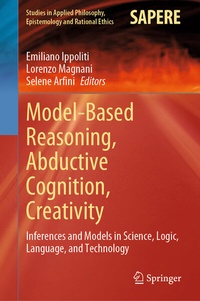
Model-Based Reasoning, Abductive Cognition, Creativity
Description

This book discusses how scientific and other types of cognition make use of models, abduction, and explanatory reasoning in order to produce important, innovative, and possibly creative changes in theories and concepts. Gathering revised contributions presented at the international conference on Model-Based Reasoning (MBR023), held on June 7-9, 2023 in Rome, Italy, the book addresses various intertwined topics ranging from the epistemology and applications of models also concerning the problem of knowledge production and scientific methodology (information visualization, experimental methods, and design) to the analysis of their role in cognition, decision-making, also with respect to social implications. The problem of model-based cognition is also illustrated taking advantage of recent results regarding problem-solving, abduction, and logic, paying attention to a critique of the dominant and received approaches, to the aim of fostering new discussions and stimulate new ideas. All in all, the book provides researchers and graduate students in the fields of applied philosophy, epistemology, cognitive science, and artificial intelligence alike with an authoritative snapshot of the latest theories and applications of model-based reasoning.
More details
Other editions
Additional editions
Content
Chapter 1. Internal Realism and the Computational Model of the Mind. A Realist Interpretation of Ontological Relativity.- Chapter 2. Toys As Tools For Good Science.- Chapter 3. The use of Fuzzy Mathematics for socio-environmental evaluation in Social Economy.- Chapter 4. From restless COG to the yawning robot: humanoid robotics as a model-based science.- Chapter 5. Ethics as Generative Modelling.- Chapter 6. Models as Moral Mediators. Cognitive Niches, Artefacts, and the Two-Faced Nature of Internet and Artificial Intelligence Mediators in the Intertwining of Morality and Violence.- Chapter 7. Counterfactuals, Models, and Scientific Realism.- Chapter 8. Computational Natural Philosophy: A Thread from Presocratics through Turing to ChatGPT.- Etc...
