

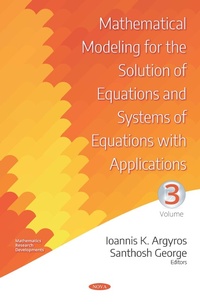
Mathematical Modeling for the Solution of Equations and Systems of Equations with Applications. Volume III
Published on 20. September 2019
456 pages
978-1-5361-5943-1 (ISBN)
Description

These books are intended for undergraduate, graduate researchers and practitioners in computational sciences, and as reference books for an advanced computational methods course. We have included new results for iterative procedures in abstract spaces general enough for handling inverse problems in various situations related to real life problems through mathematical modeling. These books contain a plethora of updated bibliography and provide comparison between various investigations made in recent years in the field of computational mathematics in the wide sense. Iterative processes are the tools used to generate sequences approximating solutions of equations describing the real life problems stated above and others originating from biosciences, engineering, mathematical economics, mathematical biology, mathematical chemistry, mathematical physics medicine, mathematical programming, and other disciplines. These books also provide, recent advancements on the study of iterative procedures, and can be used as a source from which one can obtain the proper method to use in order to solve a problem. The books require a fundamental background in mathematical statistics, linear algebra and numerical analysis. It may be used as a self-study reference or as a supplementary text for an advanced course in biosciences, engineering and computational sciences.
More details
Other editions
Additional editions
Ioannis K. Argyros
Mathematical Modeling for the Solution of Equations and Systems of Equations with Applications. Volume III
Volume III
Book
10/2019
Nova Science Publishers Inc
€355.63
Shipment within 15-20 days
Content
- Intro
- MATHEMATICAL MODELINGFOR THE SOLUTION OF EQUATIONSAND SYSTEMS OF EQUATIONS WITHAPPLICATIONSVOLUME III
- MATHEMATICAL MODELINGFOR THE SOLUTION OF EQUATIONSAND SYSTEMS OF EQUATIONS WITHAPPLICATIONSVOLUME III
- Contents
- Preface
- Chapter 1Local Convergence for a Family ofSuper-Halley Methods
- 1. Introduction
- 2. Local Convergence Analysis
- 3. Numerical Examples
- References
- Chapter 2A Unified Local ConvergenceAnalysis of Newton-Like Methods
- 1. Introduction
- 2. Local Convergence Analysis
- 3. Numerical Examples
- Conclusion
- References
- Chapter 3Ball Convergence Theorems forFourth-Order Variants of Newton'sMethod
- 1. Introduction
- 2. Local Convergence forMethod (3.3)
- 3. Numerical Examples
- References
- Chapter 4Local Convergence Theorems forSome Third and Fourth OrderMethods
- 1. Introduction
- 2. Local Convergence Analysis
- 3. Numerical Examples
- Conclusion
- References
- Chapter 5Ball Convergence of Potra-Ptak-TypeMethod
- 1. Introduction
- 2. Local Convergence Analysis
- 3. Numerical Examples
- References
- Chapter 6Householder-Type Iterative Freefrom Second Derivative
- 1. Introduction
- 2. Local Convergence Analysis
- 3. Numerical Examples
- References
- Chapter 7Convergence for aNewton-Jarratt-Like Composition
- 1. Introduction
- 3. Numerical Examples
- References
- 2. Local Convergence Analysis
- Chapter 8Convergence for a Novel IterativeMethod Free From the SecondDerivative
- 1. Introduction
- 2. Local Convergence
- 3. Numerical Examples
- References
- Chapter 9Ball Convergence Theorems forFourth-Order Variants of Newton'sMethod
- 1. Introduction
- 2. Local Convergence forMethod (9.3)
- 3. Numerical Examples
- References
- Chapter 10J. Chen's One Step Third-OrderIterative Methods
- 1. Introduction
- 2. Local Convergence forMethod (10.2)
- 3. Numerical Examples
- References
- Chapter 11Ball Convergence for a SixteenthOrder Iterative Methods
- 1. Introduction
- 2. Local Convergence Analysis
- 3. Numerical Examples
- References
- Chapter 12Convergence for a Jarratt-LikeMethod for Solving Equations
- 1. Introduction
- 2. Local Convergence Analysis
- 3. Numerical Examples
- References
- Chapter 13Convergence of a Sixth OrderOstrowski-Like Method for SolvingEquations
- 1. Introduction
- 2. Local Convergence Analysis
- 3. Numerical Examples
- References
- Chapter 14Convergence for a Householder-LikeMethod
- 1. Introduction
- 2. Local Convergence Analysis
- 3. Numerical Examples
- References
- Chapter 15Local Convergence of the Two-StepChebyshev-Like Method
- 1. Introduction
- 2. Local Convergence Analysis
- 3. Numerical Examples
- References
- Chapter 16Comparison between Two SixthOrder Newton-Jarratt Method
- 1. Introduction
- 2. Local Convergence Analysis
- 3. Numerical Examples
- References
- Chapter 17Newton's Method UsingGauss-Legendre Formulas
- 1. Introduction
- 2. Local Convergence Analysis
- 3. Numerical Examples
- References
- Chapter 18Composite Newton-Traub Method
- 1. Introduction
- 2. Local Convergence
- 3. Numerical Examples
- References
- Chapter 19Convergence of a Four Step NinthOrder Method
- 1. Introduction
- 2. Local Convergence
- 3. Numerical Examples
- References
- Chapter 20Convergence of an Eighth-OrderMethod in Banach Space
- 1. Introduction
- 2. Local Convergence
- 3. Numerical Examples
- References
- Chapter 21Convergence for a General Family ofOptimal Fourth-Order Methods
- 1. Introduction
- 2. Local Convergence
- 3. Numerical Examples
- References
- Chapter 22Gauss-Newton Method UsingRestricted Convergence Domains
- 1. Introduction
- 2. Local Convergence Analysis
- 3. Numerical Examples
- References
- Chapter 23Proximal Gauss-Newton MethodUsing Restricted ConvergenceDomains
- 1. Introduction
- 2. Background
- 3. Local Convergence Analysis of the Proximal Gauss-NewtonMethod
- 4. Numerical Examples
- References
- Chapter 24Hybrid High Convergence OrderIterative Methods
- 1. Introduction
- 2. Local Convergence
- 3. Numerical Examples
- References
- Chapter 25High Convergence Order Methodson Riemannian Manifolds
- 1. Introduction
- 2. Semi-Local Convergence
- 3. IterativeMethods on a Sphere
- 3.1. Algorithm (Newton's Algorithm on the Sphere S2 [16])
- References
- Chapter 26Convergence Analysis of a M¨ullerSecant-Type Method
- 1. Introduction
- 2. Improved Convergence Ball Analysis of Method (26.4)
- 3. Local Convergence ofMethod (26.6)
- 4. Numerical Examples
- References
- Chapter 27Convergence of Bilinear Operator
- 1. Introduction
- 2. Local Convergence
- 3. Semi-Local Convergence
- References
- Chapter 28Convergence Analysis forSemi-Smooth Newton-Type Methods
- 1. Introduction
- 2. Mathematical Background
- 3. Convergence Analysis I
- 4. Convergence Analysis II
- References
- Chapter 29Hybrid High Convergence OrderIterative Methods
- 1. Introduction
- 2. Convergence Analysis
- 3. Concluding Remarks and Applications
- References
- Chapter 30The King-Werner Method of Order1+p2
- 1. Introduction
- 2. Convergence Analysis of King-Werner-Type Methods (30.2)and (30.3)
- 3. Numerical Examples
- References
- Chapter 31Extending the Applicability ofKing-Werner-Type Methods
- 1. Introduction
- 2. Majorizing Sequences for King-Werner-TypeMethods (31.3)and (31.4)
- 3. Convergence Analysis of King-Werner-Type Methods (31.3)and (31.4)
- 4. Numerical Examples
- References
- Chapter 32Achieving Higher Order ofConvergence for Solving Systems ofEquations
- 1. Introduction
- 2. Local Convergence Analysis
- 3. Numerical Examples
- References
- Chapter 33Gauss-Newton Method for ConvexComposite Optimization
- 1. Introduction
- 2. The Gauss-Newton Algorithm
- 2.1. Algorithm
- 2.2. Regularity
- 3. Semi-Local Convergence
- 4. Special Cases and Examples
- References
- Chapter 34High Order Method Based on theDecomposition Technique
- 1. Introduction
- 2. Local Convergence
- 3. Numerical Examples
- References
- Chapter 35Kantorovich-Type Extensions forNewton Method
- 1. Introduction
- 2. Semi-Local Convergence for Newton-Like Methods
- 3. Numerical Examples
- References
- Chapter 36Divided Difference Based IterativeMethods
- 1. Introduction
- 2. Local Convergence Analysis
- 3. Numerical Examples
- References
- Chapter 37Convergence for the Osada Method
- 1. Introduction
- 2. Auxiliary Results
- 3. Local Convergence
- 4. Numerical Examples
- References
- Chapter 38Convergence forNewton-Kantorovich-Like Theorems
- 1. Introduction
- 2. Background
- 3. Semilocal Convergence
- References
- Chapter 39Unified Convergence of FourthOrder Solvers
- 1. Introduction
- 2. Auxiliary Results
- 3. Ball Convergence
- 4. Numerical Examples
- Conclusion
- References
- Chapter 40Extending the Kantorovich Theorem
- 1. Introduction
- 2. Convergence Analysis
- 3. Concluding Remarks and Applications
- References
- Chapter 41Two-Step Iterative Methods Free ofDerivatives
- 1. Introduction
- 2. Local Convergence I
- 3. Local Convergence II
- 4. Numerical Examples
- References
- Chapter 42Inexact Newton-Type Methods
- 1. Introduction
- 2. Local Convergence Analysis of INTM
- 3. Numerical Example
- References
- About the Authors
- Index
- Blank Page
