

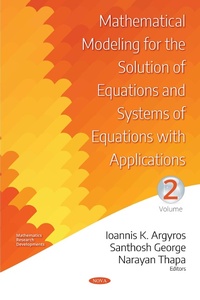
Mathematical Modeling for the Solution of Equations and Systems of Equations with Applications. Volume II
Published on 6. March 2019
384 pages
978-1-5361-3310-3 (ISBN)
Description

This book is dedicated to the approximation of solutions of nonlinear equations using iterative methods. The study about convergence matter of iterative methods is usually based on two categories: semi-local and local convergence analysis. The semi-local convergence category is, based on the information around an initial point, to provide criteria ensuring the convergence of the method; while the local one is, based on the information around a solution, to find estimates of the radii of the convergence balls. The book is divided into two volumes. The chapters in each volume are self-contained so they can be read independently. Each chapter contains semi-local and local convergence results for single, multi-step and multi-point old and new contemporary iterative methods involving Banach, Hilbert or Euclidean valued operators. These methods are used to generate a sequence defined on the aforementioned spaces that converges with a solution of a nonlinear equation, an inverse problem or an ill-posed problem. It is worth mentioning that most problems in computational and related disciplines can be brought in the form of an equation using mathematical modelling. The solutions of equations can be found in analytical form only in special cases. Hence, it is very important to study the convergence of iterative methods.
More details
Other editions
Additional editions
Ioannis K. Argyros | Santhosh George | Narayan Thapa
Mathematical Modeling for the Solution of Equations and Systems of Equations with Applications
Volume II
Book
05/2018
Nova Science Publishers Inc
€363.07
Shipment within 15-20 days
Content
- Intro
- MATHEMATICAL MODELINGFOR THE SOLUTION OF EQUATIONSAND SYSTEMS OF EQUATIONSWITH APPLICATIONSVOLUME II
- MATHEMATICAL MODELINGFOR THE SOLUTION OF EQUATIONSAND SYSTEMS OF EQUATIONSWITH APPLICATIONSVOLUME II
- Contents
- Preface
- Chapter 1Unifying Semilocal and LocalConvergence of Newton's Method
- 1.1. Introduction
- 1.2. Banach Spaces with Convergence Structure
- 1.3. Semilocal Convergence
- 1.4. Local Convergence
- 1.5. Numerical Examples
- References
- Chapter 2Higher Order Methods for NonlinearSystem of Equations
- 2.1. Introduction
- 2.2. Construction of Iterative Family
- 2.3. Convergence Analysis
- 2.4. Semilocal Convergence
- 2.5. Numerical Results
- 2.6. Conclusion
- References
- Chapter 3Semilocal Convergence of Newton'sMethod
- 3.1. Introduction
- 3.2. Convergence Analysis
- 3.3. Numerical Examples
- References
- Chapter 4Newton-Kantorovich-Like Theoremsunder W-Conditions
- 4.1. Introduction
- 4.2. Background
- 4.3. Semilocal Convergence
- References
- Chapter 5Unified Local Convergence forNewton-Kantorovich MethodUnderW- Condition
- 5.1. Introduction
- 5.2. Gauge Functions and Initial Conditions
- 5.3. local Convergence Analysis
- 5.4. Special Cases
- References
- Chapter 6Mesh Independence for SolvingNonlinear Equations
- 6.1. Introduction
- 6.2. Mesh Independence Principle
- Semilocal Convergence (Theorem 6.2.1)
- Local Convergence (Theorem 6.2.2)
- References
- Chapter 7Expanding the Applicability of FourIterative Methods
- 7.1. Introduction
- 7.2. Local Convergence for the SecantMethod
- 7.3. Local Convergence for the Three-PointMethod
- 7.4. Local Convergence for the Kurchatov Method
- 7.5. Local Convergence for the Gauss-Newton Method
- References
- Chapter 8Improved Complexity of a HomotopyMethod for Locating anApproximate Zero
- 8.1. Introduction
- 8.2. Convergence Analysis
- 8.3. Special Cases
- References
- Chapter 9Convergence Analysis of FrozenSecant-Type Methods
- 9.1. Introduction
- 9.2. Semi-Local Convergence Analysis
- 9.3. Local Convergence Analysis
- 9.4. Numerical Examples
- References
- Chapter 10Unified Convergence Analysis ofFrozen Newton-Like Methods
- 10.1. Introduction
- SINGLE POINTMETHODS
- TWO POINTMETHODS
- MULTI POINT METHODS
- 10.2. Semi-Local Convergence Analysis
- 10.3. Local Convergence Analysis
- 10.4. Special Cases and Numerical Examples
- References
- Chapter 11Solvability of Equations UsingSecant-Type Methods
- 11.1. Introduction
- 11.2. Semi-Local Convergence pn 6= qn for Each n
- 11.3. Semi-Local Convergence Analysis pn = qn for Each n
- References
- Chapter 12Newton-Tikhonov Method forIll-Posed Equations
- 12.1. Introduction
- 12.2. Majorizing Sequences
- 12.3. Semilocal Convergence of (NT)
- 12.4. Semilocal Convergence of (SNT)
- 12.5. Applications
- 12.5.1. Error Bounds Under Source Conditions
- 12.5.2. A Priori Choice of the Parameter
- 12.5.3. An Adaptive Choice of the Parameter
- 12.5.4. Stopping Rule
- 12.5.5. Algorithm
- 12.6. Numerical Example
- References
- Chapter 13Simplified Newton-TikhonovRegularizationMethod
- 13.1. Introduction
- 13.2. Convergence Analysis
- 13.2.1. A Priori Choice of the Parameter
- 13.2.2. An Adaptive Choice of the Parameter
- 13.3. Examples
- References
- Chapter 14Two Step Newton Lavrentiev Methodfor Ill-Posed Problems
- 14.1. Introduction
- 14.2. Semilocal Convergence of (TSNLM) under (C1)0
- 14.2.1. Algorithm
- 14.3. Semilocal Convergence of (TSNLM) under (C1)
- 14.4. Examples
- References
- Chapter 15Two Step Newton-Tikhonov Methodsfor Ill-Posed Problems
- 15.1. Introduction
- 15.2. Preliminaries
- 15.2.1. A Priori Choice of the Parameter
- 15.2.2. An Adaptive Choice of the Parameter
- 15.3. Semilocal Convergence of TSNTM for IFD Class
- 15.4. Semilocal Convergence of TSNTM forMFD Class
- 15.5. Algorithm
- 15.6. Numerical Examples
- References
- Chapter 16RegularizationMethods for Ill-PosedProblems
- 16.1. Introduction
- 16.2. Background
- 16.2.1. A Priori Choice of the Parameter
- 16.2.2. An Adaptive Choice of the Parameter
- 16.3. Semilocal Convergence
- 16.3.1. Linear Convergence
- 16.4. Error Bounds under Source Conditions
- 16.4.1. Stopping Index
- 16.5. Implementation of Adaptive Choice Rule
- 16.6. Examples
- References
- Chapter 17Expanding the Applicability ofLavrentiev RegularizationMethod
- 17.1. Introduction
- 17.2. Basic Assumptions and Some Preliminary Results
- 17.3. Stopping Rule
- 17.4. Error Bound for the Case of Noise-Free Data
- 17.5. Error Analysis with Noisy Data
- 17.6. Order Optimal Result with an a Posterior Stopping Rule
- 17.7. Numerical Examples
- References
- Chapter 18Iterated Lavrentiev Regularization
- 18.1. Introduction
- 18.2. Basic Assumptions and Some Preliminary Results
- 18.3. Stopping Rule
- 18.4. Error Bound for the Case of Noise-Free Data
- 18.5. Error Analysis with Noisy Data
- 18.6. Order Optimal Result with a Posterior Stopping Rule
- 18.7. Numerical Examples
- References
- Chapter 19On the Semilocal Convergence of aTwo-Step Newton-Like ProjectionMethod for Ill-Posed Equations
- 19.1. Introduction
- 19.1.1. Projection Method
- 19.2. Semilocal Convergence
- 19.3. Error Bounds Under Source Conditions
- 19.3.1. A Priori Choice of the Parameter
- 19.3.2. An Adaptive Choice of the Parameter
- 19.4. Implementation of Adaptive Choice Rule
- 19.4.1. Algorithm
- 19.5. Numerical Example
- References
- Chapter 20Local Convergence of LavrentievRegularization for Ill-PosedEquations
- 20.1. Introduction
- 20.2. Local Convergence
- 20.3. A Posterior Parameter Choice
- 20.4. Numerical Examples
- References
- Chapter 21Modified Gauss-Newton Method forNonlinear Ill-Posed Problems
- 21.1. Introduction
- 21.2. Convergence Analysis
- 21.2.1. Error Bounds under Source Conditions
- 21.2.2. A Priori Choice of the Parameter
- 21.2.3. Adaptive Choice of the Parameter
- 21.3. Implementation of the Method
- 21.3.1. Algorithm
- 21.4. Numerical Example
- References
- Chapter 22Two Step Newton-Type ProjectionMethod for Ill-Posed Problems
- 22.1. Introduction
- 22.2. Discretized Tikhonov Regularization
- 22.2.1. A Priori Choice of the Parameter
- 22.2.2. An Adaptive Choice of the Parameter
- 22.3. Convergence Analysis of the ProjectionMethod
- 22.3.1. Case 1: TSNTPM When F0(.) Is Invertible
- 22.3.2. Case 2: DTSNTMWhen F Is Monotone and F0(.) Is Non-Invertible
- 22.4. Algorithm
- 22.5. Implementation of the Method
- References
- Chapter 23Discretized Newton-TikhonovMethod for Ill-Posed HammersteinType Equations
- 23.1. Introduction
- 23.2. Preliminaries
- 23.2.1. A Priori Choice of the Parameter
- 23.2.2. An Adaptive Choice of the Parameter
- 23.3. Convergence Analysis of DTSNTM
- 23.4. Expanding the Applicability of DTSNTM
- 23.5. Error Analysis
- 23.5.1. (DTSNTM) with Assumption 23.1.1
- 23.5.2. (DTSNTM) with Assumption 23.1.2
- 23.6. Algorithm
- 23.7. Numerical Example
- 23.8. Conclusion
- References
- Author Contact Information
- Index
- Blank Page
