

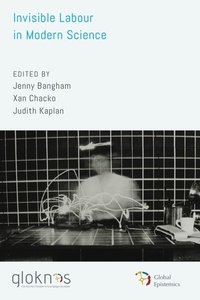
Invisible Labour in Modern Science
Rowman & Littlefield Publishers
1st Edition
Published on 1. September 2022
354 pages
978-1-5381-5996-5 (ISBN)
Description

Invisible Labour in Modern Science is about the people who are concealed, eclipsed, or anonymised in accounts of scientific research. Many scientific workers-including translators, activists, archivists, technicians, curators, and ethics review boards-are absent in publications and omitted from stories of discovery. Scientific reports are often held to ideals of transparency, yet they are the result of careful judgments about what (and what not) to reveal. Professional scientists are often celebrated, yet they are expected to uphold principles of 'objective' self-denial. The emerging and leading scholars writing in this book negotiate such silences and omissions to reveal how invisibilities have shaped twentieth and twenty-first century science.
Invisibility can be unjust; it can also be powerful. What is invisible to whom, and when does this matter? How do power structures built on hierarchies of race, gender, class and nation frame what can be seen? And for those observing science: When does the recovery of the 'invisible' serve social justice and when does it invade privacy? Tackling head-on the silences and dilemmas that can haunt historians, this book transforms invisibility into a guide for exploring the moral sensibilities and politics of science and its history.
Invisibility can be unjust; it can also be powerful. What is invisible to whom, and when does this matter? How do power structures built on hierarchies of race, gender, class and nation frame what can be seen? And for those observing science: When does the recovery of the 'invisible' serve social justice and when does it invade privacy? Tackling head-on the silences and dilemmas that can haunt historians, this book transforms invisibility into a guide for exploring the moral sensibilities and politics of science and its history.
More details
Series
Edition
1. Auflage
Language
English
Place of publication
New York
United States
Publishing group
Bloomsbury Publishing Plc
Target group
Professional and scholarly
Illustrations
19 b/w photos;
ISBN-13
978-1-5381-5996-5 (9781538159965)
Copyright in bibliographic data and cover images is held by Nielsen Book Services Limited or by the publishers or by their respective licensors: all rights reserved.
Schweitzer Classification
Other editions
Additional editions
Jenny Bangham | Xan Chacko | Judith Kaplan
Invisible Labour in Modern Science
Book
09/2022
Rowman & Littlefield Publishers
€142.10
Shipment within 3-4 weeks
Persons
Jenny Bangham is a Wellcome University Award Lecturer in the School of History, Queen Mary University of London, where she researches the politics, meanings, and practices of genetics. She is the author of Blood Relations: Transfusion and the Making of Human Genetics (2020), which explores the intimate connections between the infrastructures of blood transfusion and the development of human genetics. She is co-editor of the open access volume, How Collections End: Objects and Loss in Laboratories and Museums (2019).
Xan Chacko is a lecturer in science, technology, and society at Brown University, whose research complicates narratives of scientific practices and knowledge. Her current book, The Last Seed: Botanic Futures in Colonial Legacies situates the emergence of cryogenic seed banking as a response to catastrophic species loss of plant life in the twentieth century.
Judith Kaplan is a historian of the human sciences who teaches in the Integrated Studies Program at the University of Pennsylvania. She has published widely on topics from orientalism to sound studies and is currently completing a manuscript on Living Language and the Transformation of Linguistics, 1871-1918.
Xan Chacko is a lecturer in science, technology, and society at Brown University, whose research complicates narratives of scientific practices and knowledge. Her current book, The Last Seed: Botanic Futures in Colonial Legacies situates the emergence of cryogenic seed banking as a response to catastrophic species loss of plant life in the twentieth century.
Judith Kaplan is a historian of the human sciences who teaches in the Integrated Studies Program at the University of Pennsylvania. She has published widely on topics from orientalism to sound studies and is currently completing a manuscript on Living Language and the Transformation of Linguistics, 1871-1918.
Content
Series Editor's Note
Acknowledgements
Introduction
I. PEOPLE
Commentary: Sabine Clarke: People and the processes of erasure
1. Julia Rodriguez: Under the Mexican sun: Zelia Nuttall and eclipses in Americanist anthropology
2. Lan A. Li: Escaping immortality: science, civilization, and Lu Gwei-djen
3. María Fernanda Olarte-Sierra: Producing and delivering truth: The (in)visibility of forensic scientists in Colombia
4. Margaret Bruchac: Of animacy and afterlives: Material memories in Indigenous collections
5. Alexandra Noi: The ex-prisoners of Gulag in the Siberian Expeditions
6. Laura Stark: The bureaucratic ethic and the spirit of bio-capitalism
7. Elise Burton: 'They Say They Are Kurds': informants and identity work at the Iranian Pasteur Institute
II. POWER
Commentary: Gabriela Soto Laveaga: (Em)powering narratives of technology
8. Mihai Surdu: Categorizing Roma in censuses, surveys and expert estimates
9. Ana Carolina Vimieiro Gomes: Situated knowledge and the genetics of the Brazilian No
Acknowledgements
Introduction
I. PEOPLE
Commentary: Sabine Clarke: People and the processes of erasure
1. Julia Rodriguez: Under the Mexican sun: Zelia Nuttall and eclipses in Americanist anthropology
2. Lan A. Li: Escaping immortality: science, civilization, and Lu Gwei-djen
3. María Fernanda Olarte-Sierra: Producing and delivering truth: The (in)visibility of forensic scientists in Colombia
4. Margaret Bruchac: Of animacy and afterlives: Material memories in Indigenous collections
5. Alexandra Noi: The ex-prisoners of Gulag in the Siberian Expeditions
6. Laura Stark: The bureaucratic ethic and the spirit of bio-capitalism
7. Elise Burton: 'They Say They Are Kurds': informants and identity work at the Iranian Pasteur Institute
II. POWER
Commentary: Gabriela Soto Laveaga: (Em)powering narratives of technology
8. Mihai Surdu: Categorizing Roma in censuses, surveys and expert estimates
9. Ana Carolina Vimieiro Gomes: Situated knowledge and the genetics of the Brazilian No
