

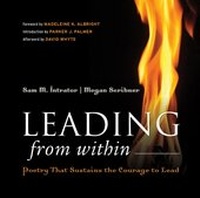
Leading from Within
Description

More details
Other editions
Additional editions
Persons
Content
- Cover
- Contents
- Title
- Copyright
- Foreword
- A Note to Our Readers
- Introduction
- Called
- Ulysses
- From "'Hope' is the Thing with Feathers"
- Madam's Calling Card
- The Way it is
- From "Asphodel, that Greeny Flower"
- From the Irony of American History
- From Songs of Innocence
- For the Children
- Cuttings
- From Little Gidding
- To Be of Use
- Ares
- Defining Moments
- In Those Years
- A Vision
- Sonnet 29
- The Avowal
- The Seven of Pentacles
- The Art of Disappearing
- From "The Love Song of J. Alfred Prufrock"
- The Contract
- Courage
- Listening
- Adios
- Sometimes it Aches
- For the Raindrop, Joy is in Entering the River
- Spring Azures
- From "Auguries of Innocence"
- Trough
- From "Childhood Friends"
- Mother to Son
- End of Elul
- When You Get Lost
- Work Around Your Abyss
- Amanecer
- Accepting This
- Pay Attention
- Lost
- From "I Am Too Alone in the World, and Not Alone Enough"
- Fluent
- Tao Ching #33
- The Opening of Eyes
- Invictus
- I'm Tired, I'm Whipped
- The Diameter of the Bomb
- The Panther
- With Kit, Age 7, At the Beach
- XXXI
- The Lover Pleads with His Friend for Old Friends
- Mending Wall
- The Real Bottom Line
- The Ponds
- The Pleasures of Merely Circulating
- The Road Not Taken
- Stone
- Sabbaths
- After Reading a Child's Guide to Modern Physics
- The Peaceable Kingdom
- The Truly Great
- The Grasp of Your Hand
- What I Have Learned So Far
- The Night House
- Dare to Endure
- From "Andrea del Sarto"
- Oh, My Friend
- The Abnormal is Not Courage
- There was a Time I Would Reject Those
- Let Me Remember
- From "What is this Fragrance"
- The Entire World is a Very Narrow Bridge
- From "The Cure at Troy"
- In Order to
- From Earth, Fire and Water
- From "The Rock Will Wear Away"
- Leading Together
- The Warning
- From "Let America Be America Again"
- From "Song of the Open Road"
- Snow
- I Dwell in Possibility
- A Note
- Replenish
- In the End We are All Light
- All Souls
- How Do I listen?
- Tell All the Truth But Tell it Slant
- From "The Spell of the Yukon"
- From "The Drum Major Instinct"
- Back at it
- For Warmth
- Directive
- Fire
- Song of Hope
- The Uses of Not
- Kindness
- Those Winter Sundays
- The Peace of Wild Things
- Silver Star
- From "Ulysses"
- Leading with Fire
- Afterword
- Gratitudes
- Center for Courage & Renewal
- The Editors
- Credits
A Note to Our Readers
by Sam M. Intrator and Megan Scribner
This book brings together leaders from virtually every sector of society: corporate executives, surgeons, community activists, clergy, politicians, educators, lawyers, journalists, coaches, and more. These are tough and tested men and women whose daily work life is chock full of problem solving, relationship building, and make-or-break challenges.
Our invitation to these leaders was simple: take a moment away from the sharp-elbowed context in which you do your work, step outside the cycle of pressure and demand, put aside your role and title, and speak to us about who you are, why you do what you do, and how you keep your heart and commitment alive in your work and leadership. In short, our interest was not in documenting the latest process for organizational growth or in describing techniques for optimizing effectiveness but in helping leaders tell the story of what is authentic and genuine in their efforts to serve. To tell these stories—stories of leading from within—we enlisted help in the form of poetry. We asked each leader to reflect on a poem that mattered to him or her. These reflections address what is personal and human in leadership. They offer snapshots of leaders encountering themselves and thus provide glimpses of the complex geography of the leader’s heart: what motivates, what inspires, what hurts, what enthralls, and more.
We invited individuals to reflect on these questions because we believe that the story of what animates people in their work and life is of great importance. Work occupies so much of our life. It’s not just that we spend vast amounts of our waking hours at work, but it is often through our vocational commitments that we engage the world. Our aspirations, our dreams, and even our understanding of who we are become shaped by the work we do in the world. And despite our efforts to keep perspective and to delineate between home and work and outside commitments, failure and success in the workplace reverberate throughout the circles of our life. In other words, work, as David Whyte tells us, is a serious matter. “It is where we can make ourselves; work is where we can break ourselves.”1 All of us, from those who lead great companies amid much fanfare to those whose leadership is less public, understand how high-stakes our work can be. When we care, we feel the bite of both success and failure deep in our bones.
Though so much of who we are is bound up in the work we do, the simple but crucial questions we asked—Why do you do what you do? How do you keep your heart and commitment alive?—often get lost in the giddyup world of our organizations and institutions. This book represents our efforts to listen to leaders make sense of their own stories and to share their passion, suffering, inspiration, and learning as they journey across the arc of vocation.
What makes our effort distinctive is our use of poetry to evoke stories of the work and leadership journey. Poetry by its nature can shake us up and turn us inward. Walt Whitman said that he wrote poetry because he wanted the reader to “stand by my side and look in the mirror with me.”2 Our project capitalizes on this reflective moment. It is a moment of disciplined stillness amidst the many demands of the life and work of leaders.
To fully appreciate this encounter that Whitman describes, we invited leaders to not only share a cherished poem but to write a 250-word commentary describing what happens when they reflect on the poem. We aspired to hear from a wide range of people—from those who identify themselves as conventional leaders to those who work quietly behind the scenes for worthy causes. In our effort to secure a diverse range of voices, we scattered the call for submissions widely: we posted to electronic listservs, put up a Web site, wrote letters to leaders we admired, and beseeched friends and colleagues to invite those they respected to consider our invitation. In the end, we were gratified and overwhelmed to receive hundreds of responses.
As each submission crossed our desk or unscrolled on our e-mail screen, we felt as though we had been given the gift of bearing witness to a special and private communion between a leader and a poem. The commentaries are almost sacred in that they reveal a raw glimpse of an open heart striving to live and work with dignity and grace. An enduring image that stayed with us throughout this project and our prior work on Teaching with Fire is from Edward Hirsch’s memorable book, How to Read a Poem and Fall in Love with Poetry. He describes poetry as a passionate, private communication from a soul to another soul. He also quotes the French poet Paul Celan, who believed poems were “messages in a bottle.” We grew to love that image, in that we imagined ourselves standing on the shore uncorking these bottles and discovering not just the poem but the heartfelt response to it. We began to see our work as eavesdropping on a leader’s meditation, and sometimes that took our breath away.
Despite the diversity of poems and contributors, the “bottles we opened” shared a fairly consistent message. Over and over, individuals told stories of a strong sense of purpose and the conviction to work for what they believed in. They were clear-eyed and matter-of-fact as they described the burdens of responsibility, the long hours, the high stakes, and the demands of decision making.
Implied throughout the submissions was a storyline on leadership that struck us as courageous. These leaders told us that leadership and work are journeys of uncountable obstacles and challenges. They described the enemy or the shadow side of leadership—those times when they feel vulnerable and ineffective and when they trudge through their days in a state of mindless reactivity. They named the human impulse to retreat and disconnect but articulated a conviction that the true test of leadership involves the courage to persevere and, in the face of failure and painful public criticism, to resist the temptation to become isolated. They knew that isolation from self, from others, and from animating beliefs is toxic to leadership and service.
Throughout the commentaries, we heard leaders say that meaningful leadership hinges on the leader being reflective, intentional, and self-aware. Leadership, they told us, begins from within. The task of effective, inspiring, and wise leadership (we heard) is for leaders to remain connected to their own values, principles, and beliefs—connected to colleagues, to the institutions they serve, and to the “best lights” and possibilities of their work.
All of us know the alternative. All of us have experienced leaders, colleagues, and professionals who treated us like widgets or chess pieces. The physician who touches your body but does not ask your name; the teacher who describes your child’s struggles in school as if your son or daughter were a simple machine; the politician whose calculating positions have virtually no moral coherence; the CEO who renegotiates the unfathomably large salary, even while the company falters—and so on.
It would be an exaggeration to claim that reading, sharing, and talking about poetry can improve the bottom line or resolve nagging personnel issues within an organization. It’s not commonsensical to assert that encounters with Keats or Neruda will translate into measurable outcomes or even result in leaders showing up the next day with amplified charisma, new ideas or strategies, or an idea for an innovative new product line. We’ll leave that for other leadership books.
Poetry offers a different kind of vision. It traffics in imagery, metaphor, insight, energy, and emotion. In doing so, it speaks to the heart of matters crucial to leadership. William Butler Yeats could be talking about leadership when he says this about poetry: “It is blood, imagination, intellect running together. . . . It bids us touch and taste and hear and see the world, and shrink from all that is of the brain only.” The leaders in this book get this. They see their work as of the heart, of the mind, of the spirit, and of the soul. Poetry, they tell us, is not ornamental to their leadership practice but indispensable because it provokes deliberation about living one’s own truth and consideration of whether one’s actions in the world are intentional, authentic, and congruent with the ancient Greek imperatives, “Know thyself” and “Become what you are.” In other words, poetry provokes the reflection necessary for leadership from the inside out.
As you traipse through this book and spend time with both the poems and the commentaries, it’s worth keeping in mind the words of the great poet, teacher, and social critic John Ciardi, who writes:
There is no poetry for the practical man. There is poetry only for the man who spends a certain amount of his time turning the practical wheel, because if he spends too much time at the mechanics of practicality, he’ll become something less of a man or be eaten up by the frustrations that are stored in his irrational personality. An ulcer is the unkissed imagination taking its revenge for having been jilted. It’s an unwritten poem, an undanced dance, an unpainted water color. It’s a declaration from the mankind of a man that a clear spring of joy has not been tapped and that it must break through muddily on its own.3
While our organizations, corporations, schools, and other institutions strive for rationality, predictability, and efficiency, there must still be room...
