

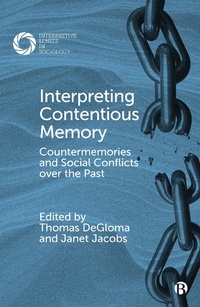
Interpreting Contentious Memory
Countermemories and Social Conflicts over the Past
Bristol University Press
1st Edition
Published on 28. June 2023
292 pages
978-1-5292-1868-8 (ISBN)
Description

Memory is at the center of a diverse array of political conflicts, moral disputes, and power dynamics.
This book illustrates how scholars use different interpretive lenses to study and explain profound conflicts rooted in the past. Addressing issues of racism, genocide, trauma, war, nationalism, colonial occupation, and more, it highlights how our interpretations of contentious memories are indispensable to our understandings of contemporary conflicts and identities.
Featuring an international group of scholars, this book makes important contributions to social memory studies, but also shows how studying memory is vital to our understanding of enduring social problems that span the globe.
This book illustrates how scholars use different interpretive lenses to study and explain profound conflicts rooted in the past. Addressing issues of racism, genocide, trauma, war, nationalism, colonial occupation, and more, it highlights how our interpretations of contentious memories are indispensable to our understandings of contemporary conflicts and identities.
Featuring an international group of scholars, this book makes important contributions to social memory studies, but also shows how studying memory is vital to our understanding of enduring social problems that span the globe.
Reviews / Votes
"This book represents the state of the art in sociological memory studies. It will help sociologists understand why memory is so important, just as it will help non-sociological memory scholars understand what sociology has to offer the field." Jeffrey Olick, University of VirginiaMore details
Series
Edition
First Edition
Language
English
Place of publication
Bristol
United Kingdom
Target group
Professional and scholarly
Illustrations
Not illustrated
File size
0,75 MB
ISBN-13
978-1-5292-1868-8 (9781529218688)
Copyright in bibliographic data and cover images is held by Nielsen Book Services Limited or by the publishers or by their respective licensors: all rights reserved.
Schweitzer Classification
Other editions
Additional editions
Interpreting Contentious Memory
Countermemories and Social Conflicts over the Past
Book
12/2024
1st Edition
Bristol University Press
€42.00
Shipment within 3-4 weeks
Interpreting Contentious Memory
Countermemories and Social Conflicts over the Past
Book
06/2023
1st Edition
Bristol University Press
€99.00
Shipment within 3-4 weeks
Persons
Thomas DeGloma is Associate Professor of Sociology at Hunter College and the Graduate Center at the City University of New York.
Janet Jacobs is Professor of Distinction in Women and Gender Studies and Sociology at the University of Colorado Boulder.
Janet Jacobs is Professor of Distinction in Women and Gender Studies and Sociology at the University of Colorado Boulder.
Content
1. Introduction: Interpreting Contentious Memories and Conflicts over the Past - Thomas DeGloma and Janet Jacobs
Part 1: Interpreting Memories in the Social Dynamics of Contention
2 On the Social Distribution of Soldiers' Memories: Normalization, Trauma, and Morality - Edna Lomsky-Feder
3. Feminist Approaches to Studying Memory and Mass Atrocity - Nicole Fox
4. Mobilizing Memories: Remembrance as a Social Movement Tool in the Vieques Anti-Military Movement (1999-2004) - Roberto Velez-Velez
5. The Ballot of Donald and Hillary: Hateful Memories of Celebrity Leaders - Gary Alan Fine, Christopher Robertson, and Cal Abbo
Part 2: Racism, Exclusion, and Mnemonic Conflict
6. Building a Case for Citizenship: Countermemory Work among Deported Veterans - Sofya Aptekar
7. Commemorations as Transformative Events: Collective Memory, Temporality, and Social Change - Claire Whitlinger
8. Contentious Pasts, Contentious Futures: Race, Memory, and Politics in Montgomery's Legacy Museum - Amy Sodaro
Part 3: Genocide, Memory, and the Historicizing of Trauma
9. Remembrance and Historicization: Transformation of Individual and Collective Memory Processes in the Federal Republic of Germany - Werner Bohleber
10. Enlisting Lived Memory: From Traumatic Silence to Authentic Witnessing - Carol A. Kidron
11. Changing Memories of the Shoah in Post-Communist Countries: New Memories and Conflicts - Selma Leydesdorff
12. How Difficult Pasts Complicate the Present: Comparative Analysis of the Genocides in Western Armenia and Rwanda - Jacob Caponi and Fatma Muege Goecek
13. Conclusion: Memory and the Social Dynamics of Conflict and Contention: Interpretive Lenses for New Cases and Controversies - Janet Jacobs and Thomas DeGloma
Part 1: Interpreting Memories in the Social Dynamics of Contention
2 On the Social Distribution of Soldiers' Memories: Normalization, Trauma, and Morality - Edna Lomsky-Feder
3. Feminist Approaches to Studying Memory and Mass Atrocity - Nicole Fox
4. Mobilizing Memories: Remembrance as a Social Movement Tool in the Vieques Anti-Military Movement (1999-2004) - Roberto Velez-Velez
5. The Ballot of Donald and Hillary: Hateful Memories of Celebrity Leaders - Gary Alan Fine, Christopher Robertson, and Cal Abbo
Part 2: Racism, Exclusion, and Mnemonic Conflict
6. Building a Case for Citizenship: Countermemory Work among Deported Veterans - Sofya Aptekar
7. Commemorations as Transformative Events: Collective Memory, Temporality, and Social Change - Claire Whitlinger
8. Contentious Pasts, Contentious Futures: Race, Memory, and Politics in Montgomery's Legacy Museum - Amy Sodaro
Part 3: Genocide, Memory, and the Historicizing of Trauma
9. Remembrance and Historicization: Transformation of Individual and Collective Memory Processes in the Federal Republic of Germany - Werner Bohleber
10. Enlisting Lived Memory: From Traumatic Silence to Authentic Witnessing - Carol A. Kidron
11. Changing Memories of the Shoah in Post-Communist Countries: New Memories and Conflicts - Selma Leydesdorff
12. How Difficult Pasts Complicate the Present: Comparative Analysis of the Genocides in Western Armenia and Rwanda - Jacob Caponi and Fatma Muege Goecek
13. Conclusion: Memory and the Social Dynamics of Conflict and Contention: Interpretive Lenses for New Cases and Controversies - Janet Jacobs and Thomas DeGloma
