

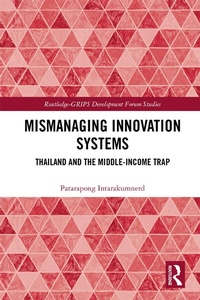
Mismanaging Innovation Systems
Thailand and the Middle-income Trap
Published on 22. September 2017
128 pages
978-1-351-36656-4 (ISBN)
Description

Once recognised as a high-performing newly industrialising Asian economy with the potential for economic and developmental success similar to South Korea, Taiwan, Hong Kong and Singapore, Thailand's growth rate and competitive edge have declined substantially. With slower adoption and movement towards the knowledge-intensive industries, the loss of the competitive edge is a cause of growing concern among Thai policymakers, with Thailand succumbing to the middle-income trap. This book analyses Thailand's declining competitiveness in the past 50 years, considering both the national and sectoral roles and capabilities of key players, including the government, universities and research institutes, as well as the electronics, food, and automotive industries.
Including comparative analyses with other Asian nations, this book is a must-read for both students and practitioners with interests in development economics, industrial economics and public policy.
Including comparative analyses with other Asian nations, this book is a must-read for both students and practitioners with interests in development economics, industrial economics and public policy.
Reviews / Votes
'Mismanaging Innovation Systems: Thailand and the Middle-income Trap by Patarapong Intarakumnerd looks at the problems of innovation systems of Thailand, and their contributions to the failure to emerge from the middle-income trap. It makes comparison with other more successful countries like those of East Asia (Japan, Korea and Taiwan) and Singapore. It draws lessons from misdirected or incomplete measures taken by successive governments in the past twenty years to stimulate the innovation systems successfully so as to launch the country in the path away from the middle-income trap. The diagnosis and solutions suggested are well worth serious consideration by those involved in trying to solve the problems, although like a moderate student in the classroom, more comparison with other moderate students like Malaysia, Vietnam, Philippines and Indonesia would also help in improving future performance. The student would also be encouraged by examples of past actions, albeit only a few, which were in the "right" directions.' - Yongyuth Yuthavong, Former Deputy Prime Minister and Minister of Science and Technology, Thailand'Mismanaging Innovation Systems is an important, timely and provocative volume. There is much debate about the meaning and origins of the so-called 'middle income trap'. But what is clear in the case of Thailand is that the country's earlier economic dynamism has waned, and that a new economic model is needed to regain that dynamism. Skills and innovation will be central to this new development strategy. Policy makers and academics in Thailand and other middle-income developing countries will benefit greatly from a close study of Dr Patarapong's pioneering analysis.' - Professor Hal Hill, Australian National University
'This is an important subject and a timely book. Thailand's economy, once pictured as a tiger, is now said to be caught in a trap. Where is the failure located-in the education system, in government policy-making, or in how firms behave? Patarapong Intarakumnerd looks at the problem, not from the old angle of "economic development" but rather "innovations systems". He examines how government, education institutions, firms, and others work together. He shows that there have been some successful cases, but they are too limited in extent. This fascinating and practical book shows a way to set the tiger free again.' - Pasuk Phongpaichit, Professor, Faculty of Economics, Chulalongkorn University
'In 2016, the Prayut administration decided to introduce a new national strategy of "Thailand 4.0" to overcome the problem of the middle-income trap which Thailand has suffered for the past decade. "Thailand 4.0" comprises of a variety of ideas such as the rehabilitation of the Eastern Seaboard Industrial Development (now Eastern Economic Corridor or EEC), the development of digital economy, and the promotion of next-generation industries like robotics and smart electronics. Keywords in "Thailand 4.0" are value-based economy, creativity, and innovation. The new national strategy invites people to turn their eyes towards historical questions of how the Thai government has designed science and technology policy at the macro level and how foreign and local firms have promoted innovative works at the micro level. Intarakumnerd's book is a comprehensive academic work to fully answer these important questions. This book includes: the overview of the government policies relating to national innovation system; evaluation of the roles and capabilities of key players such as firms, public research institutions, universities and industrial associations; and in-depth empirical studies of innovative works in three major sectors including electronics, automotive and seafood industries. This book is very valuable for students and policy makers who are interested in the trajectory and prospects of newly emerging Asian economies.' - Akira Suehiro, Professor and Dean, Faculty of International Social Sciences, Gakushuin University, and Professor Emeritus, University of Tokyo
More details
Series
Language
English
Place of publication
London
United Kingdom
Publishing group
Taylor & Francis Ltd
Target group
College/higher education
Illustrations
11 Tables, black and white
File size
0,76 MB
ISBN-13
978-1-351-36656-4 (9781351366564)
Copyright in bibliographic data and cover images is held by Nielsen Book Services Limited or by the publishers or by their respective licensors: all rights reserved.
Schweitzer Classification
Other editions
Additional editions
Book
09/2019
1st Edition
Routledge
€67.50
Shipment within 15-20 days
Book
09/2017
1st Edition
Routledge
€215.41
Shipment within 10-20 days
Person
Patarapong Intarakumnerd is Professor at the National Graduate Institute for Policy Studies (GRIPS) in Tokyo, Japan. He is a regional editor and member of international editorial boards of several international journals relating to innovation management and policies. He has worked as an advisor/consultant for the World Bank, UNESCO, UNCTAD, OECD, Japan International Cooperation Agency (JICA), German Development Institute, International Development Research Center of Canada, and Economic Research Institute of ASEAN and East Asia (ERIA).
Content
1. Introduction Part I: Thailand's National Innovation System: Performance of Key Actors 2. Science, Technology and Innovation Policy of the Thai Government 3. Technological Learning and Innovation of Firms in Thailand 4. Universities and Public Research Institutes 5. Innovation Financing 6. Institutions Part II: Sectoral Innovation Systems of Strategic Industries 7. Thai Electronic Industry 8. Thai Automotive Industry 9. Thai Seafood Industry
