

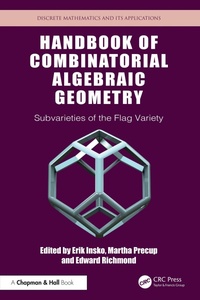
Handbook of Combinatorial Algebraic Geometry
Subvarieties of the Flag Variety
1st Edition
Will be published approx. on 17. July 2026
1060 pages
978-1-040-70079-2 (ISBN)
Description

This handbook presents a thorough introduction to current topics of mathematical research in combinatorial algebraic geometry. The editors' aim is to introduce researchers to key literature from the past 20-30 years needed to address open questions in the field. The chapters of Handbook of Combinatorial Algebraic Geometry: Subvarieties of the Flag Variety give concrete, computational examples of Lie-theoretic and combinatorial tools applied to the geometry of flag varieties and their subvarieties.
Lie theory provides a common language for the articles in this text, so while chapters are self-contained, it is recommended readers have some prior familiarity with the foundations of the subject. Each chapter benefits multiple sets of readers including:
Graduate students seeking to conduct research in algebraic combinatorics and Lie theory. New researchers will be introduced to relevant techniques used to prove key results and gain insight from leading researchers into the context of these results.
Experts in the field seeking insights and exposure to techniques and the finer expository points of related topics.
Mathematicians looking for a centralized reference on the geometry and combinatorics of flag varieties.
The topics of this handbook break down into four sections. The first section of this book consists of an introduction to the cohomology of flag varieties, Schubert varieties, and Schubert polynomials. The second section explores subvarieties of the flag variety that generalize or complement Schubert varieties in various ways. The third section of the book focuses on Hessenberg varieties. Finally, the last section explores additional topics related to flag varieties.
Last, the editors include a brief word about a few things this book does not do. Although great care is taken to streamline notation, the avid reader will still find variation throughout the chapters. This is reflective of, and prepares the reader for, the state of the field. For example, different notations for Richardson varieties typically appear in work on positivity than in other subfields of combinatorial algebraic geometry.
The editors and contributors hope readers find this book useful and enjoyable.
Lie theory provides a common language for the articles in this text, so while chapters are self-contained, it is recommended readers have some prior familiarity with the foundations of the subject. Each chapter benefits multiple sets of readers including:
Graduate students seeking to conduct research in algebraic combinatorics and Lie theory. New researchers will be introduced to relevant techniques used to prove key results and gain insight from leading researchers into the context of these results.
Experts in the field seeking insights and exposure to techniques and the finer expository points of related topics.
Mathematicians looking for a centralized reference on the geometry and combinatorics of flag varieties.
The topics of this handbook break down into four sections. The first section of this book consists of an introduction to the cohomology of flag varieties, Schubert varieties, and Schubert polynomials. The second section explores subvarieties of the flag variety that generalize or complement Schubert varieties in various ways. The third section of the book focuses on Hessenberg varieties. Finally, the last section explores additional topics related to flag varieties.
Last, the editors include a brief word about a few things this book does not do. Although great care is taken to streamline notation, the avid reader will still find variation throughout the chapters. This is reflective of, and prepares the reader for, the state of the field. For example, different notations for Richardson varieties typically appear in work on positivity than in other subfields of combinatorial algebraic geometry.
The editors and contributors hope readers find this book useful and enjoyable.
More details
Series
Edition
1. Auflage
Language
English
Place of publication
London
United Kingdom
Publishing group
Taylor & Francis Ltd
Target group
College/higher education
Professional and scholarly
Product notice
Reflowable
Illustrations
23 Tables, color; 223 Line drawings, color; 1 Halftones, color; 224 Illustrations, color
File size
25,61 MB
ISBN-13
978-1-040-70079-2 (9781040700792)
Copyright in bibliographic data and cover images is held by Nielsen Book Services Limited or by the publishers or by their respective licensors: all rights reserved.
Schweitzer Classification
Other editions
Additional editions
Erik Insko | Martha Precup | Edward Richmond
Handbook of Combinatorial Algebraic Geometry
Subvarieties of the Flag Variety
Book
approx. 07/2026
1st Edition
Chapman & Hall/CRC
€284.50
Not yet published
Persons
Erik Insko received his Ph.D. in Mathematics in 2012 under the guidance of Julianna Tymoczko. He served on the faculty at Florida Gulf Coast University from 2012 to 2023 before joining Central College as a Professor of Mathematics and Computer Science. He enjoys mentoring student researchers and was awarded the Mid-Career Faculty Mentor Award by the Council on Undergraduate Research in the Mathematics and Computer Science Division in 2021. His research interests lie in Algebraic Combinatorics and Graph Theory. He has 26 publications indexed on MathSciNet.
Martha Precup received her Ph.D. in Mathematics from the University of Notre Dame in 2013 under the supervision of Samuel Evens. She subsequently held postdoctoral fellowships at Baylor University and Northwestern University. Since 2018, she has been a faculty member at Washington University in St. Louis, where she is now an Associate Professor. Precup has an active and growing research program, with 19 publications listed on MathSciNet. She previously held a single-PI NSF research grant and currently holds an NSF CAREER award. She was recently awarded the 2026-2027 Ruth I. Michler Prize by the Association for Women in Mathematics.
Edward Richmond received his Ph.D. in Mathematics in 2008 from the University of North Carolina at Chapel Hill under the direction of Prakash Belkale. He has held postdoctoral appointments at the University of Oregon and the University of British Columbia. Since 2014, he has been a faculty member at Oklahoma State University, where he is now a Professor and the Director of Graduate Studies. His research lies in algebraic combinatorics and Lie theory, with a focus on Schubert varieties, flag varieties, and related combinatorial and geometric objects. He has 23 publications listed on MathSciNet and his work has been supported by the NSA and the Simons Foundation.
Martha Precup received her Ph.D. in Mathematics from the University of Notre Dame in 2013 under the supervision of Samuel Evens. She subsequently held postdoctoral fellowships at Baylor University and Northwestern University. Since 2018, she has been a faculty member at Washington University in St. Louis, where she is now an Associate Professor. Precup has an active and growing research program, with 19 publications listed on MathSciNet. She previously held a single-PI NSF research grant and currently holds an NSF CAREER award. She was recently awarded the 2026-2027 Ruth I. Michler Prize by the Association for Women in Mathematics.
Edward Richmond received his Ph.D. in Mathematics in 2008 from the University of North Carolina at Chapel Hill under the direction of Prakash Belkale. He has held postdoctoral appointments at the University of Oregon and the University of British Columbia. Since 2014, he has been a faculty member at Oklahoma State University, where he is now a Professor and the Director of Graduate Studies. His research lies in algebraic combinatorics and Lie theory, with a focus on Schubert varieties, flag varieties, and related combinatorial and geometric objects. He has 23 publications listed on MathSciNet and his work has been supported by the NSA and the Simons Foundation.
Content
Part 1: Flag varieties and Schubert varieties 1. Introduction to the Cohomology of the Flag Variety Part 2: Subvarieties of the flag variety 2. Schubert Geometry and Combinatorics 3. Richardson varieties, projected Richardson varieties and positroid varieties 4. Torus orbit closures in the flag variety 5. Pattern avoidance and K-orbit closures Part 3: Hessenberg Varieties 6. An Introduction to Hessenberg Varieties 7. The cohomology rings of regular nilpotent Hessenberg varieties 8. Hessenberg varieties and algebraic combinatorics of hyperplane arrangements 9. Combinatorics and Hessenberg Varieties Part 4: Additional topics 10. Generalizations of the flag variety tied to the Macdonald-theoretic delta operators 11. Nil-Hecke rings and Schubert calculus 12. Coxeter groups and Billey-Postnikov decompositions
