

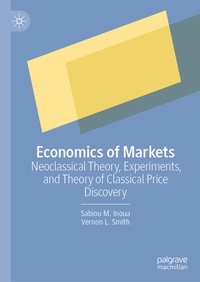
Economics of Markets
Description

This book establishes that neoclassical economics based on the marginal utility calculus failed to derive a theory of consumer market price discovery consistent with the experimental market evidence. Such markets involve inherently discrete final-demand items bought for consumption and not subject to resale. Classical economists following Adam Smith articulated a rich narrative of price discovery theory consistent with experimental evidence based on operational concepts of discrete demand values (maximum willingness-to-pay), and symmetrically, supply costs (minimum willingness-to-accept). We develop and extend a mathematical model of classical market price formation. Chapter 1 & 2 describes this theme and chapter 3 connects it with experiments. Chapter 4 builds on experimental examples for an intuitive overview of the theory. A partial equilibrium version of the theory constitutes Chapter 5. Chapter 6 extends this framework to price formation by wealth constrained agents in multiple-goods markets. Chapter 7 applies this framework to the study of re-tradable durable-goods and financial claims that are subject to sources of instability absent in markets for consumer non-durables.
More details
Other editions
Additional editions
Persons
Sabiou M. Inoua is a visiting research associate at the Economic Science Institute at Chapman University. His primary research now pertains to value theory and its intellectual history; his other research interests include the stylized facts of financial markets, the link between economic complexity and economic development, and the theory of inequality measurement.
Dr. Vernon L. Smith received the Nobel Prize in Economic Sciences in 2002 for his groundbreaking work in experimental economics. Dr. Smith has joint appointments with the Argyros School of Business & Economics and the School of Law, and is part of the team that has created the new Economic Science Institute at Chapman University. He is also a cofounder of The Smith Institute for Political Economy and Philosophy which has been established to create the Humanomics undergraduate research and education program at Chapman University.
Content
Chapter 1. Introduction.- Chapter 2. Rediscovering Classical Economics in the Laboratory.- Chapter 3. Price Formation: Overview of the Theory.- Chapter 4. Price Formation: Partial Equilibrium.- Chapter 5. Price Formation: General Equilibrium.- Chapter 6. Financial Instability: Re-tradable Assets and Speculation.
