

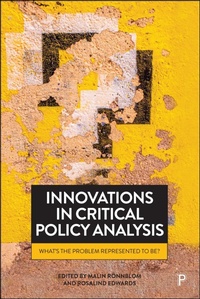
Innovations in Critical Policy Analysis
What's the Problem Represented to Be?
Policy Press
1st Edition
Published on 13. January 2026
224 pages
978-1-4473-7381-0 (ISBN)
Description

Public policy is often framed as a response to social problems rather than the cause of them. Carol Bacchi's influential 'What's the Problem Represented to Be?' (WPR) approach - first published in her 2009 book, Analysing Policy - addresses this contrast and has become an essential methodology for post-structural analysis of public policy.
This edited volume brings together leading international scholars to rethink, extend and reflect on the WPR approach in novel ways, demonstrating its applicability beyond policy documents and across diverse social science disciplines. It presents innovative perspectives on a radical methodology, making it a must-read for research methods scholars and critical policy analysts.
Engaging with multiple theories, concepts and purposes, this book provides cutting-edge insights and real-world applications that make it an essential tool for interrogating policy and power in practice.
This edited volume brings together leading international scholars to rethink, extend and reflect on the WPR approach in novel ways, demonstrating its applicability beyond policy documents and across diverse social science disciplines. It presents innovative perspectives on a radical methodology, making it a must-read for research methods scholars and critical policy analysts.
Engaging with multiple theories, concepts and purposes, this book provides cutting-edge insights and real-world applications that make it an essential tool for interrogating policy and power in practice.
Reviews / Votes
"This timely volume reflects the burgeoning of international and interdisciplinary engagements with the WPR approach for critical policy analysis. It will be an invaluable resource for researchers and policy activists." Susan Goodwin, The University of Sydney"This expertly curated volume invites readers to rediscover the critical foundations and innovative potential of the WPR approach - an inspiring catalyst for fresh thinking and reflexivity in critical policy research." Regine Paul, University of Bergen
"As a sophisticated treatise on the existing power and latent potential of the WPR approach, this book will excite anyone interested in the political contingencies of problematisations." Rebecca Hewer, University of Edinburgh
More details
Edition
First Edition
Language
English
Place of publication
Bristol
United Kingdom
Publishing group
Bristol University Press
Target group
Professional and scholarly
Illustrations
2 s/w Tabellen, 2 s/w Abbildungen
Not illustrated
File size
1,79 MB
ISBN-13
978-1-4473-7381-0 (9781447373810)
Copyright in bibliographic data and cover images is held by Nielsen Book Services Limited or by the publishers or by their respective licensors: all rights reserved.
Schweitzer Classification
Other editions
Additional editions
Innovations in Critical Policy Analysis
What's the Problem Represented to Be?
Book
approx. 01/2026
1st Edition
Policy Press
€120.50
Not yet published
Persons
Malin Roennblom is Professor of Political Science at Karlstad University.
Rosalind Edwards is Professor of Sociology at the University of Southampton.
Rosalind Edwards is Professor of Sociology at the University of Southampton.
Content
Thinking with the What's the problem represented to be? critical approach to research and analysis - Malin Roennblom and Rosalind Edwards
PART I: Rethinking WPR
2. What's the 'problem' of 'underlying health conditions' represented to be? Applying WPR to concepts - Carol Bacchi and Anne Wilson
3. Comparing and contrasting WPR and CDA: divergent conceptions of discourse and distinct analytical strategies - Jian Wu
4. Genealogy and WPR: the importance of Bacchi's questions when evoking a genealogical sensibility - Stephen Kelly
PART II: Extending WPR
5. WPR and construction of the object as lenses to understand governing families through AI technologies: combining
epistemologies - Rosalind Edwards and Pamela Ugwudike
6. Where critical hands touch: towards decolonial policy analysis - Amelia Odida
7. Where is the problem represented to be? - Tomas Mitander and Andreas OEjehag Pettersson
8. Emotional problems: post-structural policy analysis and emotional discourses in the case of birth tourism - Stephanie Paterson and Lindsay Larios
9. Winding up the future? The crank radio as policy - Lina Rahm and Jorgen Behrendtz
PART III: Reflecting on WPR
10. Enabling self-problematising? Strategically choosing re- analysis and co-authorship with an attention to difference - Hanne Marlene Dahl
11. Reflecting on the value of the WPR framework as a teaching tool in public policy analysis - John Boswell
12. Doing WPR with practitioners: from emotions to a potential for political change - Malin Roennblom
13. Concluding conversation on thinking with WPR - Malin Roennblom and Rosalind Edwards
PART I: Rethinking WPR
2. What's the 'problem' of 'underlying health conditions' represented to be? Applying WPR to concepts - Carol Bacchi and Anne Wilson
3. Comparing and contrasting WPR and CDA: divergent conceptions of discourse and distinct analytical strategies - Jian Wu
4. Genealogy and WPR: the importance of Bacchi's questions when evoking a genealogical sensibility - Stephen Kelly
PART II: Extending WPR
5. WPR and construction of the object as lenses to understand governing families through AI technologies: combining
epistemologies - Rosalind Edwards and Pamela Ugwudike
6. Where critical hands touch: towards decolonial policy analysis - Amelia Odida
7. Where is the problem represented to be? - Tomas Mitander and Andreas OEjehag Pettersson
8. Emotional problems: post-structural policy analysis and emotional discourses in the case of birth tourism - Stephanie Paterson and Lindsay Larios
9. Winding up the future? The crank radio as policy - Lina Rahm and Jorgen Behrendtz
PART III: Reflecting on WPR
10. Enabling self-problematising? Strategically choosing re- analysis and co-authorship with an attention to difference - Hanne Marlene Dahl
11. Reflecting on the value of the WPR framework as a teaching tool in public policy analysis - John Boswell
12. Doing WPR with practitioners: from emotions to a potential for political change - Malin Roennblom
13. Concluding conversation on thinking with WPR - Malin Roennblom and Rosalind Edwards
