
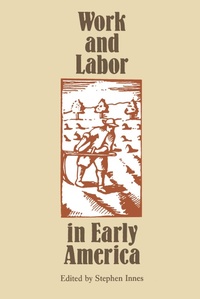
Work and Labor in Early America
Description
Alles über E-Books | Antworten auf Fragen rund um E-Books, Kopierschutz und Dateiformate finden Sie in unserem Info- & Hilfebereich.
Ten leading scholars of early American social history here examine the nature of work and labor in America from 1614 to 1820. The authors scrutinize work diaries, private and public records, and travelers' accounts. Subjects include farmers, farmwives, urban laborers, plantation slave workers, midwives, and sailors; locales range from Maine to the Caribbean and the high seas. These essays recover the regimen that consumed the waking hours of most adults in the New World, defined their economic lives, and shaped their larger existence. Focusing on individuals as well as groups, the authors emphasize the choices that, over time, might lead to prosperity or to the poorhouse. Few people enjoyed sinecures, and every day brought new risks. Stephen Innes introduces the collection by elucidating the prophetic vision of Captain John Smith: that the New World offered abundant reward for one’s “owne industrie.” Several motifs stand out in the essays. Family labor has begun to assume greater prominence, both as a collective work unit and as a collective economic unit whose members worked independently. Of growing interest to contemporary scholars is the role of family size and sex ratio in determining economic decision, and vice ersa. Work patterns appear to have been driven by the goal of creating surplus production for markets; perhaps because of a desire for higher consumption, work patterns began to intensify throughout the eighteenth century and led to longer work days with fewer slack periods. Overall, labor relations showed no consistent evolution but remained fluid and flexible in the face of changing market demands in highly diverse environments. The authors address as well the larger questions of American development and indicate the directions that research in this expanding field might follow.
All prices
More details
Other editions
Additional editions
Person
Stephen Innes is author of Labor in a New Land: Economy and Society in Seventeenth-Century Springfield.

System requirements
File format: ePUB
Copy protection: Adobe-DRM (Digital Rights Management)
System requirements:
- Computer (Windows; MacOS X; Linux): Install the free reader Adobe Digital Editions prior to download (see eBook Help).
- Tablet/smartphone (Android; iOS): Install the free app Adobe Digital Editions or the app PocketBook before downloading (see eBook Help).
- E-reader: Bookeen, Kobo, Pocketbook, Sony, Tolino and many more (not Kindle).
The file format ePub works well for novels and non-fiction books – i.e., „flowing” text without complex layout. On an e-reader or smartphone, line and page breaks automatically adjust to fit the small displays.
This eBook uses Adobe-DRM, a „hard” copy protection. If the necessary requirements are not met, unfortunately you will not be able to open the eBook. You will therefore need to prepare your reading hardware before downloading.
Please note: We strongly recommend that you authorise using your personal Adobe ID after installation of any reading software.
For more information, see our ebook Help page.
File format: PDF
Copy-Protection: Adobe-DRM (Digital Rights Management)
System requirements:
- Computer (Windows; MacOS X; Linux): Install the free reader Adobe Digital Editions prior to download (see eBook Help).
- Tablet/smartphone (Android; iOS): Install the free app Adobe Digital Editions or the app PocketBook before downloading (see eBook Help).
- E-reader: Bookeen, Kobo, Pocketbook, Sony, Tolino and many more (only limited: Kindle).
The file format PDF always displays a book page identically on any hardware. This makes PDF suitable for complex layouts such as those used in textbooks and reference books (images, tables, columns, footnotes). Unfortunately, on the small screens of e-readers or smartphones, PDFs are rather annoying, requiring too much scrolling.
This eBook uses Adobe-DRM, a „hard” copy protection. If the necessary requirements are not met, unfortunately you will not be able to open the eBook. You will therefore need to prepare your reading hardware before downloading.
Please note: We strongly recommend that you authorise using your personal Adobe ID after installation of any reading software.
For more information, see our eBook Help page.
File format: ePUB
Copy protection: Watermark-DRM (Digital Rights Management)
System requirements:
- Computer (Windows; MacOS X; Linux): Use a reading software that can process the file format ePUB: e.g., Adobe Digital Editions or FBReader – both free (see eBook Help).
- Tablet/Smartphone (Android; iOS): Before downloading, install the free app Adobe Digital Editions (see eBook Help).
- E-reader: Bookeen, Kobo, Pocketbook, Sony, Tolino and many more (not Kindle).
The file format ePUB works well for novels and non-fiction books – i.e., „flowing” text without complex layout. On an e-reader or smartphone, line and page breaks automatically adjust to fit the small displays.
This eBook uses Watermark-DRM, a „soft” copy protection. This means that there are no technical restrictions to prevent illegal distribution. However, there is a personalised watermark embedded in the eBook that can be used to identify the purchaser of the eBook in the event of misuse and to provide evidence for legal purposes.
For more information, see our eBook Help page.
