

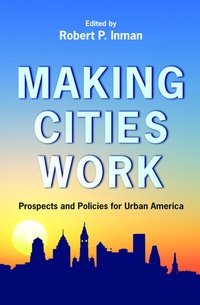
Making Cities Work
Prospects and Policies for Urban America
1st Edition
Published on 16. June 2015
432 pages
978-1-4008-3315-3 (ISBN)
Description

Making Cities Work brings together leading writers and scholars on urban America to offer critical perspectives on how to sustain prosperous, livable cities in today's fast-evolving economy. Successful cities provide jobs, quality schools, safe and clean neighborhoods, effective transportation, and welcoming spaces for all residents. But cities must be managed well if they are to remain attractive places to work, relax, and raise a family; otherwise residents, firms, and workers will leave and the social and economic advantages of city living will be lost.
Drawing on cutting-edge research in the social sciences, the contributors explore optimal ways to manage the modern city and propose solutions to today's most pressing urban problems. Topics include the urban economy, transportation, housing and open space, immigration, race, the impacts of poverty on children, education, crime, and financing and managing services. The contributors show how to make cities work for diverse urban constituencies, and why we still need cities despite the many challenges they pose. Making Cities Work brings the latest findings in urban economics to policymakers, researchers, and students, as well as anyone interested in urban affairs.
In addition to the editor, the contributors are David Card, Philip J. Cook, Janet Currie, Edward L. Glaeser, Joseph Gyourko, Richard J. Murnane, Witold Rybczynski, Kenneth A. Small, and Jacob L. Vigdor.
Drawing on cutting-edge research in the social sciences, the contributors explore optimal ways to manage the modern city and propose solutions to today's most pressing urban problems. Topics include the urban economy, transportation, housing and open space, immigration, race, the impacts of poverty on children, education, crime, and financing and managing services. The contributors show how to make cities work for diverse urban constituencies, and why we still need cities despite the many challenges they pose. Making Cities Work brings the latest findings in urban economics to policymakers, researchers, and students, as well as anyone interested in urban affairs.
In addition to the editor, the contributors are David Card, Philip J. Cook, Janet Currie, Edward L. Glaeser, Joseph Gyourko, Richard J. Murnane, Witold Rybczynski, Kenneth A. Small, and Jacob L. Vigdor.
More details
Edition
Course Book
Language
English
Place of publication
Princeton, NJ
United States
Publishing group
De Gruyter
Target group
Professional and scholarly
Edition type
Digital original
Illustrations
53 line illus. 36 tables.
File size
1,19 MB
ISBN-13
978-1-4008-3315-3 (9781400833153)
Schweitzer Classification
Other editions
Additional editions
Book
02/2009
Princeton University Press
€80.47
Article exhausted; check different version
Book
01/2009
Princeton University Press
€45.70
Shipment within 10-20 days
Person
Robert P. Inman is the Richard K. Mellon Professor, Finance and Economics, at the Wharton School of the University of Pennsylvania. His books include Managing the Service Economy.
Content
List of Illustrations and Tables vii
Foreword by Robert P. Inman xi
Acknowledgments by Robert P. Inman xiii
Contributors xv
Chapter 1: Introduction: City Prospects, City Policies by Robert P. Inman 1
Chapter 2: Growth: The Death and Life of Cities by Edward L. Glaeser 22
Chapter 3: Transportation: Urban Transportation Policy by Kenneth A. Small 63
Chapter 4: Space: The Design of the Urban Environment by Witold Rybczynski 94
Chapter 5: Housing: Urban Housing Markets by Joseph Gyourko 123
Chapter 6: Immigration: How Immigration Affects U.S. Cities by David Card 158
Chapter 7: Race: The Perplexing Persistence of Race by Jacob L. Vigdor 201
Chapter 8: Poverty: Poverty among Inner-City Children by Janet Currie 226
Chapter 9: Education: Educating Urban Children by Richard J. Murnane 269
Chapter 10: Crime: Crime in the City by Philip J. Cook 297
Chapter 11: Finances: Financing City Services by Robert P. Inman 328
Index 363
Foreword by Robert P. Inman xi
Acknowledgments by Robert P. Inman xiii
Contributors xv
Chapter 1: Introduction: City Prospects, City Policies by Robert P. Inman 1
Chapter 2: Growth: The Death and Life of Cities by Edward L. Glaeser 22
Chapter 3: Transportation: Urban Transportation Policy by Kenneth A. Small 63
Chapter 4: Space: The Design of the Urban Environment by Witold Rybczynski 94
Chapter 5: Housing: Urban Housing Markets by Joseph Gyourko 123
Chapter 6: Immigration: How Immigration Affects U.S. Cities by David Card 158
Chapter 7: Race: The Perplexing Persistence of Race by Jacob L. Vigdor 201
Chapter 8: Poverty: Poverty among Inner-City Children by Janet Currie 226
Chapter 9: Education: Educating Urban Children by Richard J. Murnane 269
Chapter 10: Crime: Crime in the City by Philip J. Cook 297
Chapter 11: Finances: Financing City Services by Robert P. Inman 328
Index 363
