

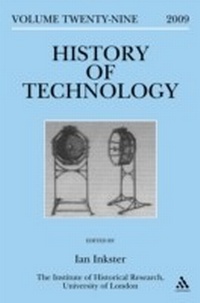
History of Technology Volume 29
Technology in China
1st Edition
Published on 15. June 2010
232 pages
978-1-4411-7708-7 (ISBN)
Description

The common question from the western point of view is of the sort; why did China lose its early leadership of productive technologies to Europe during the early modern period? Answers to this seemingly clear enquiry vary from general cultural inwardness to the interferences of imperial governance. This collection surveys such theories but alters the issue by raising the notion that Chinese technologies did not so much fail as move along a path different from that of Europe.
Our second collection on the Mindful Hand, also shifts common ground by querying and modifying common views of the links between knowledge and technique in early-modern European development. Scientific or related knowledge was not brought to technique as a socio-cultural gift from an educated elite to the working man. Rather, educated gents, practitioners, instrument makers, craftsfolk and technicians of all kinds intermingled both socially and in terms of the recognition of technical problems as well as in the assemblage of the mental, commercial and cognitive resources required to pursue innovative production projects.
Our second collection on the Mindful Hand, also shifts common ground by querying and modifying common views of the links between knowledge and technique in early-modern European development. Scientific or related knowledge was not brought to technique as a socio-cultural gift from an educated elite to the working man. Rather, educated gents, practitioners, instrument makers, craftsfolk and technicians of all kinds intermingled both socially and in terms of the recognition of technical problems as well as in the assemblage of the mental, commercial and cognitive resources required to pursue innovative production projects.
Reviews / Votes
"This volume of the series is devoted entirely to two special issues. The first explores the divergence between Chinese and European technology during the early modern period. Restating the conventional question of why Chinese technology failed, five studies show how the progression there was logical, and it was Europe that veered off. They cover cultural logics for the regime of useful knowledge and the movers and shakers of knowledge during the Ming and early Qing around 1400-1700, and provide a historiographical survey and elaboration and a review of recent revisionist scholarship in Western languages. The second issue challenges the assumption--by academics, of course--that practical knowledge was bestowed by the intellectual elite on technicians during the early modern period in Europe. A more accurate representation, six papers argue, is that the two groups mingled, artisans recognizing the value of a knowledge base, and experimenters learning techniques and identifying problems to solve. Topics there include crystals and the recreation of nature in 17th-century garden caves and cabinets, the inventions and identity of Ivan Petrovich Kulibin in 18th-century St. Petersburg, and Dutch-Japanese trade during the second half of the 18th century." -Eithne O'Leyne, BOOK NEWS, Inc.More details
Series
Language
English
Place of publication
New York
United States
Target group
Professional and scholarly
Illustrations
20
ISBN-13
978-1-4411-7708-7 (9781441177087)
Copyright in bibliographic data and cover images is held by Nielsen Book Services Limited or by the publishers or by their respective licensors: all rights reserved.
Schweitzer Classification
Other editions
Additional editions
Book
12/2009
Continuum Publishing Corporation
€263.90
Shipment within 15-20 days
Person
Ian Inkster is Professorial Research Associate at the School of Oriental and African Studies, University of London, UK.
Content
Ian Inkster, 'Introduction to volume 29'.
Special Issue: Kent Deng and Jerry Liu ed., Chinese Technological History: The Great Divergence.
Deng and Liu, 'Editorial Introduction'.
Patrick K. O'Brien, 'The Needham Question Updated: a Historiographical Survey and Elaboration'.
Jerry C.Y. Liu, 'Cultural Logics for the Regime of Useful Knowledge during the Ming and early Qing China c. 1400-1700'.
Harriet T. Zurndorfer, 'China and Science on the Eve of the 'Great Divergence' 1600-1800: A review of recent revisionist scholarship in Western languages'.
Kent Deng, 'Movers and Shakers of Knowledge in China during the Ming-Qing Period'.
Special Issue : Lissa Roberts and Ian Inkster ed., Mindful Hand.
Lissa Roberts, 'Introduction'.
Alette Fleischer, 'From darkness into light: The transformation of rock crystal into an object of adornment and revelation'.
Chandra Mukerji, 'The Mindful Hands of Peasants: Construction of an Eight-Lock Staircase at Fonseranes, 1678-1679'.
Simon Werrett, 'Enlightenment in Russian Hands: Instruments, Inventions, and Ivan Petrovich Kulibin in Eighteenth-Century St. Petersburg'.
Lissa Roberts, 'The mindful hand goes to Japan. Dutch-Japanese trade in the second half of the eighteenth century'.
Ian Inkster, 'Conclusions'.
Special Issue: Kent Deng and Jerry Liu ed., Chinese Technological History: The Great Divergence.
Deng and Liu, 'Editorial Introduction'.
Patrick K. O'Brien, 'The Needham Question Updated: a Historiographical Survey and Elaboration'.
Jerry C.Y. Liu, 'Cultural Logics for the Regime of Useful Knowledge during the Ming and early Qing China c. 1400-1700'.
Harriet T. Zurndorfer, 'China and Science on the Eve of the 'Great Divergence' 1600-1800: A review of recent revisionist scholarship in Western languages'.
Kent Deng, 'Movers and Shakers of Knowledge in China during the Ming-Qing Period'.
Special Issue : Lissa Roberts and Ian Inkster ed., Mindful Hand.
Lissa Roberts, 'Introduction'.
Alette Fleischer, 'From darkness into light: The transformation of rock crystal into an object of adornment and revelation'.
Chandra Mukerji, 'The Mindful Hands of Peasants: Construction of an Eight-Lock Staircase at Fonseranes, 1678-1679'.
Simon Werrett, 'Enlightenment in Russian Hands: Instruments, Inventions, and Ivan Petrovich Kulibin in Eighteenth-Century St. Petersburg'.
Lissa Roberts, 'The mindful hand goes to Japan. Dutch-Japanese trade in the second half of the eighteenth century'.
Ian Inkster, 'Conclusions'.
