

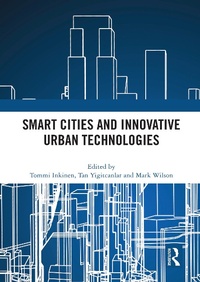
Smart Cities and Innovative Urban Technologies
1st Edition
Published on 29. December 2020
168 pages
978-1-000-32950-6 (ISBN)
Description

Over the past decade smart urban technologies have begun to blanket our cities, forming the backbone of a large intelligent infrastructure. Along with this development, dissemination of the smart cities ideology has had a significant imprint on urban planning and development. Smart Cities and Innovative Urban Technologies focuses on the concepts of smart cities and innovative urban technologies. It contains research that provides insight into spatial formations of information and communication technologies, and knowledge production practices from various perspectives-including analyses of public and private sectors together with NGOs and other stakeholders. It provides a state-of-the-art analysis from multidisciplinary point-of-view in urban studies.
Contributions in this edited volume include theoretical developments as well as empirical analyses. This book will be of great use to various audiences including academics as well as practitioners, spatial developers, planners, and public administrators in order to increase understanding of the dynamics and factors effecting smart cities conceptual maturation and their physical emergence. Information generated in these chapters, particularly regarding the challenges and obstacles of smart cities and innovative urban technologies, are intended to be of benefit to the key local actors in making decision in their cities or/and peripheral locations.
This book was originally published as a special issue of the Journal of Urban Technology.
Contributions in this edited volume include theoretical developments as well as empirical analyses. This book will be of great use to various audiences including academics as well as practitioners, spatial developers, planners, and public administrators in order to increase understanding of the dynamics and factors effecting smart cities conceptual maturation and their physical emergence. Information generated in these chapters, particularly regarding the challenges and obstacles of smart cities and innovative urban technologies, are intended to be of benefit to the key local actors in making decision in their cities or/and peripheral locations.
This book was originally published as a special issue of the Journal of Urban Technology.
More details
Edition
1. Auflage
Language
English
Place of publication
London
United Kingdom
Publishing group
Taylor & Francis Ltd
Target group
College/higher education
ISBN-13
978-1-000-32950-6 (9781000329506)
Copyright in bibliographic data and cover images is held by Nielsen Book Services Limited or by the publishers or by their respective licensors: all rights reserved.
Schweitzer Classification
Other editions
Additional editions
Tommi Inkinen | Tan Yigitcanlar | Mark Wilson
Smart Cities and Innovative Urban Technologies
Book
09/2023
1st Edition
Routledge
€51.98
Shipment within 15-20 days
Tommi Inkinen | Tan Yigitcanlar | Mark Wilson
Smart Cities and Innovative Urban Technologies
Book
12/2020
1st Edition
Routledge
€179.51
Shipment within 15-20 days
Persons
Tommi Inkinen is Professor and Research Director at the University of Turku, Finland. He is a current chairman of the International Geographical Union's (IGU) Innovation, Information and Technology Commission and serves in editorial boards of several international journals.
Tan Yigitcanlar is Associate Professor at Queensland University of Technology, Australia. He also carries out an Honorary Professor role at the School of Technology, Federal University of Santa Catarina, Florianopolis, Brazil, and the Founding Director positions of Urban Studies Lab, and Australia-Brazil Smart City Research and Practice Network.
Mark Wilson is Professor at School of Planning, Design and Construction, Michigan State University, USA. He is the director of the Planning, Design and Construction doctorate program. His research and teaching interests address urban planning, information technology, economic geography, public policy and non-profit organizations.
Tan Yigitcanlar is Associate Professor at Queensland University of Technology, Australia. He also carries out an Honorary Professor role at the School of Technology, Federal University of Santa Catarina, Florianopolis, Brazil, and the Founding Director positions of Urban Studies Lab, and Australia-Brazil Smart City Research and Practice Network.
Mark Wilson is Professor at School of Planning, Design and Construction, Michigan State University, USA. He is the director of the Planning, Design and Construction doctorate program. His research and teaching interests address urban planning, information technology, economic geography, public policy and non-profit organizations.
Content
Introduction: Smart Cities and Innovative Urban Technologies
Tommi Inkinen, Tan Yigitcanlar and Mark Wilson
1. Smart City Planning from an Evolutionary Perspective
N. Komninos, C. Kakderi, A. Panori and P. Tsarchopoulos
2. Smart Cities and Mobility: Does the Smartness of Australian Cities Lead to Sustainable Commuting Patterns?
Tan Yigitcanlar and Md. Kamruzzaman
3. The (In)Security of Smart Cities: Vulnerabilities, Risks, Mitigation, and Prevention
Rob Kitchin and Martin Dodge
4. E-Capital and Economic Growth in European Metropolitan Areas: Applying Social Media Messaging in Technology-Based Urban Analysis
Juho Kiuru and Tommi Inkinen
5. How to Overcome the Dichotomous Nature of Smart City Research: Proposed Methodology and Results of a Pilot Study
Luca Mora, Mark Deakin, Alasdair Reid and Margarita Angelidou
6. "Mapping" Smart Cities
Becky P. Y. Loo and Winnie S. M. Tang
7. Towards Post-Anthropocentric Cities: Reconceptualizing Smart Cities to Evade Urban Ecocide
Tan Yigitcanlar, Marcus Foth and Md. Kamruzzaman
Tommi Inkinen, Tan Yigitcanlar and Mark Wilson
1. Smart City Planning from an Evolutionary Perspective
N. Komninos, C. Kakderi, A. Panori and P. Tsarchopoulos
2. Smart Cities and Mobility: Does the Smartness of Australian Cities Lead to Sustainable Commuting Patterns?
Tan Yigitcanlar and Md. Kamruzzaman
3. The (In)Security of Smart Cities: Vulnerabilities, Risks, Mitigation, and Prevention
Rob Kitchin and Martin Dodge
4. E-Capital and Economic Growth in European Metropolitan Areas: Applying Social Media Messaging in Technology-Based Urban Analysis
Juho Kiuru and Tommi Inkinen
5. How to Overcome the Dichotomous Nature of Smart City Research: Proposed Methodology and Results of a Pilot Study
Luca Mora, Mark Deakin, Alasdair Reid and Margarita Angelidou
6. "Mapping" Smart Cities
Becky P. Y. Loo and Winnie S. M. Tang
7. Towards Post-Anthropocentric Cities: Reconceptualizing Smart Cities to Evade Urban Ecocide
Tan Yigitcanlar, Marcus Foth and Md. Kamruzzaman
