

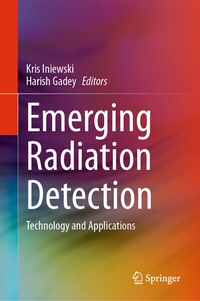
Emerging Radiation Detection
Description

This book provides readers an overview of emerging trends in the radiation detection field. Detailed in many of the chapters are specific aspects of radiation detectors, including comprehensive reviews of the historical development, and current state of each topic. The authors particularly cover emerging detection materials and detectors. High-Z materials like CdTe, CZT and GaAs offer the best implementation possibility of direct conversion X-ray detectors and are covered in this book. The authors discuss material challenges, detector operation physics and technology, and readout integrated circuits required to detect signals processes by high-Z sensors. Authors also contrast these emerging technologies with more established ones based on scintillator materials.
More details
Other editions
Additional editions
Persons
Krzysztof (Kris) Iniewski is a director of detector architectures and applications at Redlen Technologies Inc., a detector company based in British Columbia, Canada. During his 18 years at Redlen he has managed the development of highly integrated CZT detector products in medical imaging and security applications. Prior to Redlen Kris held various management and academic positions at PMC-Sierra, University of Alberta, SFU, UBC and University of Toronto. Dr. Iniewski has published over 150+ research papers in international journals and conferences. He holds 25+ international patents granted in USA, Canada, France, Germany, and Japan. He wrote and edited 75+ books for Wiley, Cambridge University Press, Mc-Graw Hill, CRC Press and Springer. He is a frequent invited speaker and has consulted for multiple organizations internationally.
Harish Gadey is a Spent Fuel Analyst at the Idaho National Laboratory (INL) specializing in the areas of radiation detection and spent fuel analysis with over 8 years of hands-on experience in Monte Carlo based simulations, spent fuel research, detector development, and systems analysis. Dr. Gadey is proficient in Geant4, MATLAB, Python, and CAD software packages. He has worked on a number of detector development efforts including several projects in the areas of radioxenon noble gas detection. Currently Dr. Gadey is focusing on reactor backend analysis, systems engineering, and spent fuel transportation. He has led and contributed to over 30 publications and conference presentations.
Content
Radiation Interactions with Matter.- Photon counting X-ray detectors.-, LYSO-GAPD Photon Counting Detectors for DEXA Applications.-Duo-Spectral Imaging with Multi-Layered Energy-Integrating Detectors.- A novel algorithm to create quantitative X-ray images based on precise analysis of polychromatic X-ray attenuation.- Characterization of noise and noise correlation in photon-counting CT for multi-material decomposition-based spectral imaging .-,Photon-counting computed tomography (PCCT) for radiation therapy.-,New approaches for metal artifact reduction in computed tomography.- Recent advances and clinical applications of low-dose dental cone-beam computed tomography.- High efficient Compton scattering computed tomography based on a Thomson scattering X-ray source.- Machine Learning for Contaminant Detection using X-ray Photon Counting.- Gamma Ray and Cosmic Ray Muon Modalities for Cargo Inspection.
