

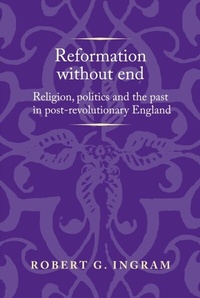
Reformation without End
Religion, Politics and the Past in Post-Revolutionary England
1st Edition
Published on 27. March 2018
384 pages
978-1-5261-2696-2 (ISBN)
Description

This study provides a radical reassessment of the English Reformation. No one in eighteenth-century England thought that they were living during 'the Enlightenment'; instead, they saw themselves as facing the religious, intellectual and political problems unleashed by the Reformation, which began in the sixteenth century. Moreover, they faced those problems in the aftermath of two bloody seventeenth-century political and religious revolutions. This book examines how the eighteenth-century English debated the causes and consequences of those revolutions and the thing they thought had caused them, the Reformation. It draws on a wide array of manuscript sources to show how authors crafted and pitched their works. -- .
Reviews / Votes
'Ingram's work is a brilliant engagement with the practice of history and theology, contextualizing them in the four ministers he anatomizes. In contrast to many other accounts of early modern religious debate, Ingram is a breath of fresh air.'J.C. Parks, Lehigh University, Left History
'In this remarkable book, Robert G. Ingram immerses the reader in the heated religious controversies that fueled the print culture of 18th-century England. [...] Through its sensitive and detailed analysis of the religious disputes of the polemical divines, Reformation without end therefore makes an important contribution to our understanding of the intellectual life of 18th-century England.'
Felicity Loughlin, University of St. Andrews, Reading Religion, July 2019
'By locating eighteenth-century politico-theological disputes as part of the "long Reformation," Ingram's study breaks new ground in the field of ecclesiastical history. [...] this study makes a fundamental contribution to our knowledge of polemical divinity in eighteenth-century England. Ingram is to be congratulated on writing such a stimulating and thought-provoking monograph. Not only does it enhance our understanding of the differing ways in which eighteenth-century divines interpreted the past, it also - and more importantly - shows that the past was always pertinent to theological controversies during this period.'
Simon Lewis, Trinity College, Dublin, Journal of Religious History
'Rich, sophisticated, finessed and fine-grained [...] this is a highly successful book, and essential reading on the mental universe of eighteenth-century English divines.'
Mark Goldie, Churchill College, Cambridge, Journal of Ecclesiastical History of books
'Ingram's conclusion raises interesting and provocative questions and opens up new avenues for other scholars to explore further, especially extending to a trans-Atlantic context. The book should appeal to scholars of early modern England, religious historians, and political historians as well.'
Journal of British Studies
'This is a clever book with many strands in play: we are learning not just about views of key arguments chiefly drawn from the seventeenth century, but also about the nature of the "Enlightenment" of the eighteenth century. Ingram explores the way in which eighteenth-century Britain was "revolution-haunted", for the debates were not only theological in nature, but also political in considering the causes and consequences of the British Civil Wars.'
Taylor & Francis Online
'This work is a remarkable achievement and an important contribution to intellectual, religious and political history. It will revolutionise our understanding of the eighteenth century and is a book that those working on the period will find indispensable.'
English Historical Review
'This is a clever book with many strands in play: we are learning not just about views of key arguments chiefly drawn from the seventeenth century, but also about the nature of the "Enlightenment" of the eighteenth century.'
The Seventeenth Century -- .
All prices
More details
Series
Language
English
Place of publication
United Kingdom
Target group
College/higher education
Illustrations
6 black & white illustrations
ISBN-13
978-1-5261-2696-2 (9781526126962)
Copyright in bibliographic data and cover images is held by Nielsen Book Services Limited or by the publishers or by their respective licensors: all rights reserved.
Schweitzer Classification
Other editions
Additional editions
Book
09/2019
Manchester University Press
€42.10
Shipment within 15-20 days
Book
03/2018
Manchester University Press
€131.50
Shipment within 15-20 days
Person
Content
Preface
1 Why then are we still reforming?
Part I: Purity of faith and worship against corruptions: Daniel Waterland
2 Truth is always the same
3 Philosophy-lectures or the Sermon on the Mount: Samuel Clarke and the Trinity
4 Has not reason been abused as well as religion?: Matthew Tindal and the Scriptures
5 The sacrament Socinianized: Benjamin Hoadly and the Eucharist
Part II: The history of the Church be fabulous: Conyers Middleton
6 I know not what to make of the author
7 Conversing...with the ancients: Rome and the Bible
8 Treating me worse, than I deserved: heterodoxy and the politics of patronage
9 Flood of resentment: assailing the primitive Church
Part III: Neither Jacobite, nor republican, Presbyterian, nor papist: Zachary Grey
10 Popery in its proper colours
11 Factions, seditions and schismatical principles: Puritans and Dissenters
12 The religion of the first ages: primitivism and the primitive Church
13 None of us are born free: self-restraint and salvation
Part IV: The abuses of fanaticism: William Warburton
14 The incendiaries of sedition and confusion
15 Neither a slave nor a tyrant: Church and state reimagined
16 The triumph of Christ over Julian: prodigies, miracles and providence
17 A due degree of zeal: enthusiasm and Methodism
Conclusion
Index -- .
1 Why then are we still reforming?
Part I: Purity of faith and worship against corruptions: Daniel Waterland
2 Truth is always the same
3 Philosophy-lectures or the Sermon on the Mount: Samuel Clarke and the Trinity
4 Has not reason been abused as well as religion?: Matthew Tindal and the Scriptures
5 The sacrament Socinianized: Benjamin Hoadly and the Eucharist
Part II: The history of the Church be fabulous: Conyers Middleton
6 I know not what to make of the author
7 Conversing...with the ancients: Rome and the Bible
8 Treating me worse, than I deserved: heterodoxy and the politics of patronage
9 Flood of resentment: assailing the primitive Church
Part III: Neither Jacobite, nor republican, Presbyterian, nor papist: Zachary Grey
10 Popery in its proper colours
11 Factions, seditions and schismatical principles: Puritans and Dissenters
12 The religion of the first ages: primitivism and the primitive Church
13 None of us are born free: self-restraint and salvation
Part IV: The abuses of fanaticism: William Warburton
14 The incendiaries of sedition and confusion
15 Neither a slave nor a tyrant: Church and state reimagined
16 The triumph of Christ over Julian: prodigies, miracles and providence
17 A due degree of zeal: enthusiasm and Methodism
Conclusion
Index -- .

