

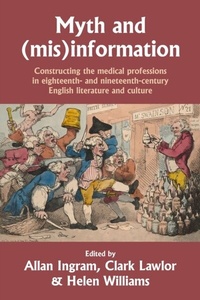
Myth and (Mis)Information
Constructing the Medical Professions in Eighteenth- and Nineteenth-Century English Literature and Culture
1st Edition
Published on 25. June 2024
312 pages
978-1-5261-6683-8 (ISBN)
Description

This collection draws together original scholarship from international contributors on a range of aspects of professional and semi-professional medical work and its relations to British culture. It combines a diverse spectrum of scholarly approaches, from medical history to book history, exploring literary and scientific texts, such as satiric poetry, essays, anatomies, advertisements, and the novel, to shed light on the mythologisation and transmission of medical (mis)information through literature and popular culture. It analyses the persuasive and sometimes deceptive means by which myths, as well as information and beliefs, about medicine and the medical professions proliferated in English literary culture of this period, from early eighteenth-century household remedies to the late nineteenth-century concerns with vaccination that are still relevant today. -- .
Reviews / Votes
'Myth and (Mis)information expand our understanding of what counts as science, who gets to make it,and how it circulates.'
SEL Summer 63, 3 Thematic Review
'Studies of the connections between literature and medicine of the eighteenth and nineteenth centuries have increased in number over the past few years but rarely do we see such in-depth studies of the lexical and textual mechanics of this intersection. The stimulating essays of Myth and (mis)information remind us that important debates about truth, meaning, and representation go to the heart of the social and global history of medicine and that if we are to understand the present, we must first take an interdisciplinary, collaborative approach to the languages of the past.'
-Professor Andrew Mangham, University of Reading
'Myth and (mis)information is a must read for anyone in search of new insights into the modern medical marketplace, the circulation of knowledge, reader-reception of medical texts, and the shaping of medical culture. In a post-COVID era, it skilfully historicises the current anxieties we have about health misinformation. The book encompasses multiple aspects of medical writings within a cultural and historical perspective: women publishers, herbalists and healers, overlooked texts by medical celebrities, dog doctors, illness narratives of poxed men, medical branding and advertising, medical controversies on epidemics, vaccination or anatomy. A rattling good read!'
-Sophie Vasset, Institut de Recherches sur la Renaissance, l'Age Classique et les Lumieres (IRCL), Universite de Montpellier Paul-Valery -- .
All prices
More details
Language
English
Place of publication
United Kingdom
Illustrations
23 illustrations
ISBN-13
978-1-5261-6683-8 (9781526166838)
Copyright in bibliographic data and cover images is held by Nielsen Book Services Limited or by the publishers or by their respective licensors: all rights reserved.
Schweitzer Classification
Other editions
Additional editions
Allan Ingram | Helen Williams | Clark Lawlor
Myth and (Mis)Information
Constructing the Medical Professions in Eighteenth- and Nineteenth-Century English Literature and Culture
Book
04/2024
Manchester University Press
€125.70
Shipment within 15-20 days
Persons
Allan Ingram is Emeritus Professor of English at the University of Northumbria
Clark Lawlor is Professor of Eighteenth-Century Literature at the University of Northumbria
Helen Williams is Associate Professor of English Literature at the University of Northumbria -- .
Clark Lawlor is Professor of Eighteenth-Century Literature at the University of Northumbria
Helen Williams is Associate Professor of English Literature at the University of Northumbria -- .
Content
Introduction - Clark Lawlor and Helen Williams
1. "To level those monstrous Blotches or Pustules": Skincare in De Morbis Cutaneis (1714) - Katherine Aske
2. Dr John Arbuthnot's Literary Treatment for False Learning, Pedantry, and Excess: from Physic to Metaphysics - John Baker
3. "The very women read it": Medical Self-Fashioning, Mythologies and (Mis)Information in George Cheyne M.D.'s Medical Writings - Clark Lawlor
4. Studying in Solitude: Demythologising the Masculine Medical Monopoly with Jane Barker's Galesia and Tobias Smollett's Sagely - Laurence Sullivan
5. "Take physic, Pomp": Imagining Dog Doctors in Eighteenth-Century Britain - Stephanie Howard-Smith
6. "A man of common understanding": Venereal Disease, Myth, and Reading as a Protective Practice in Eighteenth-Century Britain - Declan Kavanagh
7. Sir Anthony Carlisle's Gothic (Medical) Intervention: Carving the Criminal Body in The Horrors of Oakendale Abbey - Bethany Brigham
8. Mislabelling and the Medical Printer-Publisher: Demystifying the Ephemera of Elizabeth Rane Cox (1765-1841) - Helen Williams
9. The Uneasy Relationship between Traditional and Orthodox Medicine in the Works of Elizabeth Gaskell - Barbara Witucki
10. Medical Men Recommend Them: Branded Medicines and the Myth of the Medical Moral Economy c. 1876-1880 - Laura Robson-Mainwaring
11. Dissecting Venus: Popular Consumption of Flap Anatomies, 1890-1910 - Jessica Dandona
12. "You taught us that which you knew not to be the truth": The Anti-Vaccination Medical Doctor in Henry Rider Haggard's Doctor Therne (1898) - Carlotta Fiammenghi
Afterword - Allan Ingram
Index -- .
1. "To level those monstrous Blotches or Pustules": Skincare in De Morbis Cutaneis (1714) - Katherine Aske
2. Dr John Arbuthnot's Literary Treatment for False Learning, Pedantry, and Excess: from Physic to Metaphysics - John Baker
3. "The very women read it": Medical Self-Fashioning, Mythologies and (Mis)Information in George Cheyne M.D.'s Medical Writings - Clark Lawlor
4. Studying in Solitude: Demythologising the Masculine Medical Monopoly with Jane Barker's Galesia and Tobias Smollett's Sagely - Laurence Sullivan
5. "Take physic, Pomp": Imagining Dog Doctors in Eighteenth-Century Britain - Stephanie Howard-Smith
6. "A man of common understanding": Venereal Disease, Myth, and Reading as a Protective Practice in Eighteenth-Century Britain - Declan Kavanagh
7. Sir Anthony Carlisle's Gothic (Medical) Intervention: Carving the Criminal Body in The Horrors of Oakendale Abbey - Bethany Brigham
8. Mislabelling and the Medical Printer-Publisher: Demystifying the Ephemera of Elizabeth Rane Cox (1765-1841) - Helen Williams
9. The Uneasy Relationship between Traditional and Orthodox Medicine in the Works of Elizabeth Gaskell - Barbara Witucki
10. Medical Men Recommend Them: Branded Medicines and the Myth of the Medical Moral Economy c. 1876-1880 - Laura Robson-Mainwaring
11. Dissecting Venus: Popular Consumption of Flap Anatomies, 1890-1910 - Jessica Dandona
12. "You taught us that which you knew not to be the truth": The Anti-Vaccination Medical Doctor in Henry Rider Haggard's Doctor Therne (1898) - Carlotta Fiammenghi
Afterword - Allan Ingram
Index -- .
