

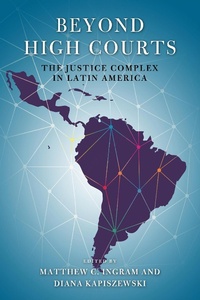
Beyond High Courts
The Justice Complex in Latin America
1st Edition
Published on 15. May 2019
382 pages
978-0-268-10284-5 (ISBN)
Description

Beyond High Courts: The Justice Complex in Latin America is a much-needed volume that will make a significant contribution to the growing fields of comparative law and politics and Latin American legal institutions. The book moves these research agendas beyond the study of high courts by offering theoretically and conceptually rich empirical analyses of a set of critical supranational, national, and subnational justice sector institutions that are generally neglected in the literature. The chapters examine the region's large federal systems (Argentina, Brazil, and Mexico), courts in Chile and Venezuela, and the main supranational tribunal in the region, the Inter-American Court of Human Rights. Aimed at students of comparative legal institutions while simultaneously offering lessons for practitioners charged with designing such institutions, the volume advances our understanding of the design of justice institutions, how their form and function change over time, what causes those changes, and what consequences they have. The volume also pays close attention to how justice institutions function as a system, exploring institutional interactions across branches and among levels of government (subnational, national, supranational) and analyzing how they help to shape, and are shaped by, politics and law. Incorporating the institutions examined in the volume into the literature on comparative legal institutions deepens our understanding of justice systems and how their component institutions can both bolster and compromise democracy and the rule of law.
Contributors: Matthew C. Ingram, Diana Kapiszewski, Azul A. Aguiar-Aguilar, Ernani Carvalho, Natalia Leitao, Catalina Smulovitz, John Seth Alexander, Robert Nyenhuis, Sidia Maria Porto Lima, Jose Mario Wanderley Gomes Neto, Danilo Pacheco Fernandes, Louis Dantas de Andrade, Mary L. Volcansek, and Martin Shapiro.
Contributors: Matthew C. Ingram, Diana Kapiszewski, Azul A. Aguiar-Aguilar, Ernani Carvalho, Natalia Leitao, Catalina Smulovitz, John Seth Alexander, Robert Nyenhuis, Sidia Maria Porto Lima, Jose Mario Wanderley Gomes Neto, Danilo Pacheco Fernandes, Louis Dantas de Andrade, Mary L. Volcansek, and Martin Shapiro.
Reviews / Votes
"The most important contribution of Beyond High Courts is shedding light on fascinating institutions that have received, quite undeservedly, little scholarly attention. In addition, these remarkable chapters offer interesting analytical and theoretical lessons. Readers from different disciplines that are interested in law and courts or socio-legal studies will find many gems in each chapter included within this edited volume." -Bulletin of Latin American Research"As a researcher and teacher in comparative judicial politics, it is exciting to see a new work on non-peak judicial institutions. Beyond High Courts: The Justice Complex in Latin America makes an important contribution to the field. The contributors address a clear set of questions across an array of judicial actors in Latin America. The volume contains comparative and single country case studies and helps to fill both empirical and theoretical gaps in the literature on comparative judicial politics." -Druscilla Scribner, University of Wisconsin, Oshkosh
"As is true in most of the democratic world, justice institutions in Latin America other than the Supreme Court are important yet understudied. Beyond High Courts: The Justice Complex in Latin America is an excellent contribution that helps address that lacuna." -Scott Mainwaring, Jorge Paulo Lemann Professor of Brazil Studies, Harvard Kennedy School
"Matthew Ingram and Diana Kapiszewski persuasively set out to design a new agenda in the study of judicial institutions in Latin America. The volume is aimed at political science students and those particularly interested in institutional configuration and design. It will also appeal to scholars and students of comparative law and other social science fields, because it provides rich descriptions and background information about little understood judicial institutions." -Lydia Brashear Tiede, University of Houston
All prices
More details
Series
Language
English
Place of publication
Notre Dame IN
United States
Target group
Professional and scholarly
Product notice
Reflowable
Illustrations
- 23 Tables, unspecified - 14 Line drawings, unspecified - 2 Maps
ISBN-13
978-0-268-10284-5 (9780268102845)
Copyright in bibliographic data and cover images is held by Nielsen Book Services Limited or by the publishers or by their respective licensors: all rights reserved.
Schweitzer Classification
Other editions
Additional editions
Book
05/2019
University of Notre Dame Press
€53.00
Shipment within 10-20 days
Persons
Matthew C. Ingram is associate professor of political science at the University at Albany, State University of New York. He is the author of Crafting Courts in New Democracies: The Politics of Subnational Judicial Reform in Brazil and Mexico.
Diana Kapiszewski is associate professor of government at Georgetown University. She is author, co-editor, and co-author of a number of books, including High Courts and Economic Governance in Argentina and Brazil.
Diana Kapiszewski is associate professor of government at Georgetown University. She is author, co-editor, and co-author of a number of books, including High Courts and Economic Governance in Argentina and Brazil.
Content
List of Figures and Tables
1. Introduction: Beyond High Courts by Matthew C. Ingram and Diana Kapiszewski
2. Reforms to the Public Prosecutor's Office in Brazil, Chile, and Mexico: The Role of Justice Sector Interest Groups by Azul A. Aguiar-Aguilar
3. Operationalizing and Measuring Prosecutorial Independence: The Brazilian Case by Ernani Carvalho and Natalia Leitao
4. Public Defense and Access to Justice in a Federal Context: Who Gets What, and How, in the Argentinean Provinces by Catalina Smulovitz
5. Judging Elections: Electoral Courts and Democracy in Latin America's Federal Systems by Diana Kapiszewski, John Seth Alexander, and Robert Nyenhuis
6. The Electoral Court and Party Politics in Brazil by Sidia Maria Porto Lima
7. Watching the Watchmen: The Role of the Brazilian Supreme Court's Chief Justice in Checking Lower Court Activism by Jose Mario Wanderley Gomes Neto, Ernani Carvalho, Danilo Pacheco Fernandes, and Louise Dantas de Andrade
8. Judicial Councils in Mexico: Design, Roles, and Origins at the National and Subnational Levels by Matthew C. Ingram
9. Transnational Protection of Human Rights in Latin America by Mary L. Volcansek and Matthew C. Ingram
10. Comparative Law and Courts Studies: Some Reflections and Directions by Martin Shapiro
List of Contributors
Index
1. Introduction: Beyond High Courts by Matthew C. Ingram and Diana Kapiszewski
2. Reforms to the Public Prosecutor's Office in Brazil, Chile, and Mexico: The Role of Justice Sector Interest Groups by Azul A. Aguiar-Aguilar
3. Operationalizing and Measuring Prosecutorial Independence: The Brazilian Case by Ernani Carvalho and Natalia Leitao
4. Public Defense and Access to Justice in a Federal Context: Who Gets What, and How, in the Argentinean Provinces by Catalina Smulovitz
5. Judging Elections: Electoral Courts and Democracy in Latin America's Federal Systems by Diana Kapiszewski, John Seth Alexander, and Robert Nyenhuis
6. The Electoral Court and Party Politics in Brazil by Sidia Maria Porto Lima
7. Watching the Watchmen: The Role of the Brazilian Supreme Court's Chief Justice in Checking Lower Court Activism by Jose Mario Wanderley Gomes Neto, Ernani Carvalho, Danilo Pacheco Fernandes, and Louise Dantas de Andrade
8. Judicial Councils in Mexico: Design, Roles, and Origins at the National and Subnational Levels by Matthew C. Ingram
9. Transnational Protection of Human Rights in Latin America by Mary L. Volcansek and Matthew C. Ingram
10. Comparative Law and Courts Studies: Some Reflections and Directions by Martin Shapiro
List of Contributors
Index
