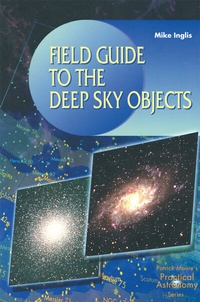
Field Guide to the Deep Sky Objects
Description

- Stars (bright, coloured, double, triple, quad, multiple);
- The spectral sequence;
- Clusters;
- Globular clusters;
- Stellar associations;
- Stellar streams;
- Nebulae (emission, dark, reflection, planetary);
- Supernovae remnants;
- Galaxies (spiral, elliptical, irregular).
Each of these groups is organised by month of best visibility, and within that by ease of observing. Simply, this means that you can choose a class of object, and for any month of the year find an observing list that begins with easiest through to progressively more difficult targets!
Amateur astronomers of all levels of ability will find this book invaluable for its broad-ranging background material, its lists of fascinating objects, and for its application as "graded exercises" to improve practical observing skills while viewing many different types of deep-sky object.
Reviews / Votes
From the reviews:
"Inglis's Field Guide to the Deep Sky Objects is brimming with information in tabular form. The statistical approach means fewer descriptions but permits consultation of material right at the telescope. I waded into the section on star clusters and was delighted to find notes on clusters of every dimension . . Each cluster garners two lines of stats but the best-known Messier and NGC entries blossom into informative and consistently well-written paragraphs. . Inglis has a dry wit and a friendly writing style." (Ken Hewitt-White, Sky & Telescope, November, 2001)
"The Field Guide to the Deep Sky Objects serves as a useful guide for observers of the sky. . the book provides a valuable introduction to astronomical observation. . This book's ability to allow readers to determine what one is able to see at any given time of the year . represents its most valuable and unique feature. . its ease of use should make the book appealing to general readers and amateur astronomers, in addition to those more advanced in stargazing." (Kymberly Goodson, E-STREAMS, Vol. 5 (10), 2002)
"New from Mike Inglis is the Field Guide to the Deep Sky Objects . . Good planning is the way to ensure best use of observing time and that's what this book is all about. The introductory chapter provides solid sensible advice on the art of observing ... . Field Guide to the Deep Sky Objects is a very useful aid to organized observing and I will certainly be using it to bring some organization to my observing nights!" (Astronomy & Space, June, 2001)
More details
Other editions
Additional editions