

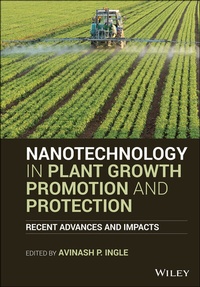
Nanotechnology in Plant Growth Promotion and Protection
Description

In Nanotechnology in Plant Growth Promotion and Protection, distinguished researcher and author Dr. Avinash P. Ingle delivers a rigorous and insightful collection of some of the latest developments in nanotechnology particularly related to plant growth promotion and protection. The book focuses broadly on the role played by nanotechnology in growth promotion of plants and their protection through the management of different microbial pathogens.
You'll learn about a wide variety of topics, including the role of nanomaterials in sustainable agriculture, how nano-fertilizers behave as soil feed, and the dual role of nanoparticles in plant growth promotion and phytopathogen management. You'll also discover why nanotechnology has the potential to revolutionize the current agricultural landscape through the development of nano-based products, like plant growth promoters, nano-fertilizers, nano-pesticides, and nano-insecticides.
Find out why nano-based products promise to be a cost-effective, economically viable, and eco-friendly approach to tackling some of the most intractable problems in agriculture today.
You'll also benefit from the inclusion of:
* A thorough introduction to the prospects and impacts of using nanotechnology to promote the growth of plants and control plant diseases
* An exploration of the effects of titanium dioxide nanomaterials on plant growth and the emerging applications of zinc-based nanoparticles in plant growth promotion
* Practical discussions of nano-fertilizer in enhancing the production potentials of crops and the potential applications of nanotechnology in plant nutrition and protection for sustainable agriculture
* A concise treatment of nanotechnology in seed science and soil feed
* Toxicological concerns of nanomaterials used in agriculture
Perfect for undergraduate, graduate, and research students of nanotechnology, agriculture, plant science, plant physiology, and crops, Nanotechnology in Plant Growth Promotion and Protection will also earn a place in the libraries of professors and researchers in these areas, as well as regulators and policymakers.
More details
Other editions
Additional editions
Person
Avinash P. Ingle, Ramanujan Fellow, Biotechnology Centre, Department of Agricultural Botany, Dr. Panjabrao Deshmukh Agricultural University, Akola, Maharashtra, India. His research focus is on nanobiotechnology and nano-biofuel technology and he has over 10 years of research experience in the field of nanotechnology.
Content
List of Contributors xii
Preface xvi
1 Nanotechnology as a Smart Way to Promote the Growth of Plants and Control Plant Diseases: Prospects and Impacts 1
Heba Mahmoud Mohammad Abdel-Aziz and Mohammed Nagib Abdel-ghany Hasaneen
1.1 Introduction 1
1.2 Nanofertilizers 2
1.2.1 Methods for Application of Nanofertilizers 2
1.2.1.1 Seed Priming 2
1.2.1.2 In Soil 2
1.2.1.3 Foliar Application 3
1.2.2 Possible Ways for Uptake and Translocation of Nanofertilizers in Plants 3
1.2.3 Macronutrient Nanofertilizers 3
1.2.4 Micronutrient Nanofertilizers 5
1.2.5 Non-nutrient Nanofertilizers 6
1.2.6 Advantages of Nanofertilizers 6
1.2.7 Limitations of Nanofertilizers 7
1.3 Nanopesticides and Nanoantimicrobials 7
1.3.1 Nano-Insecticides 8
1.3.2 Nanobactericides 8
1.3.3 Nanofungicides 8
1.3.4 Nano-Antivirals 9
1.3.5 Advantages of Using Nanopesticides 9
1.3.6 Risks of Using Nano-based Agrochemicals 9
1.4 Conclusions 10
References 11
2 Effects of Titanium Dioxide Nanomaterials on Plants Growth 17
Martin sebesta, Illa Ramakanth, Ondrej Zverina, Martin seda, Pavel DiviS, and Marek Kolencík
2.1 Introduction 17
2.2 Properties of TiO2NPs Important for Biological Interaction 18
2.3 Pathways and Interaction of TiO2NPs with Plants 20
2.3.1 Foliar Exposure 20
2.3.2 Root Exposure 21
2.3.3 Seed Exposure 22
2.3.4 Interaction of TiO2NPs with Plants 22
2.4 Effect of Different Concentrations of TiO2 NPs on Plants 23
2.5 Benefits of Using TiO2NPs Alone and in Complex Formulations on Plant Growth and Yield 31
2.6 Conclusion and Future Perspective 35
References 37
3 The Emerging Applications of Zinc-Based Nanoparticles in Plant Growth Promotion 45
Anil Timilsina and Hao Chen
3.1 Introduction 45
3.2 Applications and Effects of Zn Based NPs on Plant Growth Promotion 46
3.2.1 Zn NPs in Seed Treatments and Its Effects 46
3.2.2 Effects of Zn NPs on Seed Germination 46
3.2.3 Effects of Seed Treatment on Plant Growth 50
3.2.4 Molecular Mechanisms Involved in Effects of Zn NPs on Seed 50
3.3 ZnO NPs in Enhanced Plant Growth 50
3.3.1 Application Methods 51
3.3.2 Effects of Zn NPs on Plant Growth Promotion 51
3.3.2.1 Effects of Zn NPs Via Foliar Application 51
3.3.2.2 Effects of Zn NPs Used in Agar Media and Hydroponic Application 55
3.3.2.3 Effects Zn NPs Through Soil Application 55
3.3.2.4 Effects of Zn NPs on Plant Physiological and Biochemical Changes 56
3.4 Zn NPs in Crop Protection 56
3.4.1 Improvement on Disease Resistance 56
3.4.2 Enhancement of Stress Tolerance 57
3.5 Conclusions 57
References 58
4 Nanofertilizer in Enhancing the Production Potentials of Crops 63
C. Sharmila Rahale, K.S. Subramanian, and A. Lakshmanan
4.1 Introduction 63
4.2 Nanofertilizers 64
4.3 Synthesis of Nanofertilizer 64
4.4 Uptake, Translocation, and Fate of Nanofertilizers in Plants 66
4.5 Percolation Studies to Assess Nutrient Release Pattern 67
4.6 Application of Nanofertilizers in Plants 68
4.7 Specific Properties of Nanofertilizers 70
4.8 Biosafety Issues in Nanofertilizer Application 70
4.9 Nanofertilizer Studies at Tamil Nadu Agricultural University (TNAU) 71
4.10 Conclusion 74
References 75
5 Potential Applications of Nanobiotechnology in Plant Nutrition and Protection for Sustainable Agriculture 79
Vishnu D. Rajput, Abhishek Singh, Tatiana M. Minkina, Sudhir S. Shende, Pradeep Kumar, Krishan K. Verma, Tatiana Bauer, Olga Gorobtsova, Svetlana Deneva, and Anna Sindireva
5.1 Introduction 79
5.2 Nanomaterial in Sustainable Crop Production 81
5.2.1 Nanomaterial in Soil Management 81
5.2.2 Nanomaterials in Nutrient Use Efficiency (NUE) 82
5.2.3 Nanomaterials in Plant Protection 82
5.2.3.1 Nanomaterials as Nano-Pesticides 83
5.2.3.2 Nanomaterials as Nano-Insecticides 83
5.2.3.3 Nanomaterials as Nano-Fungicides 84
5.2.3.4 Nanomaterials as Nano-Herbicides 84
5.3 Nanomaterials in Crop Improvement 85
5.3.1 Abiotic Stresses 85
5.3.1.1 Drought Stress 86
5.3.1.2 Salinity Stress 86
5.4 Nanomaterials in Plant Genetic Engineering 87
5.4.1 Nanoparticle's Mediated Transformation 87
5.4.2 Non-vector Mediated Transformation 87
5.5 Future Perspectives and Challenges 88
5.6 Conclusions 89
References 89
6 Immunity in Early Life: Nanotechnology in Seed Science and Soil Feed 93
Garima Shandilya and Kirtan Tarwadi
6.1 Introduction 93
6.2 Nano Frontiers in Agricultural Development 94
6.2.1 Nanoagronomics 94
6.2.2 Smart Systems for Agrochemicals Delivery 94
6.2.2.1 Nanocapsules 94
6.2.2.2 Liposomes 96
6.2.2.3 Nanoemulsions 96
6.2.2.4 Nanogels 96
6.2.2.5 Nanoclays 97
6.2.2.6 Nanodispersions 97
6.2.2.7 Nanobionics 97
6.3 Nanotechnology in Agriculture 99
6.3.1 Effects of Nanoparticles on Plants 99
6.3.2 Nanoparticle-Plant Hormones Interactions 99
6.3.3 Effect of Nanoparticles on Crop Quality 100
6.4 Immunity in Early Life 101
6.4.1 Seed 101
6.4.2 Pre-sowing Treatments and Priming as Tools for Better Seed Germination 102
6.4.3 Phenomenon of Seed Priming 102
6.4.4 Gene Therapy for Seed 103
6.4.5 Immuning Seeds Using Nanoparticles 104
6.5 Nanotechnology in Soil Feed and Waste Water Treatment 104
6.6 Conclusions 106
References 107
7 Effects of Natural Organic Matter on Bioavailability of Elements from Inorganic Nanomaterial 113
Martin Urík, Marek Kolencík, Nobuhide Fujitake, Pavel DiviS, Ondrej Zverina, Illa Ramakanth, and Martin seda
7.1 Introduction 113
7.2 Effect of Natural Organic Matter on Nanoparticles' Aggregation and Agglomeration 114
7.3 Natural Organic Matter Effects on Nanoparticles' Dissolution 116
7.4 Effect of Mutual Interactions of Natural Organic Matter and Nanoparticles on Their Bioavailability 117
7.5 Conclusions 120
References 120
8 Induction of Stress Tolerance in Crops by Applying Nanomaterials 129
Yolanda González-García, Magín González-Moscoso, Hipólito Hernández-Hernández, Alonso Méndez-López, and Antonio Juárez-Maldonado
8.1 Introduction 129
8.2 Impact of Stress on Crops 130
8.2.1 Losses of Crops Due to the Main Stress Conditions 130
8.2.2 Plant Responses to Abiotic Stress 133
8.2.3 Plant Responses to Biotic Stress 135
8.3 Impact of Nanomaterials on Crops 137
8.3.1 Induction of Tolerance to Abiotic Stress by the Application of Nanomaterials 138
8.3.2 Induction of Tolerance to Biotic Stress by the Application of Nanomaterials 146
8.4 Conclusions 151
References 151
9 Nanoparticles as Elicitors of Biologically Active Ingredients in Plants 170
Sumaira Anjum, Amna Komal, Bilal Haider Abbasi, and Christophe Hano
9.1 Introduction 170
9.2 Routes of Exposure, Uptake, and Interaction of NPs into Plant Cells 172
9.3 Elicitation of BAIs of Plants by Nanoelicitors 175
9.3.1 Elicitation of Polyphenols by Nanoelicitors 175
9.3.2 Elicitation of Alkaloids by Nanoelicitors 184
9.3.3 Elicitation of Terpenoids by Nanoelicitors 186
9.3.4 Elicitation of Essential Oils by Nanoelicitors 189
9.4 Mechanism of Action of Nanoelicitors 191
9.5 Conclusions 191
References 193
10 Dual Role of Nanoparticles in Plant Growth and Phytopathogen Management 203
Tahsin Shoala
10.1 Introduction 203
10.2 Nanoparticles: Notion and Properties 206
10.3 Mode of Entry, Uptake, Translocation and Accumulation of Nanoparticles in Plant Tissues 207
10.4 Nanoparticle-Plant Interactions 208
10.5 Impact of Nanoparticles 209
10.5.1 Influence of Nanoparticles on Photosynthesis 209
10.5.2 Nanoparticles in Plant Growth 211
10.5.3 Nanoparticles in Enhancement of Root and Shoot Growth 212
10.5.4 Impact of Nanoparticles in Phytopathogen Suppression 213
10.6 Conclusions 214
References 215
11 Role of Metal-Based Nanoparticles in Plant Protection 220
Avinash P. Ingle and Indarchand Gupta
11.1 Introduction 220
11.2 Nanotechnology in Agriculture 221
11.3 Metal-Based Nanoparticles in Plant Protection 222
11.3.1 Silver-Based Nanoparticles 222
11.3.2 Copper-Based Nanoparticles 224
11.3.3 Zinc-Based Nanoparticles 225
11.3.4 Magnesium Oxide Nanoparticles 226
11.3.5 Titanium Dioxide Nanoparticles 227
11.3.6 Other Metal-Based Nanoparticles 228
11.4 Possible Antimicrobial Mechanisms for Metal-Based Nanoparticles 228
11.4.1 Cell Membrane Damage 229
11.4.2 ROS Generation 230
11.4.3 DNA Damage 230
11.5 Conclusions 230
References 231
12 Role of Zinc-Based Nanoparticles in the Management of Plant Diseases 239
Anita Tanwar
12.1 Introduction 239
12.2 Plant Diseases and Their Symptoms 241
12.3 Importance of Zn for Plants 242
12.4 Distribution of Zn in Plants 242
12.5 Efficiency of Zn in Plants 243
12.6 Deficiency Symptoms 243
12.7 Effects of Zn on Microbial Activity 245
12.8 Nanotechnology and Agriculture 246
12.9 Zn-Based Nanoparticles in Plants 247
12.9.1 ZnONPs 249
12.9.1.1 Antimicrobial Activity 250
12.9.1.2 Seed Germination and Plant Growth 251
12.9.1.3 Mechanism of Action of ZnONPs 252
12.10 Conclusions 253
References 253
13 Effects of Different Metal Oxide Nanoparticles on Plant Growth 259
Harris Panakkal, Indarchand Gupta, Rahul Bhagat, and Avinash P. Ingle
13.1 Introduction 259
13.2 Effects of Nanoparticles on Plant Growth and Development 261
13.2.1 Effect of Titanium Dioxide Nanoparticles on Plant Growth 262
13.2.2 Effect of Copper Oxide Nanoparticles on Plant Growth 263
13.2.3 Effect of Iron Oxide Nanoparticles on Plant Growth 264
13.2.4 Effect of Zinc Oxide Nanoparticles on Plant Growth 264
13.2.5 Effect of Cerium Oxide Nanoparticles on Plant Growth 266
13.2.6 Effect of Other Nanoparticles on Plant Growth 268
13.3 Mechanisms of Nanoparticles and Plant Interactions 269
13.4 Conclusions 271
References 271
14 Biostimulation and Toxicity: Two Levels of Action of Nanomaterials in Plants 283
Adalberto Benavides-Mendoza, Magín González-Moscoso, Dámaris Leopoldina Ojeda-Barrios, and Laura Olivia Fuentes-Lara
14.1 Introduction 283
14.2 Induction of Biostimulation or Toxicity in Plants Due to the Physical Properties of the NMs 285
14.3 Induction of Biostimulation or Toxicity in Plants Due to the Chemical Properties of NM Core and the Composition of Corona 290
14.4 Examples of Biphasic Phenotypic Responses of Plants to Nanomaterials Concentration 294
14.5 Conclusions 298
References 299
15 Toxicological Concerns of Nanomaterials in Agriculture 304
Ryan Rienzie and Nadeesh Adassooriya
15.1 Introduction 304
15.2 Uptake and Translocation of Nanomaterials 305
15.3 Mechanisms and Factors Affecting Uptake and Translocation of Nanomaterials 305
15.4 Nature and Factors Affecting Nanomaterial Phytotoxicity 306
15.5 Non-Metallic Nanomaterials 307
15.5.1 Carbon Nanotubes (CNTs) 307
15.5.1.1 Graphene Family Nanomaterials 308
15.5.1.2 Mesoporous Carbon Nanoparticles 308
15.5.1.3 Carbon Dots 308
15.5.2 Nanoclay-Based Systems 309
15.5.3 Nano-Hydroxyapatite (nHAP) 309
15.5.4 Nanoplastics 309
15.6 Metallic Nanoparticles 310
15.6.1 Silver Nanoparticles (AgNPs) 310
15.6.2 Mn-Based Nanoparticles 310
15.6.3 NiO Nanoparticles 311
15.6.4 ZnO Nanoparticles 311
15.6.5 TiO2 Nanoparticles 312
15.6.6 Au Nanoparticles 312
15.6.7 Cu-Based Nanoparticles 313
15.6.7.1 Cu Nanoparticles 313
15.6.7.2 CuO Nanoparticles 313
15.6.8 MgO Nanoparticles 314
15.6.9 CdS Nanoparticles 314
15.6.10 Fe-Based Nanoparticles 314
15.6.11 Al2O3 Nanoparticles 315
15.6.12 Rare Earth Element Nanoparticles 315
15.6.13 Multi-Metallic Nanoparticles 315
15.7 Alteration of Toxic Effects Caused by Nanomaterials; Co-Exposure Experiments 316
15.8 Effects of Nanomaterials on Enzymatic and Non-Enzymatic Defense Systems 318
15.9 Antioxidant-Mediated Removal of Reactive Oxygen Species (ROS) 318
15.10 Effects of Nanomaterials on Micro and Macro Organismal Communities Associated with Soil in Agroecosystems 319
15.10.1 Plant Growth-Promoting Rhizobacteria (PGPR) 319
15.10.2 Effects of Nanomaterials on Soil Dwelling Earthworms 320
15.10.3 Effects on Organisms Associated with Aquatic Ecosystems 321
15.11 Conclusions 321
References 322
Index 331
1
Nanotechnology as a Smart Way to Promote the Growth of Plants and Control Plant Diseases: Prospects and Impacts
Heba Mahmoud Mohammad Abdel-Aziz and Mohammed Nagib Abdel-ghany Hasaneen
Botany Department, Faculty of Science, Mansoura University, Mansoura, Egypt
1.1 Introduction
Nanotechnology is a modern and creative science which involves the designing, manipulation, and use of nanoscale materials (Ali et al. 2014; Agrahari and Dubey 2020). The term "nano" is a Greek word which actually means "dwarf," and when it is used to describe materials, it is supposed to have at least one dimension of 100 nm or less. Today, nanotechnology has entered in every aspect of day to day life (Zulfiqar et al. 2019). In medicine, nanotechnology has made breakthrough improvements as a means of smart drug delivery systems and many other applications. When it comes to agriculture field, research is still under way to discover the applications of nanomaterials to improve plant growth and control plant diseases (Ali et al. 2014; Zulfiqar et al. 2019; Agrahari and Dubey 2020).
Nanomaterials or nanoparticles can be manufactured using different ways, such as top-down and bottom-up approach. The production of nanomaterials through top-down approach involves the breaking down of bulk materials into nanosized structures or particles. The disadvantage of this method is low control on the size of nanoparticles and a greater amount of impurities. On the contrary, bottom-up approach of nanoparticles synthesis involves building up of a material from the bottom, i.e. atom-by-atom, molecule-by-molecule, or cluster-by-cluster. It is usually a chemically controlled synthesis process, so this method has better control on particle size and also reduces impurities. In addition, nanoparticles can be biologically manufactured which is also called as biomanufacturing method. Different biological systems such as plants, fungi, and bacteria can be used for this purpose. The advantage of this method is the greater control over the toxicity and size of the particle (Heikal and Abdel-Aziz 2020). The global population is rapidly increasing and is supposed to reach 9.6 billion by 2050 leading to many concerns (Zhang et al. 2015). The major problem will be how to provide food to such growing mass population (Zulfiqar et al. 2019). On the one hand, concerns related to soil fertility are getting worse year after year and the development of urban activities continuously decreasing the cultivated areas. On the other hand, problems related to plant pathogens and their control are also major issues in current scenario (Chhipa 2017). Therefore, question arises that how to produce more food when there are less cultivated lands and nonfertile soils? One of the recent approaches proposed by scientists all over the world is the introduction of nanotechnology in agriculture to solve these problems. The introduction of nanotechnology to agriculture may provide solutions to improve plant growth through the applications of various nano-based agrochemicals such as nanofertilizers, nanoherbicides, and nanoantimicrobials. In addition, utilization of smart Nanodevices like nanosensors can also help in the detection of pathogens and heavy metals in soil. Thus, nanotechnology converted conventional farming into precision farming (Raliya et al. 2018).
Different nanoformulations like nanofertilizers composed of either macronutrients or micronutrients have been tested in many research works. Some studies showed positive effects on growth and productivity of tested plants and some showed negative impacts especially when used in higher concentrations. Considering these facts, the present chapter is focused on detail review of all such studies. The use of nanotechnology in the management of plant diseases showed promising results having significant impacts on different plant pathogens such as insects, bacteria, fungi, or even viruses. Like every new technology, nanotechnology also has its merits and demerits. The concerns of the use of nanotechnology in agriculture arise from toxicity issues, and their hazardous effects to human health and environment are also discussed in this chapter.
1.2 Nanofertilizers
Nanofertilizers being used in agriculture to increase the efficiency of nutrient uptake by plants. The term nanofertilizer means any nanomaterials which has potential to enhance the nutrient uptake in plants. They can be nanoforms of different fertilizers like nitrogen (N), phosphorus (P), and potassium (K) with other macro- or micronutrients (Singh et al. 2017; Bajpai et al. 2020). There are three proposed types of nanofertilizers: (1) nanofertilizers (nanoparticles of fertilizers), (2) nanocoatings (traditional fertilizers being loaded on nanoparticles), and (3) nanoadditives (traditional fertilizers with additives in the nano form) (Naderi and Danesh-Shahraki 2013).
1.2.1 Methods for Application of Nanofertilizers
Nanofertilizers can be applied by three different methods discussed below:
1.2.1.1 Seed Priming
In this method, seeds are soaked in an emulsion containing nanoparticles before being put in soil. This method was found to be best suited for dormant seeds (Abdel-Aziz et al. 2019).
1.2.1.2 In Soil
Incorporation of nanofertilizers in soil can be done in two ways: either by mixing solid nanoparticles with soil before cultivation or through addition of nanofertilizers to irrigation water and being given to the plant at times of irrigation (Hasaneen et al. 2016).
1.2.1.3 Foliar Application
Nanoemulsions of nanofertilizers are being used as sprays to foliar products of plants either in seedling or early vegetative stages (Abdel-Aziz et al. 2019).
From several studies, it was suggested that foliar application is the best method to apply nanofertilizers to plants. Seed priming with nanofertilizers could be toxic to embryo cells of seeds and therefore seeds abort to germinate. On the other hand, soil incorporation of nanofertilizers fails to give the desired target because of the presence of soil microflora which could easily degrade and decompose the tiny nanofertilizers in soil (Abdel-Aziz et al. 2019).
1.2.2 Possible Ways for Uptake and Translocation of Nanofertilizers in Plants
When nanofertilizers are introduced in soil, they are supposed to come in contact with root hairs and get absorbed by them. Further, thus absorbed nanofertilizer is expected to reach root epidermal tissues and then move deep to reach xylem vessels, followed by their transport to every part of the plant (Tripathi et al. 2017). When nanofertilizers are applied through foliar spray, they are supposed to come in contact with stomatal openings and tiny pores in the epidermal tissue. From where they enter and move deep into the leaves tissue to reach to the phloem tissue. Then, from the phloem they are being translocated to every part of the plant (Abdel-Aziz et al. 2016, 2019).
1.2.3 Macronutrient Nanofertilizers
Macronutrient nanofertilizers are fertilizers which provide the nutrients that the plant needs in large amounts such as nitrogen (N), phosphorus (P), potassium (K), calcium (Ca), magnesium (Mg), and sulfur (S) (Ditta and Arshad 2016; Zulfiqar et al. 2019). It is proposed that the need to apply macronutrient fertilizers will increase by the year 2050, and it may reach to 265 million tons (Chhipa 2017; Adisa et al. 2019). The high ability of penetration and the high surface area of nanoparticles make them more efficient to release the nutrients in controlled manner compared to traditional fertilizers. Considering these facts, nanofertilizers with potential of slow or controlled release of nutrients being developed from macronutrients. For example, nitrogen slow release nanofertilizer was developed from urea-modified hydroxyapatite by Kottegoda et al. (2017) and evaluated their efficacy. The results obtained showed that initially nitrogen release from the developed nanofertilizer (urea-hydroxyapatite nanocomposite) is rapid; however, later its slow release was continued till the 60th day from its application. This application of nitrogen nanofertilizer reported to increase rice yield even at 50% lower concentrations than traditional urea fertilizer (Kottegoda et al. 2017).
Liu and Lal (2015) synthesized a phosphorus (P) nanofertilizer of 16 nm particles using carboxymethyl cellulose-stabilized hydroxyapatite nanoparticles and studied its effect on soybean growth. They applied the developed P nanofertilizer in soil in a greenhouse experiment and found that growth was increased by 33% and yield by 18% as compared with soybean treated with traditional P fertilizer. Mechanically, the hydroxyapatite nanoparticles have low interaction with soil particles than ionic P thus making uptake of P nanofertilizer easier than traditional P fertilizer. However, further studies are required to test the availability of P nanofertilizer under different soil types, pH, ionic states, organic carbon, and water content (Raliya et al. 2018). In another study, a biosafeP nanofertilizer was developed as a nano water phosphorite suspension (particle size: 60-120 nm) and tested on corn in greenhouse, field, and farm level. The results...
