

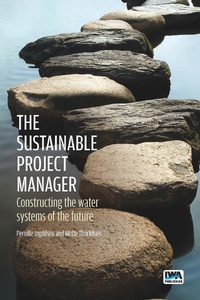
The Sustainable Project Manager
Constructing the water systems of the future
Published on 15. April 2024
272 pages
978-1-78906-334-9 (ISBN)
Description

As our planet faces increasing challenges from sustainability-related crises such as droughts, floods and deteriorating water quality, the demand for resilient and eco-intelligent water systems has never been more pressing. This book is a much-needed guide for professionals in the water sector exploring how to navigate the intersections between sustainability, leadership, and project management. It is an essential blueprint for professionals ready to reshape the future of water.
Equipped with decades of cumulative expertise in project management and environmental sustainability, the authors present a comprehensive framework for leading complex water-related projects with a commitment to making enduring contributions to the future of the water industry everywhere. This manual provides essential knowledge and fosters an appreciation for water stewardship and sustainability, emphasising the delicate balance between human needs and natural water ecosystem needs.
Through a series of exercises, readers are encouraged to reflect on their project management practices and develop a personal leadership philosophy grounded in sustainability. The book offers practical strategies for systematic project execution suited for real-world applicability. It enables readers to foster cohesive team dynamics and achieve remarkable outcomes through co-creative work.
The responsibility for pro-active handling of current and future sustainability crises lies to a great extent with water professionals. This book is a 'call to action' to elevate your professional value and make a tangible, positive difference in the world. Join us on this journey towards a better, more sustainable future, one project at a time.
Equipped with decades of cumulative expertise in project management and environmental sustainability, the authors present a comprehensive framework for leading complex water-related projects with a commitment to making enduring contributions to the future of the water industry everywhere. This manual provides essential knowledge and fosters an appreciation for water stewardship and sustainability, emphasising the delicate balance between human needs and natural water ecosystem needs.
Through a series of exercises, readers are encouraged to reflect on their project management practices and develop a personal leadership philosophy grounded in sustainability. The book offers practical strategies for systematic project execution suited for real-world applicability. It enables readers to foster cohesive team dynamics and achieve remarkable outcomes through co-creative work.
The responsibility for pro-active handling of current and future sustainability crises lies to a great extent with water professionals. This book is a 'call to action' to elevate your professional value and make a tangible, positive difference in the world. Join us on this journey towards a better, more sustainable future, one project at a time.
More details
Language
English
Place of publication
London
United Kingdom
Target group
College/higher education
Professional and scholarly
File size
8,99 MB
ISBN-13
978-1-78906-334-9 (9781789063349)
Copyright in bibliographic data and cover images is held by Nielsen Book Services Limited or by the publishers or by their respective licensors: all rights reserved.
Schweitzer Classification
Other editions
Additional editions
Pernille Ingildsen | Mette Thorkilsen
The Sustainable Project Manager
Constructing the water systems of the future
Book
04/2024
IWA Publishing
€166.50
Shipment within 3-4 weeks
Content
- Cover
- Contents
- Preface by Professor Gustaf Olsson
- Introduction
- Sustainability
- Sustainability: the problem and the opportunity
- The Planetary Boundaries
- Doughnut Economics
- The Sustainable Development Goals
- Sustainability and the Water Sector
- Practical Sustainability Tools
- Main Points
- Your Reflections
- Read More
- Part 1: Project Management is a Distinct Discipline
- Chapter 1: Decisions create movement
- Know your Project
- Decision Making Under Uncertainty
- The Project Triangle
- Project Management Models
- Monitoring and Follow-Up
- Steering Committee Work
- Main Points
- Your Reflections
- Read More
- Chapter 2 : The five essential tools
- Tool No. 1: Project Objectives
- The three concepts of an objective
- Purpose of the project
- Success criteria
- Deliverables
- The process of goal setting
- Tool No. 2: Stakeholder Management
- The three steps of stakeholder analysis
- Step 1: Identification of stakeholders
- Step 2: Stakeholder analysis and prioritisation
- Step 3: Planning specific activities for dealing with selected stakeholders
- Specifically on user involvement
- Tool No. 3: The Milestone Plan
- Define work streams
- Identification of overall milestones
- Discussion of dependencies between work streams and milestones
- Discussion of the temporal sequence
- Tool No. 4: Project Organisation
- Essential factors for the organisation
- Roles and responsibilities
- The steering committee
- Project manager and project team
- Reference groups
- Tool No. 5: Managing Risks
- Definitions and concepts: and the three steps
- Step 1: Identification of risks
- Step 2: Analysis and prioritisation
- Step 3: Risk management plan
- Iterations and Flexibility
- Main Points
- Your Reflections
- Objectives
- Stakeholder
- Milestone plans
- Project organisation
- Reflections about risk management
- Read More
- Chapter 3 : Project manager of the future
- The Sustainable Transformation
- Act on behalf of Sustainability
- The project manager ' s development path
- Inner transformation
- Stages of Development of Project Competences
- Maturity of project organisations
- The Inner Development Goals
- (1) Being: attachment to oneself
- (2) Thinking: cognitive skills
- (3) Relating: caring for others and the world
- (4) Collaborating: social skills
- (5) Acting: enabling change
- Management with the Heart
- Integrity: a movement towards an individual inner practice
- Resonance: moving empathic and cooperative relationships
- Shared responsibility: moving towards holistic understanding and responsibility
- Main Points
- Your Reflections
- Read More
- Part 2: Learn to Lead Yourself
- Chapter 4 : Be true to yourself
- Reflections on Ethics
- Project Management Inspired by Stoicism
- Thinking Fast and Slow
- What is the Primary Principle of your Leadership?
- Main Points
- Your Reflections
- Read More
- Chapter 5 : Be aware
- Use Your Senses
- People who are primarily visually orientated
- People who are primarily auditory orientated
- People who are primarily kinaesthetically orientated
- Active Listening
- Recognising your Beliefs
- Connect to your Heart
- Your Energy
- Main Points
- Your Reflections
- Read More
- Chapter 6 : Being self-disciplined
- Intention And Direction
- About Being Proactive
- Habit 1: Be proactive
- Habit 2: Begin with the end in mind
- Habit 3: Put the first thing first
- Train Self-Confidence and Patience
- Least Possible Changes
- Method
- The two steps
- The reflection process
- When the change is realised
- Main Points
- Your Reflections
- Read More
- Part 3: Collaboration shapes the future
- Chapter 7: Team awareness
- Team Roles
- Create High-Performance Teams
- Forming: shaping the group
- Storming: the storming phase
- Norming: the return to normality
- Performing: the effective team
- Building Trust
- The Scarf Model
- Conflict is Coming
- Asking the Good Questions
- Phase 1: Past-oriented simple questions
- Phase 2: Past-oriented complex questions
- Phase 3: Future-oriented complex questions
- Phase 4: Future-oriented simple questions
- Main Points
- Your Reflections
- Read More
- Chapter 8 : Partnerships
- Partnering
- Lessons learnt from the construction of the Øresund Bridge
- Lessons learnt from partnering in 2000s
- Winds of change
- Strategic Partnership Agreements
- Win-Win
- Design of Partnerships
- Tendering and contracting
- Partnership development
- Organisational set-up
- Financial matters and financial management
- Innovation
- Portfolio management of projects
- Joint skill development and activities
- Start-up and maintenance of the partnership
- Main Points
- Your Reflections
- Read More
- Chapter 9 : Co-creation
- The Good Meeting
- Facilitation
- Mediation
- Phase 1: Storytelling
- Phase 2: Identifying needs
- Phase 3: Finding solutions
- Phase 4: Design of the solution
- Phase 5: Conclusion of the contract
- See the World as a Futurist
- Theory U
- Left side process of the U: observe, observe, observe
- Bottom of the U: withdrawal and reflection
- Right side of the U: translating into action
- Tools and tools
- Fault lines
- Main Points
- Your Reflections
- Practising mediation
- Peter
- George
- Emma
- Futurist exercise
- Read More
- The Way Forward
- Understanding Change Biologically
- Thank you
- References
- Index
