

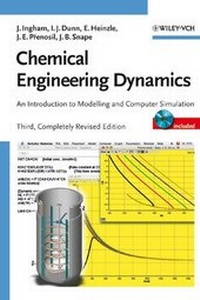
Chemical Engineering Dynamics
An Introduction to Modelling and Computer Simulation
3rd Edition
Published on 8. January 2008
XXI, 619 pages
978-3-527-61422-6 (ISBN)
Description

In this book, the modelling of dynamic chemical engineering processes is presented in a highly understandable way using the unique combination of simplified fundamental theory and direct hands-on computer simulation. The mathematics is kept to a minimum, and yet the nearly 100 examples supplied on www.wiley-vch.de illustrate almost every aspect of chemical engineering science. Each example is described in detail, including the model equations. They are written in the modern user-friendly simulation language Berkeley Madonna, which can be run on both Windows PC and Power-Macintosh computers.
Madonna solves models comprising many ordinary differential equations using very simple programming, including arrays. It is so powerful that the model parameters may be defined as "sliders", which allow the effect of their change on the model behavior to be seen almost immediately. Data may be included for curve fitting, and sensitivity or multiple runs may be performed. The results can be seen simultaneously on multiple-graph windows or by using overlays. The resultant learning effect of this is tremendous. The examples can be varied to fit any real situation, and the suggested exercises provide practical guidance.
The extensive experience of the authors, both in university teaching and international courses, is reflected in this well-balanced presentation, which is suitable for the teacher, the student, the chemist or the engineer. This book provides a greater understanding of the formulation and use of mass and energy balances for chemical engineering, in a most stimulating manner.
This book is a third edition, which also includes biological, environmental and food process examples.
Madonna solves models comprising many ordinary differential equations using very simple programming, including arrays. It is so powerful that the model parameters may be defined as "sliders", which allow the effect of their change on the model behavior to be seen almost immediately. Data may be included for curve fitting, and sensitivity or multiple runs may be performed. The results can be seen simultaneously on multiple-graph windows or by using overlays. The resultant learning effect of this is tremendous. The examples can be varied to fit any real situation, and the suggested exercises provide practical guidance.
The extensive experience of the authors, both in university teaching and international courses, is reflected in this well-balanced presentation, which is suitable for the teacher, the student, the chemist or the engineer. This book provides a greater understanding of the formulation and use of mass and energy balances for chemical engineering, in a most stimulating manner.
This book is a third edition, which also includes biological, environmental and food process examples.
Reviews / Votes
"...This third edition was terrific pleasure to read! ... The new edition is clearly the result of immense effort and labour of love. Chemical Engineering Dynamics just seems to get better and better "CURRENT ENGINEERING PRACTICE, Oct 07
More details
Other editions
Additional editions
Software
10/2007
Wiley-VCH
€437.83
No shipping information available
John Ingham | Irving J. Dunn | Elmar Heinzle
Chemical Engineering Dynamics
An Introduction to Modelling and Computer Simulation
Book
06/2007
3rd Edition
Wiley-VCH
€342.00
Article exhausted; check different version
Previous edition
John Ingham | Irving J. Dunn | Elmar Heinzle
Chemical Engineering Dynamics
Modelling with PC Simulation
E-Book
07/2008
1st Edition
Wiley-VCH
€159.99
Available for download
Persons
John Ingham is now retired from Chemical Engineering at Bradford University U.K. The first of a long series of courses on the Modelling and Simulation of Dynamical Chemical Engineering Systems was begun there in 1974, sponsored by the Institution of Chemical Engineers and inspired by leave of absence at the ETH Zurich. Research areas include Liquid-Liquid Column Hydrodynamics, Extraction Process Dynamics and Biochemical Engineeering; the latter, being developed, during a further leave of absence at the GBF, Braunschweig. He is especially proud of this and the two other VCH-Wiley Modelling and Simulation books.
Irving J. Dunn is retired from the ETH-Zurich, where he taught and did research in the area of biochemical engineering for over thirty years, within the Chemical Engineering Dept. His degrees are from the University of Washington and Princeton University. Dr. Dunn has published widely in his field, ranging from bioreactor design, process control, animal cell culture, and specialized wastewater treatment. His teaching and research has featured the use of modelling and simulation and has resulted in the publication of three textbooks: Biological Reaction Engineering, Environmental Bioprocesses and Chemical Engineering Dynamics.
Elmar Heinzle chairs Biochemical Engineering at the Saarland University in Saarbrücken, Germany. Having obtained his academic degrees from the Technical University of Graz, Austria, he spent most of his career at the Chemical Engineering Department of ETH-Zurich, Switzerland, before taking his present appointment. Professor Heinzle published over 200 scientific publications in bioreactor design, metabolic engineering, on-line analysis and control and design of sustainable processes. In his teaching in Biochemical and Chemical Engineering he is extensively using modelling. He has authored several books in these fields.
Jonathan B. Snape is Commercial Director of Mylnefield Research Services Ltd, the commercial subsidiary of the Scottish Crop Research Institute, a leading international centre for plant and environmental sciences. Dr Snape studied Biochemistry at the University of Cambridge and Biochemical Engineering at the University of Birmingham before undertaking post-doctoral research in Switzerland, Japan and Germany. His career also encompasses industrial experience with Unilever and IBM and was recently awarded an MBA by the University of Strathclyde.
Jirí E. Prenosil was born 1939 in Prague, Czechoslovakia. Educated in Prague with PhD in Chemical Engineering, he worked in the Czechoslovak Academy of Science and various universities abroad. 1971 he moved to Switzerland with appointment at the Swiss Federal Institute of Technology (ETH) in Zürich. 1984 he was a Visiting Professor at the University of London, Canada. His life interest is in Biochemical Engineering, design and modelling of bioreactors with immobilized biocatalysts. It has resulted in over 100 publications and co-authorship of two other books in this area. He is a co-founder of the renowned International Modelling and Simulation Courses in Braunwald, Switzerland since 1981. 1997 he was granted the Swiss Technology Transfer Award. In 2006, he retired from the ETH.
Irving J. Dunn is retired from the ETH-Zurich, where he taught and did research in the area of biochemical engineering for over thirty years, within the Chemical Engineering Dept. His degrees are from the University of Washington and Princeton University. Dr. Dunn has published widely in his field, ranging from bioreactor design, process control, animal cell culture, and specialized wastewater treatment. His teaching and research has featured the use of modelling and simulation and has resulted in the publication of three textbooks: Biological Reaction Engineering, Environmental Bioprocesses and Chemical Engineering Dynamics.
Elmar Heinzle chairs Biochemical Engineering at the Saarland University in Saarbrücken, Germany. Having obtained his academic degrees from the Technical University of Graz, Austria, he spent most of his career at the Chemical Engineering Department of ETH-Zurich, Switzerland, before taking his present appointment. Professor Heinzle published over 200 scientific publications in bioreactor design, metabolic engineering, on-line analysis and control and design of sustainable processes. In his teaching in Biochemical and Chemical Engineering he is extensively using modelling. He has authored several books in these fields.
Jonathan B. Snape is Commercial Director of Mylnefield Research Services Ltd, the commercial subsidiary of the Scottish Crop Research Institute, a leading international centre for plant and environmental sciences. Dr Snape studied Biochemistry at the University of Cambridge and Biochemical Engineering at the University of Birmingham before undertaking post-doctoral research in Switzerland, Japan and Germany. His career also encompasses industrial experience with Unilever and IBM and was recently awarded an MBA by the University of Strathclyde.
Jirí E. Prenosil was born 1939 in Prague, Czechoslovakia. Educated in Prague with PhD in Chemical Engineering, he worked in the Czechoslovak Academy of Science and various universities abroad. 1971 he moved to Switzerland with appointment at the Swiss Federal Institute of Technology (ETH) in Zürich. 1984 he was a Visiting Professor at the University of London, Canada. His life interest is in Biochemical Engineering, design and modelling of bioreactors with immobilized biocatalysts. It has resulted in over 100 publications and co-authorship of two other books in this area. He is a co-founder of the renowned International Modelling and Simulation Courses in Braunwald, Switzerland since 1981. 1997 he was granted the Swiss Technology Transfer Award. In 2006, he retired from the ETH.
Author
University of Saarland, Department of Technical Biochemistry, Saarbrücken, Germany
Content
BASIC CONCEPTS
Modeling Fundamentals
Formulation of Dynamic Models
Chemical Kinetics
Microbial Growth Kinetics
PROCESS DYNAMICS FUNDAMENTALS
Signal and Process Dynamics
Time Constants
Fundamentals of Automatic Control
Numerical Aspects of Dynamic Behavior
MODELLING OF STAGEWISE PROCESSES
Stirred Tank Reactors
Stage-wise Mass Transfer
DIFFERENTIAL FLOW AND REACTION APPLICATIONS
Diffusion and Heat Conduction
Tubular Chemical Reactors
Differential Mass Transfer, Heat Transfer Applications
SIMULATION EXAMPLES OF CHEMICAL ENGINEERING PROCESSES
Simulation Tools
Batch Reactor Examples
Continuous Tank Reactor Examples
Tubular Reactor Examples
Semi-Continuous Reactor Examples
Mixing-Model Examples
Tank Flow Examples
Process Control Examples
Mass Transfer Process Examples
Distillation Process Examples
Heat Transfer Examples
Diffusion Process Examples
Biological Reaction Examples
Appendix: Using the Berkeley Madonna Dynamic Simulator
Modeling Fundamentals
Formulation of Dynamic Models
Chemical Kinetics
Microbial Growth Kinetics
PROCESS DYNAMICS FUNDAMENTALS
Signal and Process Dynamics
Time Constants
Fundamentals of Automatic Control
Numerical Aspects of Dynamic Behavior
MODELLING OF STAGEWISE PROCESSES
Stirred Tank Reactors
Stage-wise Mass Transfer
DIFFERENTIAL FLOW AND REACTION APPLICATIONS
Diffusion and Heat Conduction
Tubular Chemical Reactors
Differential Mass Transfer, Heat Transfer Applications
SIMULATION EXAMPLES OF CHEMICAL ENGINEERING PROCESSES
Simulation Tools
Batch Reactor Examples
Continuous Tank Reactor Examples
Tubular Reactor Examples
Semi-Continuous Reactor Examples
Mixing-Model Examples
Tank Flow Examples
Process Control Examples
Mass Transfer Process Examples
Distillation Process Examples
Heat Transfer Examples
Diffusion Process Examples
Biological Reaction Examples
Appendix: Using the Berkeley Madonna Dynamic Simulator
