

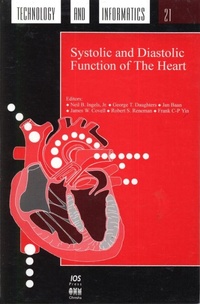
Systolic and Diastolic Function of the Heart
1st Edition
Published on 15. December 2006
458 pages
978-1-60750-865-6 (ISBN)
Description

The book addresses the meaning of the systolic function and diastolic function, how these can best be measured and interpreted, both now and in the future. It also covers topics such as: cardiac mechanics, flow dynamics, vascular properties, neural control of cardiovascular systems and pharmacological interventions. The book is of particular interest to biophysicists, bioengineers, cardiovascular physiologists, and clinicians.
More details
Series
Language
English
Place of publication
London
Netherlands
Publishing group
IOS Press
Target group
Professional and scholarly
File size
18,83 MB
ISBN-13
978-1-60750-865-6 (9781607508656)
Copyright in bibliographic data and cover images is held by Nielsen Book Services Limited or by the publishers or by their respective licensors: all rights reserved.
Schweitzer Classification
Other editions
Additional editions
Neil B. Ingels | George T. Daughters | Jan Baan
Systolic and Diastolic Function of the Heart
Book
12/2006
1st Edition
IOS Press
€138.16
Article exhausted; check different version
Content
- Title Page
- Preface
- Contents
- Diastolic Function
- Chapter 1: The Momentum of Mass, the Momentum of Ideas, and Diastolic Function
- Chapter 2: Myocardial Structure and Cardiac Function
- Chapter 3: Contribution of Myocardial Collagen to the Left Ventricular Diastolic Pressure-Volume Relationship
- Chapter 4: Contribution of the Collagen Extracellular Matrix to Ventricular Mechanics
- Chapter 5: Coronary Flow and Perfusion Effects
- Chapter 6: Restoring Forces
- Chapter 7: Systolic and Diastolic Importance of Oblique Fiber Orientation in the Left Ventricle
- Chapter 8: Ventricular Relaxation and Diastolic Filling
- Chapter 9: The Influence of Ventricular Interdependence on Indices of Left Ventricular Function
- Chapter 10: Diastolic Function from Transmitral Flow
- Chapter 11: Left Atrial and Pulmonary Venous Flow Visualization by Phase Encoding Magnetic Resonance Imaging
- Chapter 12: Application of Color Doppler M-Mode Echocardiography in the Assessment of Ventricular Diastolic Function
- Chapter 13: Response of Left Ventricular Filling to Exercise before and after Heart Failure
- Chapter 14: Indexing Left Ventricular Isovolumic Pressure Decay
- Chapter 15: Diastolic P-V Relation, Myocardial Properties, and Ventricular Stiffness
- Chapter 16: Calcium, Crossbridges, and Cellular Determinants of Relaxation
- Chapter 17: Calcium Cycling Dependent and Independent Mechanisms of Relaxation in Mammalian Ventricular Myocardium
- Systolic Function
- Chapter 18: How We View Systolic Function of the Heart: Emax and PVA 1994 CSDS Konrad Witzig Lecture
- Chapter 19: From Crossbridge to Myocardium to Intact Heart
- Chapter 20: Determinants of Force Development and Shortening Velocity in Cardiac Muscle
- Chapter 21: Time Scale and Oscillatory Features of Left Ventricular Step Response Originate from Multiple-Step Crossbridge Cycle
- Chapter 22: Crossbridge and Muscle Properties, Energetics, and Pressure-Volume Area
- Chapter 23: Constancy and Variability of Oxygen Costs of Mechanical Energy (PVA) and Contractility (Emax)
- Chapter 24: Tight Coupling between Regional Myocardial Oxygen Consumption and Contractile Function
- Chapter 25: Force-Frequency Relation, Force-Interval Relation, and Mechanical Restitution
- Chapter 26: Elastance-Based Mechanical Restitution Provides Data from the Intact Heart Not Available from Any Other Technique
- Chapter 27: Contractility Indices
- Chapter 28: Searching for Indices of Contractility Is Counterproductive
- Chapter 29: Rapid Contractile Upregulation Rematches Stroke Work to Increased Afterload Independent of Ventricular Geometry, Afterload-Related Coronary Perfusion Pressure Fluctuations and Baseline Contractile State
- Chapter 30: Wall Thickening, Shears, and Cleavage Planes
- Chapter 31: Mechanisms of Large Ventricular Wall Shortening and Thickening
- Chapter 32: Twisting, Torsion, and Other Shears
- Chapter 33: Ventricular Twist and Its Relationship to Pressure Volume and Shortening
- Chapter 34: Differences in Systolic and Diastolic Torsional Deformation of the Left Ventricle
- Chapter 35: Coronary Flow, Systolic Perfusion, and the "Gregg Phenomenon
- Chapter 36: Intramyocardial Hydraulic Regulation of Cardiac Mechanics and Energetics
- Chapter 37: Left Ventricular Afterload and Arterial Coupling
- Indexes
- Author Index
- Affiliation Index
- Subject Index
